Contents
What it is
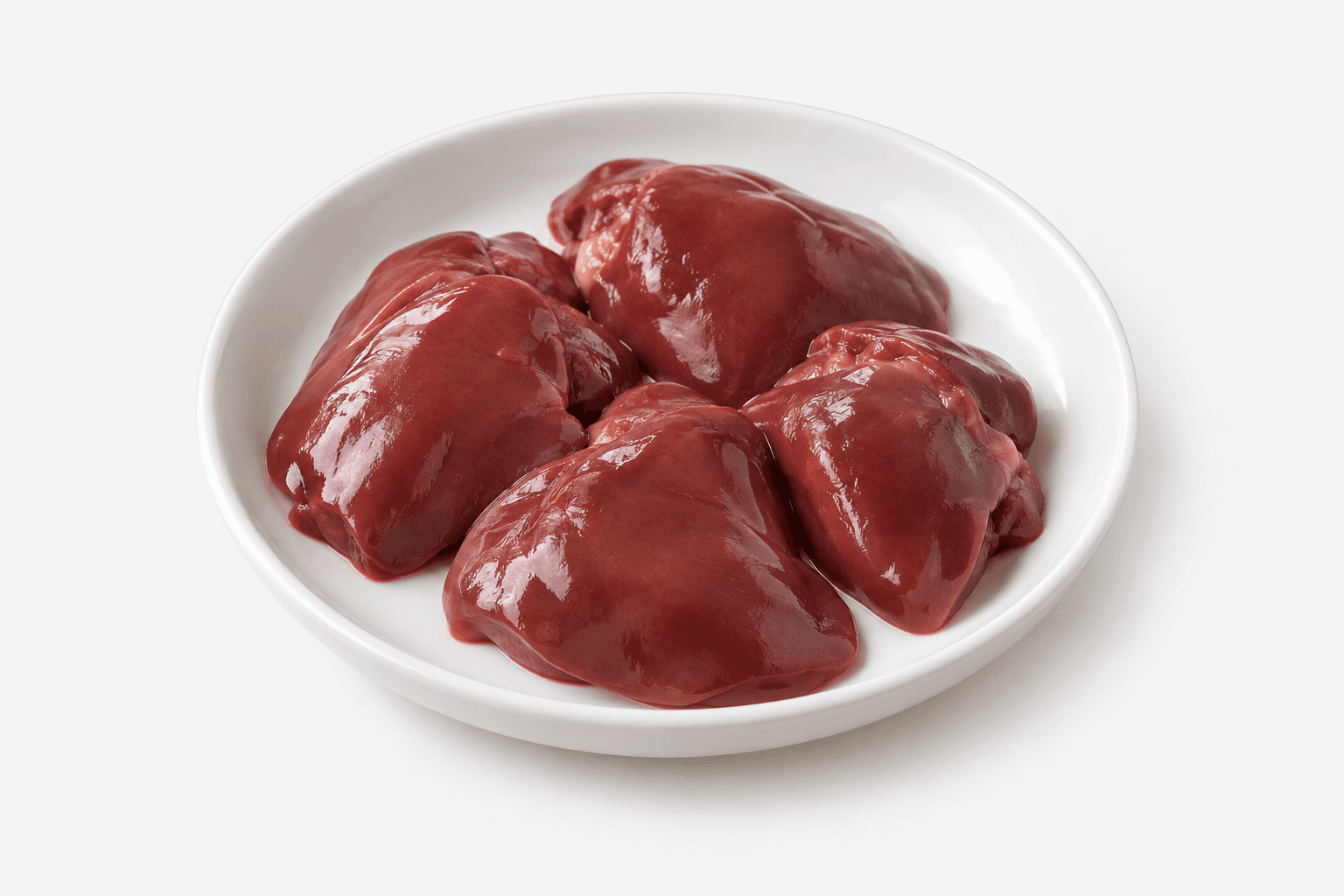
Chicken liver is the bird's liver. The liver stores nutrients and handles detoxification, so its composition has little in common with muscle meat — vitamin A, vitamin B12, iron, copper and folate are all concentrated there. That concentration is also why it is an ingredient with a sensible limit on how much to eat. It is smaller, softer and milder than beef or pork liver. It is soaked in milk or cold water to draw out blood, then trimmed of membrane and any green-stained patch near the gall bladder. Overcooking turns it grainy.
Chicken liver is about as nutrient-dense as whole food gets. Per 100 g: vitamin B12 16.6 µg (692% of the daily requirement), folate 588 µg (147%), iron 8.99 mg (112%). Few foods carry that without being a supplement.
And the same fact is the warning.
Per 100 g there is 3,300 µg RAE of vitamin A, of which 3,290 µg is retinol — the animal form. The adult upper limit is 3,000 µg. One plate is the ceiling.
Beta-carotene, from carrots or sweet potato, converts to vitamin A only as needed, so it cannot overshoot. Retinol has no such brake. What you eat accumulates in the liver.
This page does not say don't eat it. It says this is a food where how much and how often matter far more than they do elsewhere.
Key benefits
- Nutrition data
Nutrient density close to a supplement
Per 100 g of raw chicken liver, against adult daily requirements:
- Vitamin B12 16.6 µg — 692%
- Folate 588 µg — 147%
- Iron 8.99 mg — 112%, as well-absorbed haem iron
- Copper 0.492 mg — 55%
- Selenium 54.6 µg — 99%
- Riboflavin 1.78 mg — 137%
- Choline 194 mg, zinc 2.67 mg, niacin 9.73 mg
- Protein 16.9 g, for only 119 kcal
This matters most where there is iron deficiency. Non-haem iron from plants absorbs at 2–10%; haem iron from liver at 15–35%. Deficiency that spinach never fixed sometimes moves after a plate of liver.
Beef liver is not the same thing. It carries over 9,000 µg of vitamin A per 100 g — nearly three times chicken liver. The word "liver" hides a large difference in risk.
Density per calorie is what this food is. Practically nothing else puts this much into 119 kcal.
- Moderate evidence
Accumulated retinol tracked with fracture risk
[1]A 2002 JAMA analysis from the Nurses' Health Study. 72,337 postmenopausal women followed for 18 years, with 603 hip fractures from low or moderate trauma.
After adjustment for confounders:
- Highest quintile of total vitamin A (≥3,000 µg RE/day) versus lowest (<1,250 µg): RR 1.48 (95% CI 1.05–2.07), P for trend .003
- Retinol alone is sharper. ≥2,000 µg/day versus <500: RR 1.89 (1.33–2.68), P for trend <.001
- Beta-carotene did not raise risk. RR 1.22 (0.90–1.66), P for trend .10 — not significant
- Even among women taking no supplements, retinol from food at ≥1,000 µg/day gave RR 1.69 (1.05–2.74)
The split between beta-carotene and retinol is the finding. Same "vitamin A", and only one side tracked with fractures.
The limits are plain. It is observational, so causation is not established; it relies on dietary questionnaires; and it describes one population, postmenopausal women. The association weakened among women on postmenopausal oestrogen.
Still, the mechanism came first — high-dose vitamin A disturbs bone remodelling in animals — and the human data pointed the same way.
- Moderate evidence
In pregnancy, avoiding it is the standard advice
[2]This entry is a contraindication, not a benefit.
A 1995 study in the New England Journal of Medicine surveyed first-trimester diets in 22,748 pregnant women and followed the outcomes. 339 had babies with birth defects; 121 of those involved tissue derived from the cranial neural crest.
- Over 15,000 IU/day of preformed vitamin A from food and supplements combined versus ≤5,000 IU: prevalence ratio 3.5 (95% CI 1.7–7.3)
- Over 10,000 IU/day from supplements alone: 4.8 (2.2–10.5)
- A threshold appeared near 10,000 IU/day of supplemental vitamin A
- The excess was concentrated in women with high intakes before the seventh week of gestation
The authors estimated that among babies born to women taking more than 10,000 IU a day in supplements, about 1 in 57 had a malformation attributable to it.
The paper drew published dissent. Several letters ran in the same journal, and later work did not reproduce the exact threshold. The advice did not change: health authorities in the UK, Europe and Korea all recommend avoiding liver and liver products — pâté, liverwurst — during pregnancy.
100 g of chicken liver is 11,100 IU. One plate clears the supplemental threshold above.
How to eat it well
- Set the frequency. Not daily — 100 g or less, once a fortnight is the realistic way to stay under the ceiling.
- Soak it in milk for 30 minutes and the metallic smell softens along with the texture. Rinsing repeatedly in cold water to draw the blood does the same.
- Cook it right through. Liver carries campylobacter at high rates. Pink in the middle is not acceptable — 75°C or above.
- High heat, short time. Overcooked liver turns chalky. Cut it thick, sear the outside, then finish the inside.
- Eat it with vitamin C to lift iron absorption — peppers, broccoli, lemon juice.
- Save tea and coffee for an hour after; tannins block iron absorption.
- Milk and dairy in the same meal also lower it.
How to read the grades
Each benefit carries a label showing how far research on people supports it. Grades differ between items even within the same ingredient.
- Nutrition data
- A fact verifiable from food composition databases or health authorities. This is a different kind of statement from a clinical effect.
- Strong evidence
- Consistently confirmed across randomised controlled trials or meta-analyses.
- Moderate evidence
- Human studies exist, but effect sizes are small or results are mixed.
- Early research
- Cell or animal work, or small preliminary studies.
- Not established
- Commonly claimed, but not confirmed in studies on people.
What to watch out for
- Do not eat it if you are pregnant or trying to conceive. Liver, pâté, liverwurst and cod liver oil all count. Check your vitamins for retinol too.
- The vitamin A ceiling is 3,000 µg RAE a day for adults. 100 g of chicken liver is 3,300 µg. If you also take a multivitamin or cod liver oil, add them up.
- With osteoporosis or high fracture risk, cut the frequency further. That is the population the study above describes.
- Cholesterol 345 mg per 100 g. How much dietary cholesterol matters varies widely between people, but the number itself is high.
- Avoid it with gout. Liver is very high in purines.
- Contraindicated in Wilson's disease, where copper accumulates.
- Cook it thoroughly — liver is a common source of campylobacter infection.
- Children have lower limits by weight. The ceiling for ages 1–3 is 600 µg RAE a day, which 20 g of chicken liver exceeds.
Nutrition
Per 100 g of raw chicken liver. A served portion is usually around 60 g, so about 60% of this table is what you eat at once.
- Calories
- 119 kcal6%
- Protein
- 16.9 g34%
- Fat
- 4.83 g6%
- Vitamin A
- 3,300 µg367%
- Vitamin B12
- 16.6 µg692%
- Folate
- 588 µg147%
- Iron
- 8.99 mg50%
- Copper
- 0.492 mg55%
- Selenium
- 54.6 µg99%
- Vitamin B2
- 1.78 mg137%
- Choline
- 194 mg35%
- Zinc
- 2.67 mg24%
Percentages are of the US FDA Daily Value for adults and children 4 and over. National reference intakes differ by sex and age.
Calculate this alongside other ingredients →
Key nutrients
Sources
The databases and health authorities this article's nutrition figures and health statements draw on.
- 1Vitamin A intake and hip fractures among postmenopausal womenResearch literatureFeskanich D, et al. JAMA 2002PMID 11754708
- 2Teratogenicity of high vitamin A intakeResearch literatureRothman KJ, et al. N Engl J Med 1995PMID 7477116
- 3USDA FoodData CentralFood composition database
- 4NIH Office of Dietary SupplementsHealth authority
- 5European Food Safety Authority (EFSA)Health authority
- 6MFDS Food Composition Database · 식품안전나라Food composition database
- 7PubMedResearch literature