Contents
What it is
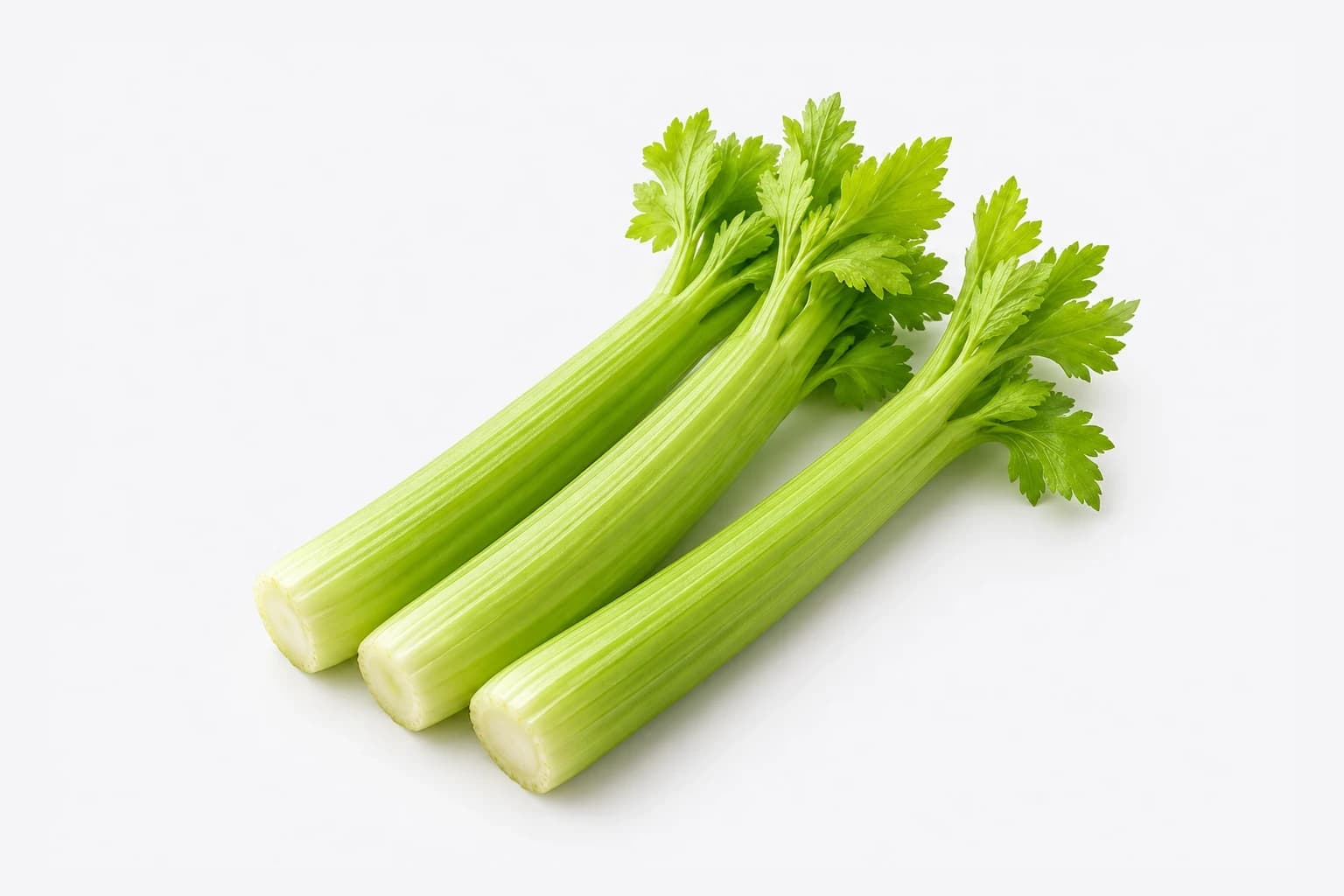
Celery is the leaf stalk of a plant in the parsley family, native to the Mediterranean. The long ribs we eat are not stems at all but the petioles of the leaves. Its aroma is strong enough to divide opinion, and that same aroma is why Western cooking pairs it with onion and carrot as a base for almost everything. Tough strings run along the outer face; a quick pass with a peeler removes them and softens the bite. It is mostly water, so it is eaten raw for the crunch and collapses quickly when simmered.
Scientific name Apium graveolens
Celery is 14 kcal per 100 g and 95.4% water. Very nearly water.
And yet a blood pressure trial genuinely exists. Reading it precisely is what this page is for.
2022, Phytotherapy Research. Fifty-two people with hypertension took celery seed extract capsules at 1.34 g a day for four weeks, in a triple-blind, placebo-controlled crossover design.
- Systolic 141.2 → 130.0 mmHg (p<0.001)
- Diastolic 92.2 → 84.2 mmHg (p<0.001)
- Mean arterial pressure 108.5 → 99.5 mmHg, pulse pressure 49.0 → 45.8 mmHg
- No significant change in the placebo group
The measurement is good. Instead of a single reading in a clinic, it used 24-hour ambulatory blood pressure monitoring, which is not fooled by pressure that only rises at the doctor's.
But the intervention was not celery. It was an extract of the seed, and the paper names 3-n-butylphthalide as the active constituent. Chewing a celery stalk is not the same intervention.
Key benefits
- Early research
Blood pressure fell — but on 1.34 g of seed extract, not the vegetable
[1][2]2022, Phytotherapy Research.
- 52 patients with hypertension, triple-blind placebo-controlled crossover, four weeks
- Four celery seed extract capsules, 1.34 g a day, or four placebo capsules
- Assessed by 24-hour ambulatory blood pressure monitoring
Measure Start At four weeks Systolic 141.2 ± 5.91 130.0 ± 4.38 mmHg p<0.001 Diastolic 92.2 ± 5.74 84.2 ± 4.87 mmHg p<0.001 Mean arterial pressure 108.5 ± 5.76 99.5 ± 4.66 mmHg p<0.001 Pulse pressure 49.0 ± 6.21 45.8 ± 6.01 mmHg p<0.01 Placebo group no significant change p>0.05 Start with what is good here.
First, it used 24-hour ambulatory monitoring. Blood pressure swings through the day and rises in clinics. Wearing a cuff for a day is far more accurate, and food research rarely goes that far.
Second, it was triple-blind and crossover. Participants, researchers and analysts were all kept unaware, and each person went through both conditions.
Third, the placebo group did not move. So this was not simply time passing.
Now what has to be said.
First, the intervention was not celery. It was 1.34 g of extract from the seed. There are no seeds in 100 g of celery stalk. Nothing licenses moving this result across to eating the vegetable.
Second, 11 mmHg is drug-sized. A single antihypertensive tablet lowers roughly that much. When a compound extracted from a food produces that, look first at the limits of the data rather than at the size of the effect. Fifty-two people, one centre, four weeks.
Third, the follow-up paper came from the same trial. The 2023 Inflammopharmacology report on anxiety and depression is not a separate study; it is a further analysis of the same participants. Two papers do not make twice the evidence.
Fourth, it was added to people already on treatment. The paper frames the extract as a supplement alongside hypertension therapy. It is not evidence that it can replace a drug.
The honest conclusion:
- For celery seed extract there is a trial worth reading, with a good measurement method
- For eating celery there is not. This site has not found a trial that fed celery stalks and measured blood pressure
- Do not use this result to stop or reduce a blood pressure medicine. Talk to your doctor
- The grade here is "early research"
- Nutrition data
14 kcal and 95.4% water — yet high in sodium for a vegetable
Per 100 g of raw celery:
- 14 kcal, water 95.4 g
- Vitamin K 29.3 µg, potassium 260 mg, sodium 80 mg
- Folate 36 µg, fibre 1.6 g
- Vitamin A 22 µg RAE, beta-carotene 270 µg, vitamin C 3.1 mg
- Calcium 40 mg, magnesium 11 mg
- Carbohydrate 2.97 g, sugar 1.34 g, protein 0.69 g, fat 0.17 g
Per stalk (40 g):
100 g One stalk (40 g) Six stalks (240 g) Energy 14 kcal 6 kcal 34 kcal Sodium 80 mg 32 mg 192 mg Vitamin K 29.3 µg 11.7 µg 70 µg Potassium 260 mg 104 mg 624 mg Look at the 80 mg of sodium. That is noticeably high for a vegetable — lettuce holds 28 mg, broccoli 33 mg. Celery draws sodium up from the soil as it grows.
At normal portions this is not a problem, since a stalk is 32 mg. A large glass of celery juice every day is different. Several stalks go into one glass, and the sodium comes along. If you are on a low-sodium diet, it is worth counting.
Vitamin K at 29.3 µg is moderate, nothing like kale or spinach. But on warfarin, what matters is keeping vitamin K intake steady rather than swinging. If you start eating a lot more celery, tell your care team.
Because it is 14 kcal, the claim appears that eating it burns more than it provides. This site has not found data confirming that in people. What is confirmed is simpler: it is low in energy, so it fills volume cheaply.
Choosing and storing. Take stalks that are firm with leaves that have not wilted. Do not throw the leaves away — they are strongly aromatic and good in stock. Wipe it dry, wrap it in kitchen paper and refrigerate; it lasts far longer that way.
If the strings bother you, one pass of a peeler along the outer ribs softens the texture.
- Not established
The celery juice cleanse, and an allergy few people here expect
This entry is about a trend and about safety.
First the juice. For several years now the advice has circulated to drink a large glass of celery juice on an empty stomach each morning to cleanse the body.
This site has not found a clinical trial showing that celery juice does anything for detoxification, weight, digestion or skin. The blood pressure trial above used seed extract, not juice.
And juicing loses something. Most of celery's 1.6 g of fibre stays in the pulp and is strained out. If fibre is what you want, juice is the wrong form. Chewing it is better.
The sodium comes along too. If six stalks went into the glass, that is about 192 mg of sodium. Not large on its own, but worth counting if you drink it daily while watching salt.
Now the part that is less known — allergy.
Celery is on the European Union's list of allergens that must be declared on labels, alongside milk, egg, peanut and crustaceans. Celery allergy is not thought of as common in Korea, but enough cases have accumulated in Europe that products must carry the warning.
Reactions range from itching around the mouth to whole-body responses. Cross-reactivity with birch pollen allergy has been reported. If your mouth itches the first time, do not brush it off.
There is phototoxicity too. Celery contains furocoumarins, so skin carrying the juice can develop dermatitis on exposure to sunlight. It has long been reported in workers who handle celery in bulk. Trimming a few stalks at home rarely causes it, but wear gloves on a day of heavy prep and wash the juice off.
If you are considering a seed extract supplement. The trial above used 1.34 g a day of a standardised extract. A concentrate is not the vegetable. If you are pregnant, have kidney disease, or take blood pressure medicine, speak to your doctor before starting.
How to eat it well
- A stalk is about 40 g and 6 kcal. You can raise the amount freely.
- Do not discard the leaves. They are aromatic and good in stock and stir-fries.
- One pass of a peeler along the outer ribs takes the stringiness down.
- Wipe it dry, wrap in kitchen paper and refrigerate — it keeps far longer.
- Chew it rather than juice it. Juicing strains out the fibre.
- On a low-sodium diet, count the sodium if you drink a lot of juice: 80 mg per 100 g.
- On warfarin, keep intake steady rather than suddenly increasing it.
- Wear gloves on a heavy prep day and wash the juice off your skin.
How to read the grades
Each benefit carries a label showing how far research on people supports it. Grades differ between items even within the same ingredient.
- Nutrition data
- A fact verifiable from food composition databases or health authorities. This is a different kind of statement from a clinical effect.
- Strong evidence
- Consistently confirmed across randomised controlled trials or meta-analyses.
- Moderate evidence
- Human studies exist, but effect sizes are small or results are mixed.
- Early research
- Cell or animal work, or small preliminary studies.
- Not established
- Commonly claimed, but not confirmed in studies on people.
What to watch out for
- The blood pressure trial used 1.34 g of seed extract, not celery. It does not transfer to eating the vegetable.
- That trial held 52 people at one centre for four weeks, added on top of existing treatment. Do not use it to adjust a blood pressure medicine.
- The 2023 anxiety and depression report comes from the same trial. Two papers are not twice the evidence.
- Celery is a declarable allergen in the European Union. Stop and seek care if your mouth itches or swells.
- Cross-reactivity with birch pollen allergy has been reported.
- Phototoxic dermatitis from furocoumarins has been reported. Keep juice-covered skin out of sunlight.
- Sodium is high for a vegetable at 80 mg per 100 g. Count it if you drink a lot of juice.
- Seed extract supplements are concentrates. With pregnancy or kidney disease, ask first.
Nutrition
Per 100 g of raw celery. One stalk is about 40 g, so the figures below are roughly two and a half stalks.
- Calories
- 14 kcal<1%
- Vitamin K
- 29.3 µg24%
- Potassium
- 260 mg6%
- Sodium
- 80 mg3%
- Folate
- 36 µg9%
- Fiber
- 1.6 g6%
- Vitamin A
- 22 µg2%
- Beta-carotene
- 270 µg
- Calcium
- 40 mg3%
- Vitamin C
- 3.1 mg3%
- Carbohydrates
- 2.97 g1%
- Sugars
- 1.34 g
- Protein
- 0.69 g1%
- Fat
- 0.17 g<1%
Percentages are of the US FDA Daily Value for adults and children 4 and over. National reference intakes differ by sex and age.
Calculate this alongside other ingredients →
Key nutrients
By health concern
Dishes with this ingredient
Sources
The databases and health authorities this article's nutrition figures and health statements draw on.
- 1Effect of celery (Apium graveolens) seed extract on hypertension: A randomized, triple-blind, placebo-controlled, cross-over, clinical trialClinical trialShayani Rad M, et al. Phytotherapy Research 2022PMID 35624525
- 2Beneficial effects of celery seed extract (Apium graveolens), as a supplement, on anxiety and depression in hypertensive patients: a randomized clinical trialClinical trialShayani Rad M, et al. Inflammopharmacology 2023PMID 36334223
- 3USDA FoodData CentralFood composition database
- 4PubMedResearch literature
- 5European Food Safety Authority (EFSA)Health authority