Contents
What it is
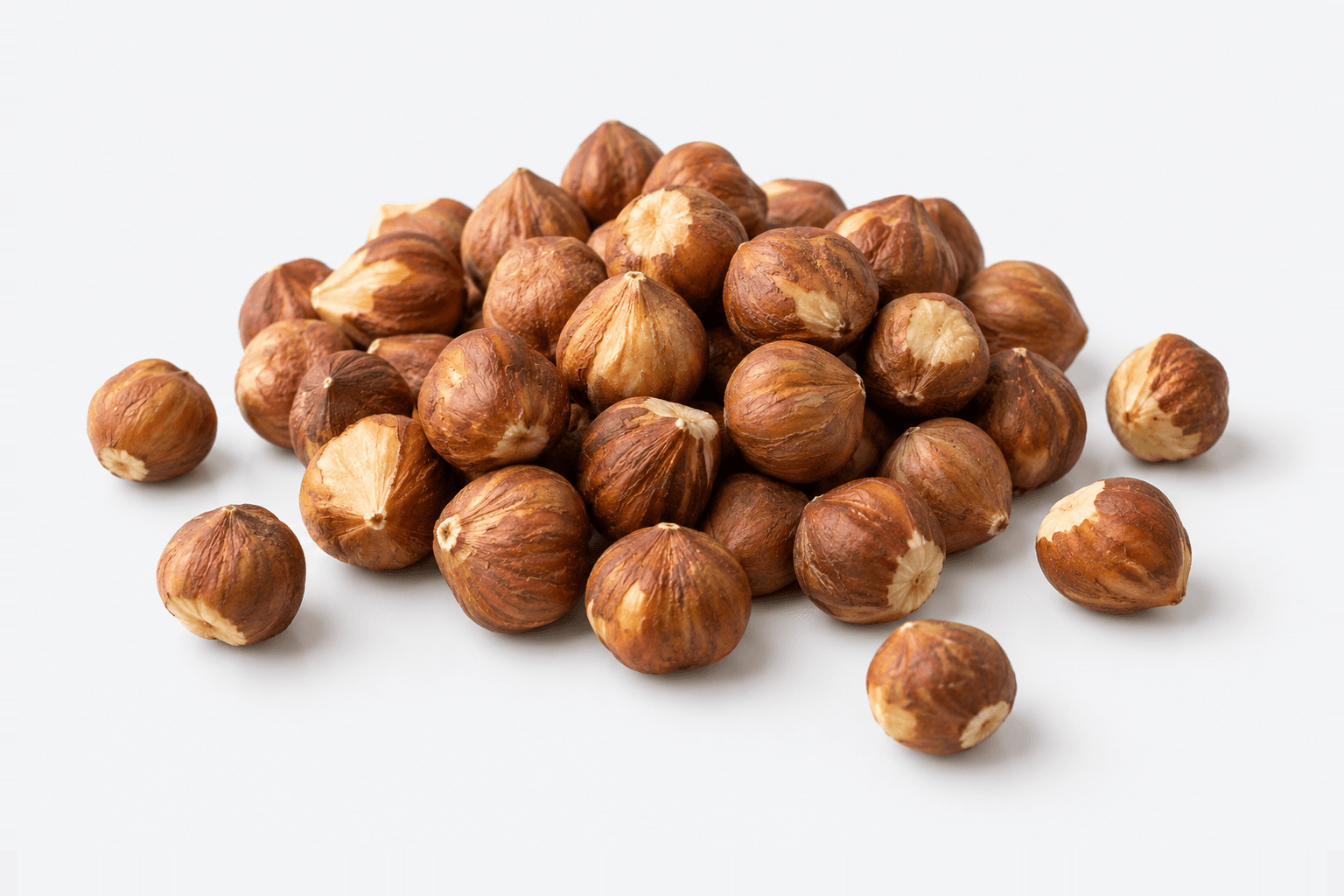
The hazelnut is the fruit of a shrub in the birch family, the same group as the Korean gaeam. It is native to Europe and western Asia, and Turkey grows most of the world's crop. A single kernel sits inside a round, hard shell. Roasting loosens the papery inner skin and brings up the characteristic toasty aroma, which is why it is so widely used in chocolate spreads and confectionery. The hazelnut note in flavoured coffee, it is worth saying, usually comes from a flavouring rather than from the nut.
Scientific name Corylus avellana
Nuts are often discussed as if interchangeable. But one analysis put them head to head.
A 2020 network meta-analysis in The American Journal of Clinical Nutrition compared walnuts, pistachios, hazelnuts, cashews and almonds against each other, across 34 randomised trials in 1,677 participants.
The results came out as a ranking.
- Pistachio ranked first for triglycerides (SUCRA 85%), LDL (87%) and total cholesterol (96%)
- Walnut ranked second for triglycerides and total cholesterol; almond second for LDL
- Pistachio and walnut beat the control diet
- Pistachio beat hazelnut on triglycerides and total cholesterol, and walnut beat hazelnut on triglycerides
Hazelnut's name appears in the sentences about being beaten.
But the authors added straight away that "these findings are limited by the low quality of evidence ratings" — the ranking itself does not rest on strong ground.
So why eat hazelnuts? The answer is in the composition table — 15.0 mg of vitamin E (100% of the requirement) and 6.18 mg of manganese (269%), an unusual combination even among nuts.
Key benefits
- Early research
Five nuts head to head — the ranking, and the limits of that ranking
[1]2020, The American Journal of Clinical Nutrition. A network meta-analysis.
First, what a network meta-analysis is. An ordinary meta-analysis looks at one pair — "nuts versus control diet". A network meta-analysis puts several interventions on one board, including indirect comparisons, and ranks them. Even with no trial directly comparing A and B, if both were compared with C, A and B can be compared indirectly.
It included 34 randomised clinical trials with 1,677 participants, comparing walnut-, pistachio-, hazelnut-, cashew- and almond-enriched diets with control diets, across triglycerides, LDL, total cholesterol and HDL. Rankings were produced with SUCRA (surface under the cumulative ranking curve).
The results:
Outcome First Second Triglycerides Pistachio (SUCRA 85%) Walnut LDL Pistachio (SUCRA 87%) Almond Total cholesterol Pistachio (SUCRA 96%) Walnut - Pistachio and walnut lowered triglycerides, LDL and total cholesterol more than the control diet
- Pistachio beat hazelnut on triglycerides and total cholesterol
- Walnut beat hazelnut on triglycerides
How to read this.
First, the authors' caveat comes before anything else. The paper states that "these findings are limited by the low quality of evidence ratings". A ranking having been produced does not make the ranking established.
Second, this is not "hazelnut is bad". What the analysis says is that it came off worse than pistachio and walnut on some outcomes. It does not say hazelnut was worse than the control diet.
Third, indirect comparison has limits. A network meta-analysis bridges pairs that were never compared directly. When participant characteristics, doses, durations and control diets differ across trials, those bridges wobble. With 34 trials and 1,677 people, each nut type has only a handful of trials behind it.
Fourth, it is still useful information. Against the assumption that nuts are all much the same, it signals that on lipid outcomes at least, the type may matter. This site's cashew page showed the same thing from the other direction — cashews moved lipids not at all.
The honest conclusion:
- If cholesterol and triglycerides are the goal, the evidence is thicker for pistachio and walnut
- That does not make hazelnut a bad choice — only that there is no evidence it is a better one
- And the authors' own rating of the evidence as low quality has to be held alongside the ranking
- The reason to eat hazelnuts is elsewhere — the next entry
- Nutrition data
15 mg of vitamin E — 30% of the requirement in a handful — and 269% of manganese
Per 100 g of hazelnuts:
- 628 kcal, fat 60.8 g, protein 15.0 g
- Of 16.7 g of carbohydrate, 9.7 g is fibre, sugar 4.34 g
- Vitamin E 15.0 mg — 100% of the requirement (15 mg)
- Manganese 6.18 mg — 269% of the requirement (2.3 mg)
- Copper 1.72 mg — 191% of the requirement
- Magnesium 163 mg, folate 113 µg, potassium 680 mg
- Thiamin 0.643 mg, vitamin B6 0.563 mg, zinc 2.45 mg
- Sodium 0 mg
The 15.0 mg of vitamin E is what this nut is. 100 g meets the daily requirement exactly. Among nuts it is second only to almond (25.6 mg) and nowhere near walnut (0.7 mg) or cashew (0.9 mg).
Vitamin E is the fat-soluble antioxidant vitamin, protecting membrane lipids from oxidation. It is no accident that fatty nuts carry it — it is also the mechanism that protects their own fat.
6.18 mg of manganese is remarkable, 269% of the requirement. Manganese is involved in bone formation, connective tissue and the antioxidant enzyme SOD.
But nobody eats 100 g. Converted to a 30 g handful (about 20 nuts):
100 g 30 g (a handful) Energy 628 kcal 188 kcal Fat 60.8 g 18.2 g Vitamin E 15.0 mg 4.5 mg (30% of the requirement) Manganese 6.18 mg 1.85 mg (80%) Copper 1.72 mg 0.52 mg (57%) Fibre 9.7 g 2.9 g Protein 15.0 g 4.5 g A handful gives 80% of the manganese requirement, 57% of the copper and 30% of the vitamin E — impressive for what one handful delivers.
The 188 kcal belongs in the same view. It is high even among nuts — more than a handful of almonds (174 kcal) or cashews (166 kcal), because the fat is 60.8%.
Most of that fat is monounsaturated, mainly oleic acid — the same family as olive oil.
The 9.7 g of fibre is also high for a nut, second to almond (12.5 g).
About the skin. The thin brown skin on a hazelnut concentrates its polyphenols. It is often rubbed off because it tastes astringent, and those compounds leave with it. But no evidence was identified that those polyphenols change a health outcome in people.
Toasting loosens the skin. Ten minutes in a dry pan or a 150°C oven, then rubbed in a dry cloth, and the skins come away. But at 60% fat they scorch fast over high heat.
- Not established
Hazelnut coffee contains no hazelnut
This entry is about what is on the label.
The place most people meet the word "hazelnut" is probably coffee, followed by chocolate spread. Neither has much to do with the nutrition of hazelnuts.
First, hazelnut-flavoured coffee.
So-called hazelnut coffee is generally roasted beans coated with flavouring. It does not contain hazelnuts; it contains substances that taste of hazelnut.
- No vitamin E, no manganese, no fibre arrives
- Almost no calories either, taken black
- It is coffee, not a nut
None of which makes it bad. Drinking flavoured coffee is a matter of taste; it just cannot be counted as eating nuts.
Second, hazelnut chocolate spread.
In the best-known product, sugar is the first ingredient and palm oil the second, with hazelnuts at around 13%. A tablespoon (20 g) contains 2.6 g of hazelnut — about four nuts.
1 tbsp of spread (20 g) A handful of hazelnuts (30 g) Energy ~110 kcal 188 kcal Sugar ~11 g 1.3 g Vitamin E negligible 4.5 mg Manganese negligible 1.85 mg Eleven grams of sugar in a tablespoon of spread is close to three sugar cubes. The presence of hazelnuts does not make it a nut food.
Third, processed nuts generally. Retail hazelnuts are often coated with salt, sugar or oil. The 0 mg of sodium in the table above is for the unprocessed nut.
The honest summary: if you want hazelnut's vitamin E and manganese, there is no route to it other than eating a handful of unsalted, unsweetened nuts. Flavoured coffee and chocolate spread share the word and little else.
How to eat it well
- A handful — 30 g, about 20 nuts — is the reference. That is 188 kcal.
- Choose unsalted and unsweetened. Processed nuts add sodium and sugar.
- Leaving the skin on keeps the polyphenols. If it is too astringent, toast lightly and rub them off.
- Toast at 150°C for about 10 minutes. At 60% fat they scorch fast over high heat.
- Store them sealed and cool. High fat means quick rancidity; refrigerate or freeze for longer keeping.
- Throw out any that taste bitter. That is the taste of rancid fat.
- If cholesterol is the goal, the evidence is thicker for pistachio and walnut.
- Do not count flavoured coffee or chocolate spread as eating nuts.
How to read the grades
Each benefit carries a label showing how far research on people supports it. Grades differ between items even within the same ingredient.
- Nutrition data
- A fact verifiable from food composition databases or health authorities. This is a different kind of statement from a clinical effect.
- Strong evidence
- Consistently confirmed across randomised controlled trials or meta-analyses.
- Moderate evidence
- Human studies exist, but effect sizes are small or results are mixed.
- Early research
- Cell or animal work, or small preliminary studies.
- Not established
- Commonly claimed, but not confirmed in studies on people.
What to watch out for
- In the network meta-analysis, hazelnut came off worse than pistachio and walnut on some lipid outcomes — though the authors noted the low quality of the evidence.
- Nut allergy can cause severe reactions; hazelnut is a labelled allergen in the EU.
- With birch pollen allergy, oral allergy syndrome can cause itching or swelling of the mouth.
- 628 kcal per 100 g. A 30 g handful is 188 kcal, high even among nuts.
- Retail products often add salt, sugar or oil. The 0 mg of sodium above is the unprocessed nut.
- Hazelnut-flavoured coffee carries none of hazelnut's nutrition.
- In chocolate spread, sugar is the first ingredient and hazelnut is around 13%.
- Do not give whole nuts to young children. They are a choking hazard.
Nutrition
Per 100 g of hazelnuts. A handful is about 30 g (roughly 20 nuts), so a real serving is under a third of the figures below.
- Calories
- 628 kcal31%
- Fat
- 60.8 g78%
- Protein
- 15.0 g30%
- Carbohydrates
- 16.7 g6%
- Fiber
- 9.7 g35%
- Vitamin E
- 15.0 mg100%
- Manganese
- 6.18 mg269%
- Copper
- 1.72 mg191%
- Magnesium
- 163 mg39%
- Folate
- 113 µg28%
- Potassium
- 680 mg14%
- Vitamin B1
- 0.643 mg54%
Percentages are of the US FDA Daily Value for adults and children 4 and over. National reference intakes differ by sex and age.
Calculate this alongside other ingredients →
Key nutrients
Dishes with this ingredient
Sources
The databases and health authorities this article's nutrition figures and health statements draw on.
- 1Comparative effects of different types of tree nut consumption on blood lipids: a network meta-analysis of clinical trialsMeta-analysisLiu K, Hui S, Wang B, Kaliannan K, Guo X, Liang L The American Journal of Clinical Nutrition 2020PMID 31773150
- 2USDA FoodData CentralFood composition database
- 3PubMedResearch literature
- 4NIH Office of Dietary SupplementsHealth authority