Contents
What it is
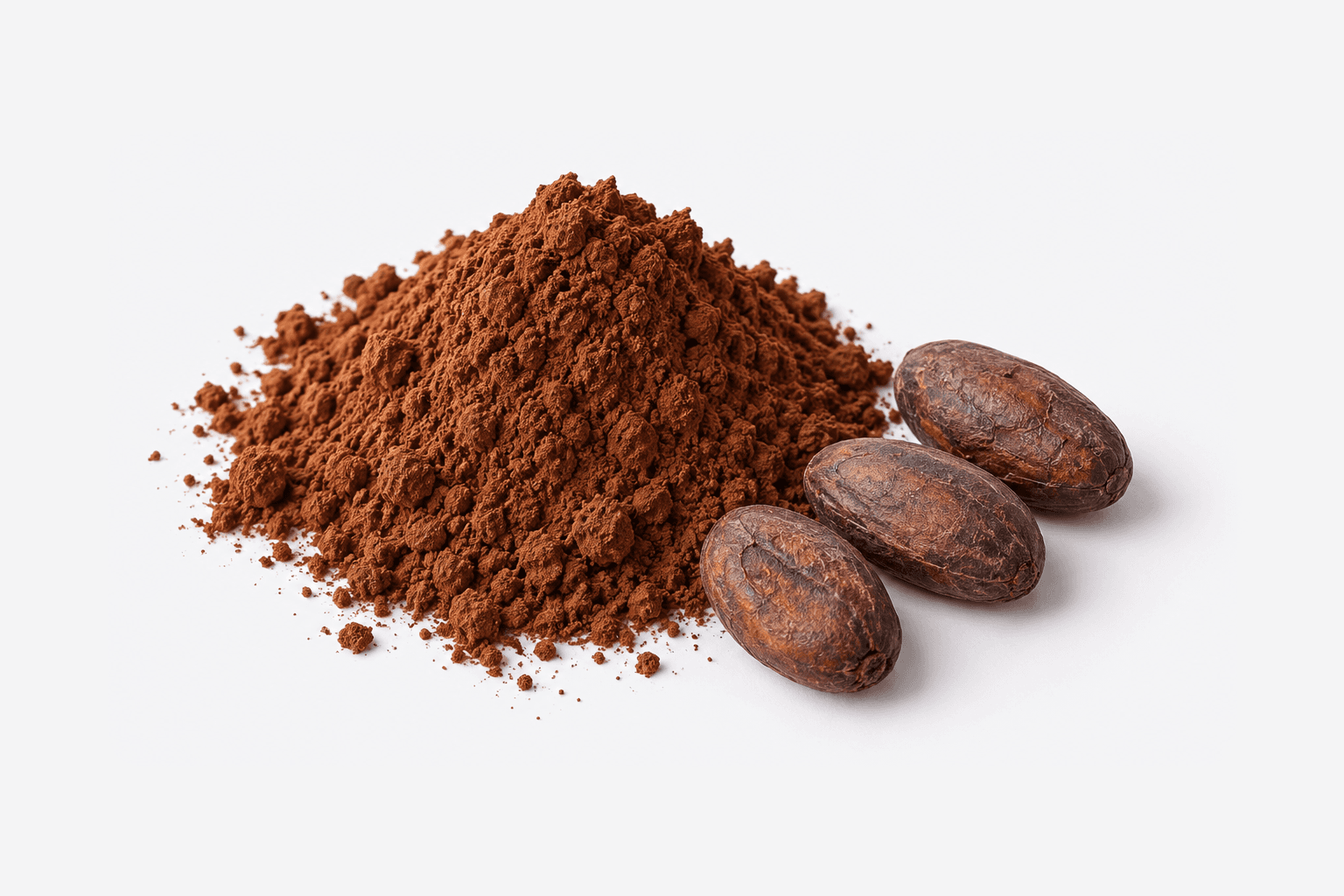
Cocoa powder is made from the seeds inside the fruit of the cacao tree: fermented, dried, roasted, pressed to remove part of the fat, and milled. The tree is native to Central and South America. The powder and chocolate come from the same seed but are not the same thing — chocolate is cocoa mass with cocoa butter and sugar added and set, while cocoa powder is what is left after much of that fat is taken out. So the powder itself has no sweetness at all, only bitterness and astringency. Dutch-processed cocoa, treated with alkali, is darker and less acidic.
Scientific name Theobroma cacao
Cocoa and blood pressure is a question Cochrane has now revisited twice. The 2017 version pooled 35 randomised controlled trials and 1,804 participants.
Overall:
- Systolic −1.76 mmHg (95% CI −3.09 to −0.43)
- Diastolic −1.76 mmHg (95% CI −2.57 to −0.94)
Split it up and the story changes.
- People with hypertension — systolic fell 4 mmHg
- Prehypertensive — a tendency to fall
- People with normal blood pressure — no significant difference (23 comparisons, 1,063 people)
And there is one line the authors wrote themselves. When trials with authors employed by the sponsoring industry were excluded and the numbers rerun, the effect got smaller — indicating, in their words, some reporting bias.
That is why the quality of the evidence was downgraded from high to moderate.
Key benefits
- Moderate evidence
Blood pressure fell — in people who already had high blood pressure
[1]The 2017 Cochrane Database of Systematic Reviews. Updating the 2012 version with 17 more trials brought it to 35 trials (40 treatment comparisons), 1,804 participants, running two to 18 weeks (mean nine).
Doses ranged from 30 to 1,218 mg of flavanols (mean 670 mg), delivered in 1.4 to 105 g of cocoa product a day.
Overall
- Systolic −1.76 mmHg (95% CI −3.09 to −0.43), P = 0.009, 40 comparisons, 1,804 participants
- Diastolic −1.76 mmHg (95% CI −2.57 to −0.94), P < 0.001, 39 comparisons, 1,772 participants
By baseline blood pressure
- Hypertensive −4 mmHg (9 comparisons, 401 people)
- Prehypertensive — tended to fall
- Normotensive — no significant difference (23 comparisons, 1,063 people)
That subgroup split needs reading carefully too. The test for subgroup differences was borderline at P = 0.08 with substantial heterogeneity (I² = 60%). The authors say it requires further research to confirm.
Two more warnings sit in the same review.
First, effects trended larger in unblinded trials. Not statistically significantly so, but the authors state that whether participant expectation influences blood pressure results needs investigating. Blood pressure is a measurement that responds to expectation.
Second, the conflicts. A sensitivity analysis excluding trials with authors employed by the sponsoring industry — leaving 33 trials and 1,482 participants — produced a smaller effect size, which Cochrane calls "indicating some reporting bias."
Between those and unexplained heterogeneity, the quality of the evidence was downgraded from high to moderate.
No long-term trial has looked at cardiovascular events or death. What is established stops at blood pressure, an intermediate marker.
- Nutrition data
The nutrient density is remarkable, and you eat 10 g of it
Per 100 g of unsweetened cocoa powder the figures are striking.
- Magnesium 499 mg — 119% of the adult requirement
- Fibre 37.0 g — 148%
- Iron 13.9 mg — 174%
- Copper 3.79 mg, manganese 3.84 mg, zinc 6.81 mg
- Potassium 1,520 mg, phosphorus 734 mg
- Protein 19.6 g, sugar 1.75 g
But nobody eats 100 g. A cup takes one or two tablespoons, 5–10 g. Which gives:
- Magnesium 25–50 mg (6–12% of the requirement)
- Fibre 1.9–3.7 g
- Iron 0.7–1.4 mg, and non-haem iron at that
That is why this site excludes cocoa from the nutrient rankings. Line foods up per 100 g and cocoa tops magnesium — true, and misleading.
Caffeine and theobromine read the same way. Per 100 g: caffeine 230 mg, theobromine 2,060 mg. Ten grams is 23 mg of caffeine — under a quarter of a cup of coffee. The theobromine is 206 mg, and theobromine is why chocolate is dangerous to dogs. Humans clear it far faster.
The point is that it is unsweetened. Pure cocoa powder carries 1.75 g of sugar per 100 g. Commercial "cocoa mix" is mostly sugar and milk powder.
- Not established
Flavanol content varies up to 200-fold between products
Practically, this is the most important entry on the page.
In the Cochrane review, the active groups received anywhere from 30 mg to 1,218 mg of flavanols. The low-flavanol cocoa powders given to control groups carried 6.4 to 88 mg.
The same "cocoa powder" covers a 6.4 mg product and a 1,218 mg product. That is close to a 200-fold range.
Processing is why. Flavanols are lost through fermentation, drying, roasting and alkalisation — Dutch processing. USDA lists alkali-processed cocoa as a separate food entry, which is how different it is.
So the label tells you the cocoa content, not the flavanol content. Whether you can reach the 670 mg average used in those trials depends on how your powder was processed, and that is usually not stated.
If you substitute dark chocolate, count the calories. Taking the trials' upper dose of 105 g of cocoa product as chocolate runs past 600 kcal. That is not a price worth paying for 2 mmHg.
The other claims — cognition, blood sugar, weight, skin — have no large trials looking at disease outcomes in people. Adverse effects were rare: gastrointestinal complaints and nausea in 1% of the cocoa groups and 0.4% of controls.
How to eat it well
- Buy unsweetened cocoa powder. If sugar is first on the ingredient list, it is a sugar drink, not a cocoa drink.
- One or two tablespoons a cup (5–10 g). More does not bring you closer to the trials — what matters is flavanols, not volume.
- Make a paste with a little hot liquid first, then add the rest, and it will not clump.
- Check for alkalised, dutched or Dutch-process on the label. Darker colour and less bitterness, at the cost of flavanols. It is a choice between taste and compound.
- If iron is the point, pair it with vitamin C. Cocoa's iron is non-haem, and the dairy in the same cup lowers absorption further.
- Watch the evening cup. 23 mg of caffeine in 10 g is little, but theobromine is also a stimulant.
- If you are tracking your blood pressure, remember that 2 mmHg sits inside the noise of home measurement.
How to read the grades
Each benefit carries a label showing how far research on people supports it. Grades differ between items even within the same ingredient.
- Nutrition data
- A fact verifiable from food composition databases or health authorities. This is a different kind of statement from a clinical effect.
- Strong evidence
- Consistently confirmed across randomised controlled trials or meta-analyses.
- Moderate evidence
- Human studies exist, but effect sizes are small or results are mixed.
- Early research
- Cell or animal work, or small preliminary studies.
- Not established
- Commonly claimed, but not confirmed in studies on people.
What to watch out for
- It does not replace blood pressure medication. Two mmHg is not comparable to a drug's 10 mmHg or more. Do not reduce medication on your own.
- If your blood pressure is normal, expect nothing. In the review above, the normotensive group showed no significant change.
- Cadmium can be an issue. Cacao concentrates cadmium from soil, and the EU sets separate cadmium limits for cocoa products. This matters for large daily intakes.
- It is high in oxalate, so cut back if you have had kidney stones.
- Migraine has been reported as a trigger; this varies a lot between people.
- Never give it to dogs or cats. At 2,060 mg of theobromine per 100 g it can be fatal to pets.
- Commercial cocoa mixes are mostly sugar. The evidence above is about unsweetened cocoa.
Nutrition
Per 100 g of unsweetened cocoa powder. A cup uses 5–10 g — one or two tablespoons — so what you actually take is about a tenth of this table.
- Calories
- 228 kcal11%
- Fiber
- 37.0 g132%
- Protein
- 19.6 g39%
- Fat
- 13.7 g18%
- Magnesium
- 499 mg119%
- Potassium
- 1,520 mg32%
- Phosphorus
- 734 mg59%
- Iron
- 13.9 mg77%
- Copper
- 3.79 mg421%
- Zinc
- 6.81 mg62%
- Manganese
- 3.84 mg167%
- Caffeine
- 230 mg
Percentages are of the US FDA Daily Value for adults and children 4 and over. National reference intakes differ by sex and age.
Calculate this alongside other ingredients →
Key nutrients
By health concern
Dishes with this ingredient
Sources
The databases and health authorities this article's nutrition figures and health statements draw on.
- 1Effect of cocoa on blood pressureMeta-analysisRied K, et al. Cochrane Database Syst Rev 2017PMID 28439881
- 2USDA FoodData CentralFood composition database
- 3Cochrane LibrarySystematic reviews
- 4European Food Safety Authority (EFSA)Health authority
- 5NIH Office of Dietary SupplementsHealth authority
- 6PubMedResearch literature