Contents
What it is
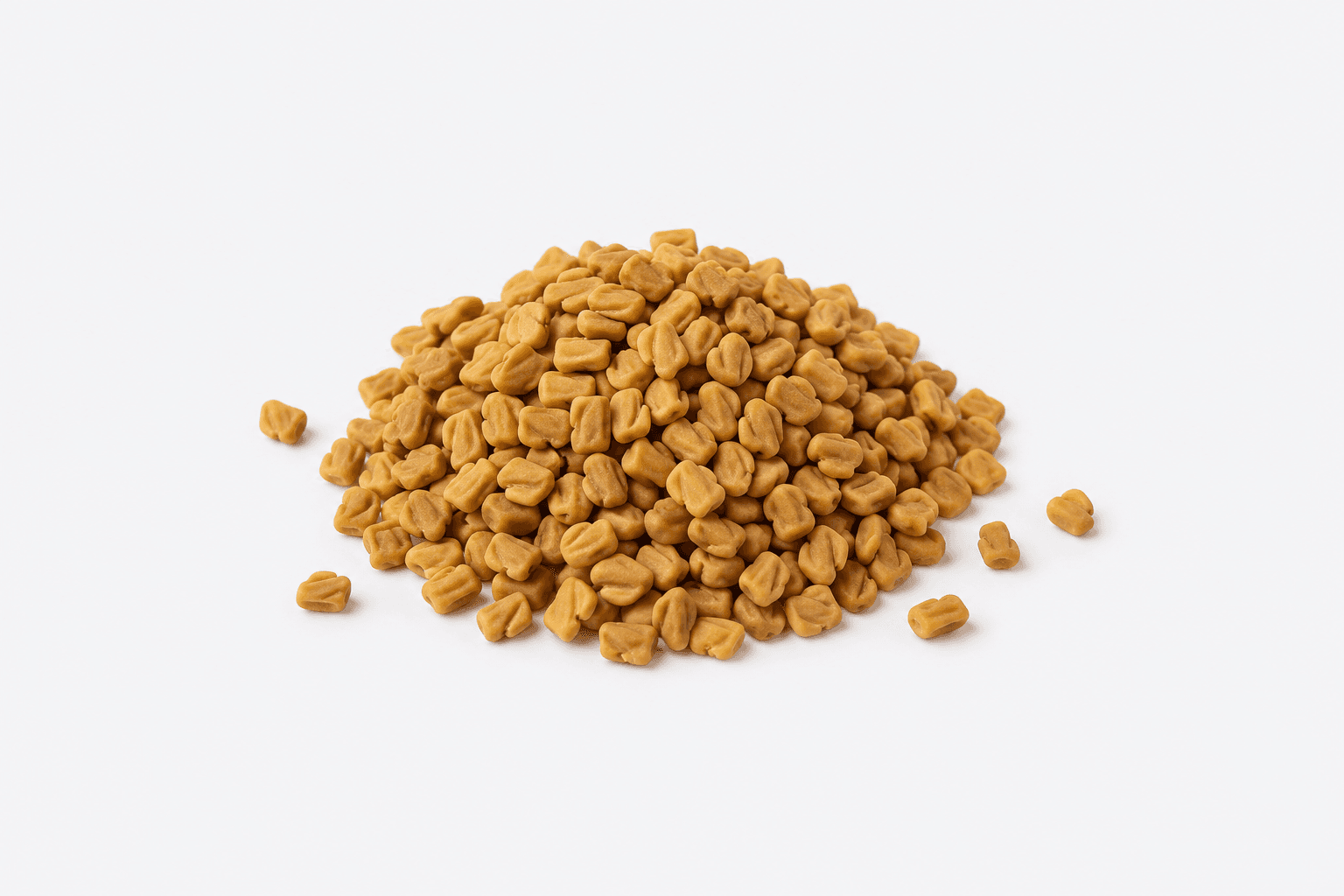
Fenugreek is the seed of an annual legume native to the eastern Mediterranean and western Asia, used as a spice across Indian and Middle Eastern cooking. The seeds are hard, angular and tan; raw they are strongly bitter, but toasting brings out a distinctive sweet aroma reminiscent of maple syrup or caramel — the compound responsible, sotolon, is also why eating a lot of it can leave a similar smell in sweat and urine. The leaves are used too, fresh as a vegetable and dried as a herb. The seeds are hard enough that they are soaked, or toasted and ground.
Scientific name Trigonella foenum-graecum
Fenugreek is a spice in Indian and Middle Eastern cooking and a long-standing complementary therapy for diabetes. There really is evidence — and it separates what moved from what did not.
2023, International Journal of Molecular Sciences. Researchers at the College of Korean Medicine, Woosuk University searched PubMed, Embase and Cochrane as well as Chinese (CNKI) and Korean (KISS, RISS, ScienceON) databases, and gathered 10 randomised controlled trials in 706 participants.
Significantly improved:
- Fasting blood glucose
- Two-hour plasma glucose on a 75 g oral glucose tolerance test
- HbA1c
- Total cholesterol, triglycerides and HDL cholesterol
Not significantly improved:
- HOMA-IR (the insulin resistance index)
- LDL cholesterol
- BMI
That contrast matters. Glucose numbers came down while the insulin resistance marker did not move. And among the lipids, three measures improved while LDL itself stayed put.
On safety — no hepatic or renal toxicity was observed, with mild gastrointestinal side effects in some trials.
Key benefits
- Moderate evidence
Fasting glucose, 2-hour glucose and HbA1c fell; HOMA-IR did not
[1]2023, International Journal of Molecular Sciences. A systematic review and meta-analysis from the College of Korean Medicine at Woosuk University in Jeonju (departments of Korean rehabilitation medicine, acupuncture and moxibustion, and herbology).
The search was unusually broad. Beyond PubMed, Embase and Cochrane, they searched the China Knowledge Resource Integrated Database (CNKI), the Korean studies Information Service System (KISS), the Research Information Sharing Service (RISS) and ScienceON for randomised trials of fenugreek in hyperglycaemia with a control group. Searching only English-language databases omits work published in East Asia, and this paper was conscious of that.
After screening, 10 studies with 706 participants remained.
On glycaemic measures:
- Fasting blood glucose — significantly reduced
- Two-hour plasma glucose on a 75 g OGTT — significantly reduced
- HbA1c — significantly reduced
- HOMA-IR — not significantly reduced
That HbA1c fell is meaningful. Fasting glucose reflects the state on the day; HbA1c reflects average blood glucose over the preceding two to three months. It means a whole period moved, not a single measurement.
But HOMA-IR did not. That index is calculated from fasting glucose and fasting insulin as a measure of insulin resistance. Glucose falling while the resistance marker holds suggests the site of action may not be improved insulin sensitivity.
Two mechanisms are proposed for fenugreek. One is galactomannan, a soluble fibre that slows the absorption of sugar in the gut; the other is 4-hydroxyisoleucine, an amino acid said to stimulate insulin secretion. An unmoved HOMA-IR fits the first better than the second.
The limits:
First, 10 trials and 706 people is not a large body.
Second, the abstract reports direction and significance but does not give pooled effect sizes. So this site does not write "fasting glucose fell by X mg/dL" — there is no number in the abstract to cite.
Third, the preparations and doses differed between trials — seed powder, aqueous extract and whole seed are mixed together.
Fourth, it does not replace diabetes medication. The authors themselves frame it as complementary therapy.
- Moderate evidence
Total cholesterol, triglycerides and HDL improved; LDL and BMI did not
[1]The lipid results from the same meta-analysis.
Significantly improved:
- Total cholesterol
- Triglycerides
- HDL cholesterol
No significant difference:
- LDL cholesterol
- BMI
That combination is unusual. Total cholesterol fell while LDL did not move. Total cholesterol is roughly LDL + HDL + triglycerides/5, so if LDL held steady while total fell, the natural reading is that the triglyceride side did most of the work — and triglycerides did indeed improve significantly.
Do not wave away the unmoved LDL. LDL is the lipid measure tied most directly to cardiovascular risk. The extract on the artichoke page lowered LDL by 14.9 mg/dL; fenugreek produced no significant difference on that same measure.
The unmoved BMI is worth stating honestly too. Fenugreek circulates as a weight-loss aid, but in this meta-analysis there was no significant difference.
What was reported on safety:
- No hepatic or renal toxicity was observed.
- There were no severe adverse events.
- Some trials reported mild gastrointestinal side effects.
The authors' conclusion: fenugreek improves overall glycaemic control parameters and lipid profile safely.
That is why this site grades it moderate. It is a meta-analysis, several measures moved in the same direction, and safety was reported. But the body is small, the abstract gives no effect sizes, and three key measures — HOMA-IR, LDL and BMI — did not move.
- Nutrition data
The trap in 33.5 mg of iron — a teaspoon is 1.2 mg
Per 100 g of fenugreek seed:
- 323 kcal, protein 23.0 g, fat 6.41 g
- Of 58.4 g of carbohydrate, 24.6 g is fibre
- Iron 33.5 mg — 186% of the 18 mg requirement for adult women
- Magnesium 191 mg, potassium 770 mg, phosphorus 296 mg
- Calcium 176 mg, copper 1.11 mg, manganese 1.23 mg
- Thiamine 0.322 mg, vitamin B6 0.6 mg, folate 57 µg
33.5 mg of iron is among the highest of any food. Beef holds 2.6 mg and spinach 2.7 mg.
But nobody eats 100 g. Fenugreek is a spice.
Converted to real amounts:
100 g A teaspoon (3.7 g) A tablespoon (11 g) Iron 33.5 mg 1.2 mg 3.7 mg Fibre 24.6 g 0.9 g 2.7 g Protein 23.0 g 0.85 g 2.5 g Magnesium 191 mg 7.1 mg 21 mg Energy 323 kcal 12 kcal 36 kcal A teaspoon gives 1.2 mg of iron — 6.7% of the requirement for an adult woman.
And plant iron is non-haem, so absorption is low; fenugreek's phytate lowers it further. Using it alongside something with vitamin C raises the uptake.
Much of the 24.6 g of fibre is galactomannan, the soluble, viscous fibre proposed as the mechanism behind the glucose findings above. It is why soaked seeds turn slippery.
The bitterness is strong. Toasting reduces it and brings out a nutty aroma. But burning brings the bitterness back — take it off the heat as the colour just begins to change.
The maple syrup smell comes from a compound called sotolon. Eat enough and your sweat and urine carry it — harmless, but it can be startling.
How to eat it well
- Toast it in a dry pan over low heat. The bitterness drops and the aroma comes out. Pull it as the colour just shifts — burnt, it turns bitter again.
- Soaking the seeds overnight softens them and draws out bitterness. The soaking water turns slippery.
- The leaves (methi) are used too, milder than the seed, and go into curries.
- A teaspoon (3.7 g) is the realistic amount for cooking. Past that the bitterness takes over.
- Use it alongside something with vitamin C to raise iron absorption — tomatoes, lemon, bell pepper.
- Ground fenugreek loses its aroma fast. Grind it just before use.
- If you take it for blood glucose, remember the dose differed between trials — and if you take diabetes medication, speak with your clinician first.
- Eat enough and your sweat smells of maple syrup.
How to read the grades
Each benefit carries a label showing how far research on people supports it. Grades differ between items even within the same ingredient.
- Nutrition data
- A fact verifiable from food composition databases or health authorities. This is a different kind of statement from a clinical effect.
- Strong evidence
- Consistently confirmed across randomised controlled trials or meta-analyses.
- Moderate evidence
- Human studies exist, but effect sizes are small or results are mixed.
- Early research
- Cell or animal work, or small preliminary studies.
- Not established
- Commonly claimed, but not confirmed in studies on people.
What to watch out for
- If you take diabetes medication, speak with your clinician. The glucose-lowering effects can stack and cause hypoglycaemia.
- HOMA-IR, LDL and BMI did not move significantly. This is not grounds to expect improved insulin sensitivity or weight loss.
- The meta-analysis above covers 10 trials and 706 people, and its abstract gives no effect sizes.
- Avoid it in pregnancy. There are concerns it may stimulate uterine contractions, and it has a traditional record of use in inducing labour.
- Discuss use while breastfeeding with your clinician. It is used to increase milk supply, but the evidence and safety are not established.
- Take care with peanut or chickpea allergy. Fenugreek is in the same legume family and cross-reactions have been reported.
- Care may be needed alongside anticoagulants such as warfarin.
- Do not mistake the 100 g figures for what you consume. A teaspoon is 3.7 g and 1.2 mg of iron.
Nutrition
Per 100 g of fenugreek seed. In practice a teaspoon is about 3.7 g, so you get 4% of these figures. The doses used in trials varied by preparation and are discussed in the text.
- Calories
- 323 kcal16%
- Protein
- 23.0 g46%
- Carbohydrates
- 58.4 g21%
- Fiber
- 24.6 g88%
- Iron
- 33.5 mg186%
- Magnesium
- 191 mg45%
- Phosphorus
- 296 mg24%
- Potassium
- 770 mg16%
- Calcium
- 176 mg14%
- Copper
- 1.11 mg123%
- Manganese
- 1.23 mg53%
- Vitamin B6
- 0.6 mg35%
Percentages are of the US FDA Daily Value for adults and children 4 and over. National reference intakes differ by sex and age.
Calculate this alongside other ingredients →
Key nutrients
By health concern
Sources
The databases and health authorities this article's nutrition figures and health statements draw on.
- 1The effect of fenugreek in type 2 diabetes and prediabetes: a systematic review and meta-analysis of randomized controlled trialsMeta-analysisKim J, et al. International Journal of Molecular Sciences 2023PMID 37762302
- 2USDA FoodData CentralFood composition database
- 3NIH Office of Dietary SupplementsHealth authority
- 4European Food Safety Authority (EFSA)Health authority
- 5PubMedResearch literature