Contents
What it is
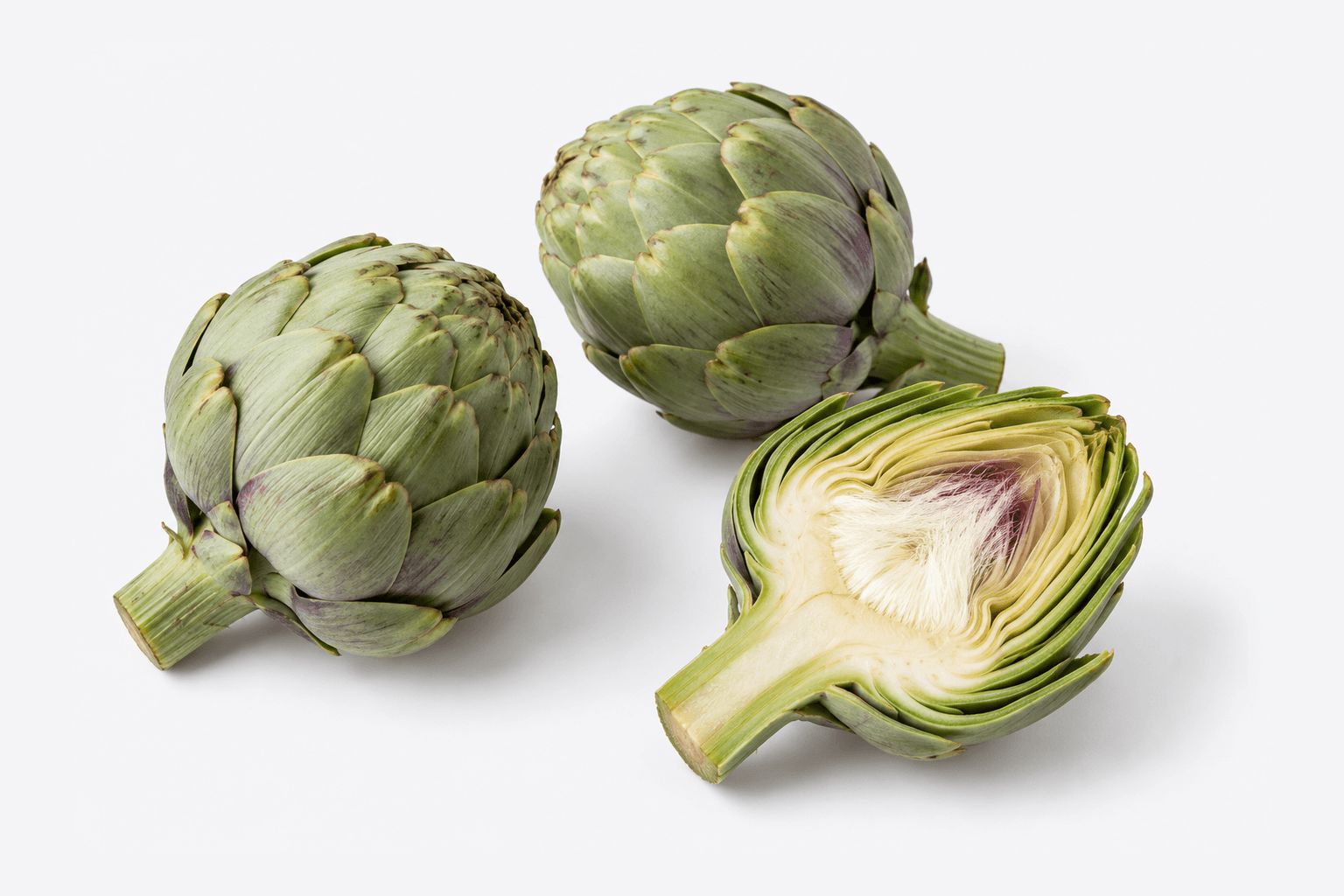
The artichoke is the flower bud of a thistle relative in the daisy family, eaten whole before it opens. It is native to the Mediterranean. The outer leaves are too fibrous to swallow, so only the fleshy base of each is scraped off with the teeth; under the hairy choke lies the heart, the tenderest part. Artichokes are boiled or roasted, and a great deal of the crop is sold marinated in jars. Fresh ones are hard to find in Korea, so most people meet them preserved.
Scientific name Cynara cardunculus var. scolymus
The numbers on artichoke are unusually large for a food. A 2018 meta-analysis in Critical Reviews in Food Science and Nutrition reported total cholesterol −17.6 mg/dL and LDL −14.9 mg/dL. Not statin territory, but not the size you normally see in food research either.
Two things have to be settled first.
One: the trials used artichoke leaf extract. Not the vegetable you steam and scrape with your teeth. Capsules or tablets at a set dose, concentrated in the compounds credited with the effect — cynarin and luteolin. Nothing in this work shows that eating the vegetable produces the same result.
Two: the Cochrane review on this question was withdrawn in 2016. Not because it was wrong — the Cochrane Heart editors judged the title "low priority for the current portfolio", closed it to a new author team, and withdrew it from publication. The evidence was not overturned; there is simply no longer a maintained Cochrane review of it.
So this page rests on one 2018 meta-analysis.
Key benefits
- Moderate evidence
Nine trials, 702 people: total cholesterol −17.6, LDL −14.9 — and HDL unchanged
[1]2018, Critical Reviews in Food Science and Nutrition. The authors gathered randomised controlled trials of artichoke extract on human plasma lipids, searching PubMed-Medline, Scopus, Web of Science and Google Scholar up to March 2017, and pooled nine trials covering 702 subjects with a random-effects model.
The results:
- Total cholesterol, weighted mean difference −17.6 mg/dL (95% CI −22.0 to −13.3), p < 0.001
- LDL cholesterol −14.9 mg/dL (95% CI −20.4 to −9.5), p = 0.011
- Triglycerides −9.2 mg/dL (95% CI −16.2 to −2.1), p = 0.011
- HDL cholesterol did not change — 1.0 mg/dL (95% CI −1.1 to 3.1), p = 0.333
What separated responders was the starting point, not the dose. The higher the baseline LDL, the larger the fall (slope −0.170, 95% CI −0.288 to 0.051, p = 0.005). So this is not grounds to expect the same drop if your numbers are already normal.
How to read the unchanged HDL is a matter of judgement. As the cheese page shows, some foods drop LDL and HDL together; artichoke moves the bad one down and leaves the good one alone. On lipid profile alone, that is the favourable shape.
Four things still have to be read alongside it.
First, nine trials is not many, and 702 people is not a large body.
Second, what was given was an extract. The authors' own conclusion says supplementation "may be synergistic with lipid-lowering therapy in patients with hyperlipidemia" — this is a statement about a supplement.
Third, one of the numbers does not sit right. The slope reported for the association with baseline LDL runs from −0.288 to 0.051 — an interval that contains zero — yet is reported at p = 0.005. It is transcribed here exactly as the abstract prints it, but it should not be taken at face value.
Fourth, lipid levels are surrogate markers. No study here looked at heart attacks or death.
That is why this site grades it moderate: a meta-analysis with a large effect size, but few trials, an extract rather than a food, and no hard outcomes.
- Nutrition data
The composition: 5.4 g of fibre on 47 kcal, and 68 µg of folate
Per 100 g of raw artichoke:
- 47 kcal, protein 3.27 g, fat 0.15 g
- Of 10.5 g of carbohydrate, 5.4 g is fibre — sugar is only 0.99 g
- Folate 68 µg — 17% of the requirement
- Magnesium 60 mg, potassium 370 mg, calcium 44 mg
- Vitamin C 11.7 mg, vitamin K 14.8 µg
- Sodium 94 mg
The 5.4 g of fibre is the substance of this vegetable. More than half the carbohydrate is fibre and the sugar does not reach a gram, on 47 kcal per 100 g.
Sodium at 94 mg is high for a vegetable — broccoli holds 33 mg, cabbage 18 mg. Tinned or marinated artichokes add salt on top of that, so they go much higher. Read the label.
Folate at 68 µg and magnesium at 60 mg are the micronutrient strengths.
The trap with this vegetable is how little of it you eat. A medium head is about 120 g, but once the tough outer leaves and the fuzzy choke are discarded, only a fraction reaches your mouth. Eating the 100 g in that table takes two or three artichokes.
Inulin is artichoke's main fibre. It is fermentable — food for gut bacteria — which is why it causes gas and bloating in people unaccustomed to it.
- Not established
The claims about digestion and the liver — not established
This entry sorts through claims that are not established.
"Artichoke aids digestion" comes from long European folk use and from the observation that artichoke increases bile secretion. There is indeed research showing artichoke extract stimulates bile flow.
But the evidence that dyspepsia symptoms improve is not as solid as the lipid work above. A few randomised trials in functional dyspepsia exist, but they are small and mostly use a particular branded extract.
Claims about liver function circulate too. Artichoke appears in a 2024 network meta-analysis comparing natural products in non-alcoholic fatty liver disease, but a network meta-analysis compares trials indirectly, which carries lower certainty than direct comparison. This site does not report a benefit on that basis.
One curiosity — water often tastes sweet after eating artichoke. The usual explanation is that cynarin acts temporarily on the sweet receptors of the tongue. It is also why artichoke and wine are not served together.
The honest conclusion: the only artichoke evidence assembled at meta-analysis level is extract and blood lipids. Digestion and the liver are not there yet.
How to eat it well
- Pull off a few layers of tough outer leaves, snip the spiny tips with scissors, then steam or boil for 30–40 minutes.
- Cut surfaces brown fast. Rub with lemon or hold in lemon water.
- Always remove the fuzzy choke. What you eat is the flesh at the base of each leaf and the heart in the middle.
- Scrape the leaf base with your teeth and discard the rest.
- Check the sodium on tinned and jarred versions. Raw holds 94 mg per 100 g; marinated goes far higher.
- The inulin can cause gas. If you are new to it, start with a small amount.
- If you are eating it for your lipids, remember the trials used an extract, not the vegetable.
How to read the grades
Each benefit carries a label showing how far research on people supports it. Grades differ between items even within the same ingredient.
- Nutrition data
- A fact verifiable from food composition databases or health authorities. This is a different kind of statement from a clinical effect.
- Strong evidence
- Consistently confirmed across randomised controlled trials or meta-analyses.
- Moderate evidence
- Human studies exist, but effect sizes are small or results are mixed.
- Early research
- Cell or animal work, or small preliminary studies.
- Not established
- Commonly claimed, but not confirmed in studies on people.
What to watch out for
- The meta-analysis above studied an extract. You cannot apply −17.6 mg/dL to eating a boiled artichoke.
- HDL did not change (p = 0.333). The claim that it raises good cholesterol is not supported by this work.
- The fall was larger in people with higher baseline LDL. With normal numbers, expect less.
- With biliary obstruction or gallstones, the bile-stimulating property may worsen symptoms. Speak with your clinician.
- With an allergy to the daisy family (ragweed, daisies, marigolds), artichoke may cross-react.
- With IBS, inulin is high-FODMAP and can cause gas and pain.
- It does not replace cholesterol medication. The authors wrote "synergistic", not "substitute".
- Claims about digestion and the liver are not established.
Nutrition
Per 100 g of raw globe artichoke. A medium head is about 120 g, and the edible part is far less. What the trials below used was a leaf extract, not the vegetable.
- Calories
- 47 kcal2%
- Protein
- 3.27 g7%
- Carbohydrates
- 10.5 g4%
- Fiber
- 5.4 g19%
- Sugars
- 0.99 g
- Folate
- 68 µg17%
- Magnesium
- 60 mg14%
- Potassium
- 370 mg8%
- Sodium
- 94 mg4%
- Vitamin C
- 11.7 mg13%
- Vitamin K
- 14.8 µg12%
- Calcium
- 44 mg3%
Percentages are of the US FDA Daily Value for adults and children 4 and over. National reference intakes differ by sex and age.
Calculate this alongside other ingredients →
Key nutrients
By health concern
Dishes with this ingredient
Sources
The databases and health authorities this article's nutrition figures and health statements draw on.
- 1Lipid-lowering activity of artichoke extracts: a systematic review and meta-analysisMeta-analysisSahebkar A, et al. Critical Reviews in Food Science and Nutrition 2018PMID 28609140
- 2USDA FoodData CentralFood composition database
- 3NIH Office of Dietary SupplementsHealth authority
- 4European Food Safety Authority (EFSA)Health authority
- 5PubMedResearch literature