Contents
What it is
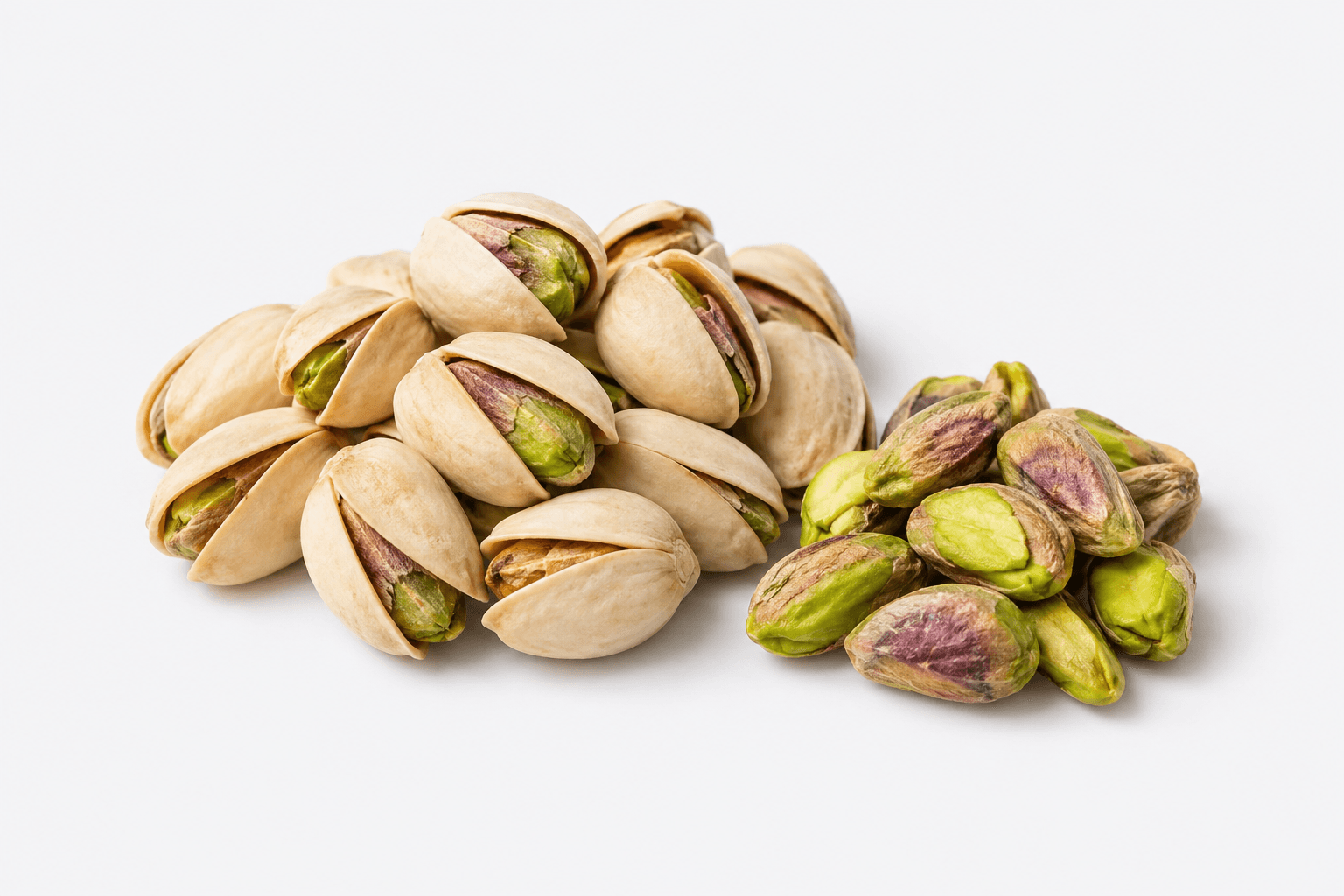
The pistachio is the seed of a tree in the cashew family, a relative of the mango. It is native to western and Central Asia, and Iran, the United States and Turkey are the main producers. As it ripens the shell splits open along one side by itself, and that gap is the sign of a properly matured nut. The green of the kernel is chlorophyll and the purplish skin is anthocyanin. Among nuts it is comparatively high in protein and lower in fat. Having to prise each shell open also slows the eating down on its own.
Scientific name Pistacia vera
There is a reason pistachios are green. Lutein and zeaxanthin.
Lined up per 100 g against other nuts:
- Pistachios 2,900 µg
- Cashews 22 µg
- Pecans 17 µg
- Walnuts 9 µg
- Almonds 1 µg
That is not a hundredfold gap; it is closer to a thousandfold. Lutein and zeaxanthin are the pigments that accumulate in the macula, and in most diets they come from dark leafy greens — spinach, kale. No other nut supplies them in this range.
There is lipid evidence too. Pooling twelve randomised controlled trials, total cholesterol, triglycerides and LDL all fell. The LDL drop was 3.82 mg/dL. Small. It is written out below as it is.
Key benefits
- Moderate evidence
LDL, total cholesterol and triglycerides fell — by a little
[1]A 2023 systematic review and meta-analysis in Critical Reviews in Food Science and Nutrition, pooling twelve randomised controlled trials.
- Total cholesterol −7.48 mg/dL (95% CI −12.62 to −2.34)
- LDL −3.82 mg/dL (95% CI −5.49 to −2.16)
- Triglycerides −11.19 mg/dL (95% CI −14.21 to −8.17)
- HDL 2.45 mg/dL (95% CI −2.44 to 7.33) — no change
Triglycerides moved most. 11.19 mg/dL is the largest of the three and carries the tightest interval.
Put the LDL figure in scale. Statins lower LDL by 30–50%. For someone at 130 mg/dL that is a fall of 40 to 65. Pistachios' 3.82 mg/dL is under a tenth of that.
That HDL did not change is also on the record. "Raises good cholesterol" attaches itself to nuts constantly; in this analysis the confidence interval crosses zero.
The authors are careful too: pistachio consumption may improve TC, LDL-C and TG in adults and may be protective against cardiometabolic disease, but larger studies are needed to confirm it.
How to read the size. A single food lowering LDL by 4 mg/dL is not a treatment. It earns its place in a diet as a replacement — a handful of pistachios instead of a packet of crisps.
- Nutrition data
Lutein and zeaxanthin far beyond any other nut
2,900 µg of lutein + zeaxanthin per 100 g. In USDA terms, against other nuts:
- Pistachios 2,900 µg
- Cashews 22 µg
- Pecans 17 µg
- Walnuts 9 µg
- Almonds 1 µg
They are carotenoids that concentrate selectively in the macula of the retina. The body cannot make them; they arrive through food.
A line has to be drawn here. As the corn page on this site records, in the AREDS2 trial, lutein and zeaxanthin supplementation did not significantly slow progression to advanced macular degeneration in the primary analysis (HR 0.90, P = .12). It did conclude that replacing beta-carotene with lutein was the safer formulation — but it did not establish that taking more lutein protects vision.
So this entry stays a fact from the composition table. That pistachios are rich in lutein is measured. What that does for eyes is a separate question.
There is also 305 µg of beta-carotene — unusual in a nut.
- Nutrition data
The most vitamin B6 and potassium of any nut
Per 100 g, two figures stand out against other nuts.
Vitamin B6 at 1.7 mg — over 100% of the adult requirement.
- Pistachios 1.7 mg
- Walnuts 0.537 mg
- Cashews 0.417 mg
- Pecans 0.21 mg
- Almonds 0.137 mg
Potassium at 1,020 mg is also the highest among nuts (almonds 733 mg, cashews 660, walnuts 441). A banana holds 358 mg per 100 g, so this is close to three times that.
Also per 100 g:
- Protein 20.2 g — near the top for nuts
- Fibre 10.6 g — 42% of the daily requirement
- Copper 1.3 mg, manganese 1.2 mg, phosphorus 490 mg, magnesium 121 mg
- Thiamine 0.87 mg — 73% of the requirement
- Of the 45.3 g of fat, only 5.91 g is saturated; 23.3 g monounsaturated and 14.4 g polyunsaturated
Energy is 560 kcal per 100 g. A 30 g handful is 168 kcal — a little more than half a bowl of rice. Most of what nuts offer arrives when they replace something else.
How to eat it well
- A handful a day — 30 g, about 49 kernels. That sits inside the range used in the trials and is manageable on calories.
- Buy them in the shell. Shelling slows you down, and the pile of shells shows you how many you have had.
- Unsalted and unsweetened. Salted products add hundreds of milligrams of sodium per 100 g.
- Raw or roasted, the lipid effect is similar. Long roasting at high heat does oxidise the unsaturated fats.
- Store them sealed, chilled or frozen. The fat content makes them go rancid quickly at room temperature. If they smell off, throw them out.
- Crushed over salad or yoghurt they arrive with fat, which also lifts carotenoid absorption from the vegetables.
- Kernels whose shells have not split are unripe. Do not force them open.
How to read the grades
Each benefit carries a label showing how far research on people supports it. Grades differ between items even within the same ingredient.
- Nutrition data
- A fact verifiable from food composition databases or health authorities. This is a different kind of statement from a clinical effect.
- Strong evidence
- Consistently confirmed across randomised controlled trials or meta-analyses.
- Moderate evidence
- Human studies exist, but effect sizes are small or results are mixed.
- Early research
- Cell or animal work, or small preliminary studies.
- Not established
- Commonly claimed, but not confirmed in studies on people.
What to watch out for
- Avoid them with nut allergy. Pistachios cross-react with cashews frequently — they are in the same family.
- They are energy-dense: 560 kcal per 100 g. Without deciding on a handful in advance, it adds up fast.
- If you restrict potassium or phosphorus for kidney disease, 100 g carries 1,020 mg and 490 mg respectively. Check with your clinician.
- Check the sodium on salted products — look for salt in the ingredient list.
- Aflatoxin — mould toxin control matters for this crop. Spit out and discard any kernel that is discoloured or bitter.
- The lipid improvement above is small. LDL −3.82 mg/dL does not substitute for medication.
- Being rich in lutein is a fact from the composition table, not a proven eye-health effect.
Nutrition
Per 100 g of raw shelled pistachios. A handful is 30 g — about 49 kernels, 168 kcal.
- Calories
- 560 kcal28%
- Fat
- 45.3 g58%
- Protein
- 20.2 g40%
- Carbohydrates
- 27.2 g10%
- Fiber
- 10.6 g38%
- Potassium
- 1,020 mg22%
- Vitamin B6
- 1.7 mg100%
- Phosphorus
- 490 mg39%
- Magnesium
- 121 mg29%
- Copper
- 1.3 mg144%
- Vitamin B1
- 0.87 mg73%
- Lutein
- 2,900 µg
Percentages are of the US FDA Daily Value for adults and children 4 and over. National reference intakes differ by sex and age.
Calculate this alongside other ingredients →
Key nutrients
By health concern
Dishes with this ingredient
Sources
The databases and health authorities this article's nutrition figures and health statements draw on.
- 1Consumption of pistachio nuts positively affects lipid profiles: A systematic review and meta-analysis of randomized controlled trialsMeta-analysisHadi A, et al. Crit Rev Food Sci Nutr 2023PMID 34933637
- 2USDA FoodData CentralFood composition database
- 3NIH Office of Dietary SupplementsHealth authority
- 4European Food Safety Authority (EFSA)Health authority
- 5PubMedResearch literature