Contents
What it is
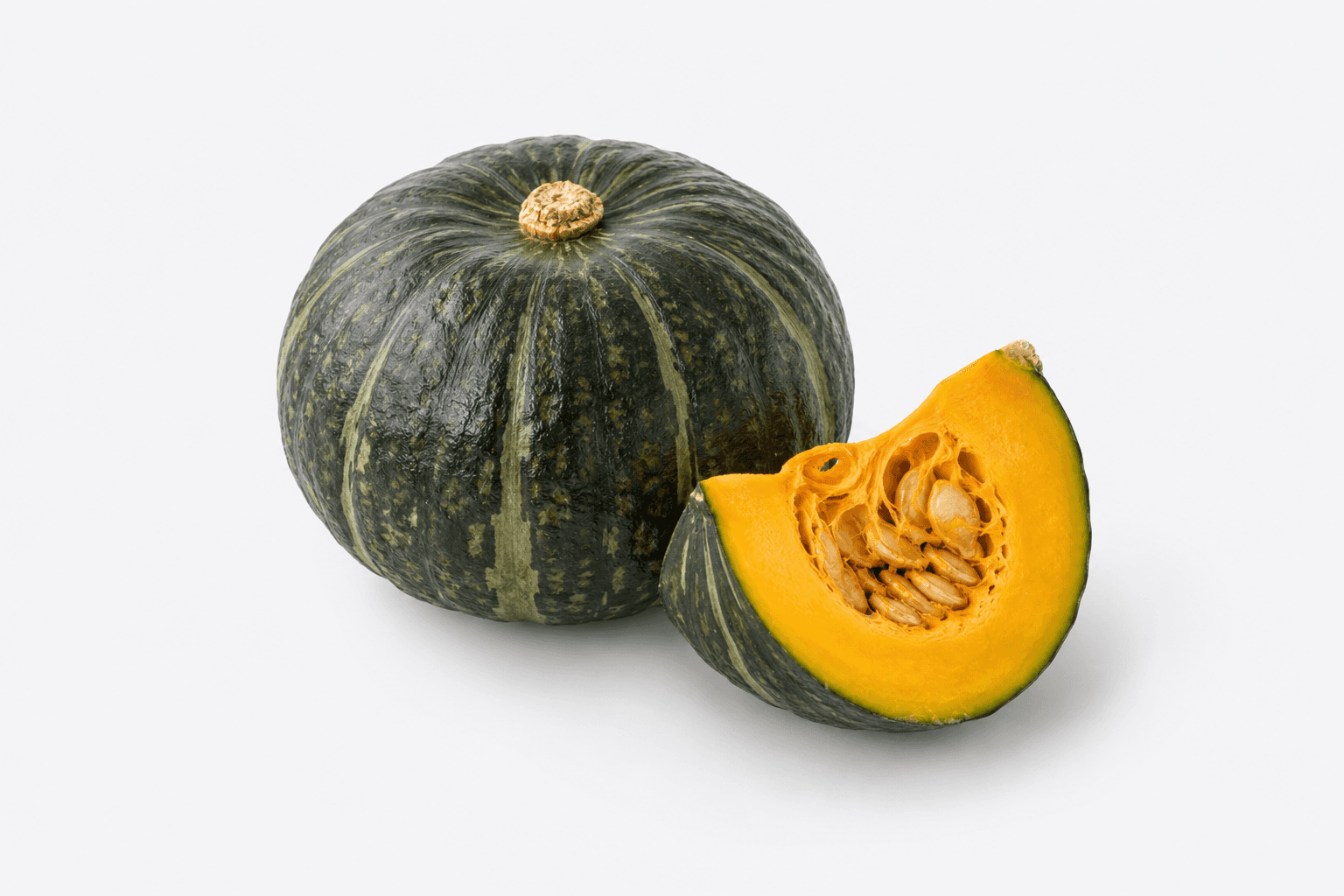
Pumpkin and squash are the fruit of a climbing vine in the gourd family, relatives of cucumber, watermelon and melon, native to Central and South America. Picked young, as with Korean aehobak, the fruit is watery and mild; left to mature, as with kabocha, it accumulates starch and sugar and turns firm and sweet — effectively two different ingredients from the same plant. A fully ripe squash has a hard rind and keeps for months at room temperature, but once cut it spoils fast, so the seeds and pith are scraped out and the rest refrigerated.
Scientific name Cucurbita
The orange is beta-carotene. Baked winter squash carries 2,790 µg per 100 g, which converts to 261 µg RAE of vitamin A — about a third of the adult requirement (900 µg for men, 700 µg for women).
One thing has to be said here. In large trials in the 1990s, smokers given beta-carotene supplements had more lung cancer and more deaths. Asking why the same compound behaves differently is fair, and the answer is not fully settled.
What is clear: that result came from high-dose supplements, while studies of vegetable intake point the other way.
And pumpkin is not a low-calorie vegetable. At 37 kcal and 8.9 g of carbohydrate per 100 g, it belongs closer to the grain slot than to the 'diet food' slot.
Key benefits
- Nutrition data
2,790 µg of beta-carotene — but do not confuse food with supplements
[1]Baked winter squash holds 2,790 µg of beta-carotene per 100 g, equal to 261 µg RAE of vitamin A, plus 1,420 µg of lutein and zeaxanthin.
The body converts beta-carotene to vitamin A only as needed, which is why food does not cause vitamin A toxicity. Preformed retinol, from liver or supplements, is a different matter.
But the 1996 CARET trial gave 18,314 smokers and asbestos-exposed workers 30 mg of beta-carotene plus 25,000 IU of retinol and was stopped early: 28 % more lung cancer and 17 % more total deaths in the active arm.
Pumpkin has 2.79 mg of beta-carotene per 100 g. The trial dose was 30 mg a day — more than a kilogram of pumpkin.
The point: carotenoids from vegetables and high-dose supplements are not the same intervention. Smokers in particular should avoid beta-carotene supplements.
- Moderate evidence
The evidence is for eating more vegetables
[2]A dose–response meta-analysis pooled 95 prospective studies (142 publications). For every extra 200 g a day of fruit and vegetables, relative risk was 0.92 for coronary heart disease, 0.84 for stroke, 0.92 for cardiovascular disease and 0.90 for all-cause mortality.
Broken down by type, green-yellow vegetables were inversely associated with total cancer risk. Pumpkin belongs to that group.
Risk kept falling to 800 g a day (600 g for cancer).
Pooled observational data, so not causation. And what it says is not 'pumpkin is special' — it is 'the total amount of vegetables matters'.
- Nutrition data
2.8 g of fibre in 37 kcal — but treat it as a grain substitute
Baked winter squash is 37 kcal, 8.9 g of carbohydrate and 2.8 g of fibre per 100 g.
That is two or three times the energy of cucumber (15 kcal) or cabbage (13 kcal), and well below sweet potato (90 kcal) or cooked rice (130 kcal).
So pumpkin earns its place replacing the grain rather than joining the vegetables. Swap a bowl of rice for pumpkin and you lower energy and glycaemic load while gaining beta-carotene and fibre. Add pumpkin on top of the rice and you have simply added carbohydrate.
Potassium is 241 mg.
How to eat it well
- Eat it with fat. Beta-carotene and lutein are fat-soluble and need it to be absorbed. Roast with olive oil, or eat alongside nuts or egg.
- Roast it with the skin on to keep the fibre. Winter squash skin softens well with cooking.
- Roasting concentrates the sweetness more than steaming. Water leaves, sugar concentrates — and so does energy density.
- Do not throw out the seeds. Rinse, dry and roast them: pumpkin seeds are one of the best magnesium sources there is.
- With diabetes, count it as carbohydrate, not as a free vegetable.
How to read the grades
Each benefit carries a label showing how far research on people supports it. Grades differ between items even within the same ingredient.
- Nutrition data
- A fact verifiable from food composition databases or health authorities. This is a different kind of statement from a clinical effect.
- Strong evidence
- Consistently confirmed across randomised controlled trials or meta-analyses.
- Moderate evidence
- Human studies exist, but effect sizes are small or results are mixed.
- Early research
- Cell or animal work, or small preliminary studies.
- Not established
- Commonly claimed, but not confirmed in studies on people.
What to watch out for
- Smokers should avoid beta-carotene supplements. This is about supplements, not food. The CARET trial above is the reason.
- Eat a great deal and your palms and soles turn yellow (carotenaemia). It is harmless and reverses on cutting back. Unlike jaundice, the whites of the eyes stay white.
- It carries carbohydrate — 8.9 g per 100 g. If you manage blood glucose, count it with the grains.
- Potassium is 241 mg. Count it on a potassium-restricted renal diet.
- The figures are USDA's 'winter squash, all varieties, baked'. Sweetness and carotene vary considerably by cultivar and ripeness.
Nutrition
Approximate values per 100 g edible portion.
- Calories
- 37 kcal2%
- Protein
- 0.9 g2%
- Carbohydrates
- 8.9 g3%
- Fiber
- 2.8 g10%
- Vitamin A
- 261 µg29%
- Beta-carotene
- 2790 µg
- Lutein
- 1420 µg
- Vitamin C
- 9.6 mg11%
- Potassium
- 241 mg5%
- Magnesium
- 13 mg3%
Percentages are of the US FDA Daily Value for adults and children 4 and over. National reference intakes differ by sex and age.
Calculate this alongside other ingredients →
Key nutrients
Dishes with this ingredient
Sources
The databases and health authorities this article's nutrition figures and health statements draw on.
- 1Effects of a combination of beta carotene and vitamin A on lung cancer and cardiovascular diseaseClinical trialOmenn GS, et al. N Engl J Med 1996PMID 8602180
- 2Fruit and vegetable intake and the risk of cardiovascular disease, total cancer and all-cause mortality-a systematic review and dose-response meta-analysis of prospective studiesMeta-analysisAune D, et al. Int J Epidemiol 2017PMID 28338764
- 3USDA FoodData CentralFood composition database
- 4NIH Office of Dietary SupplementsHealth authority
- 5PubMedResearch literature