Contents
What it is
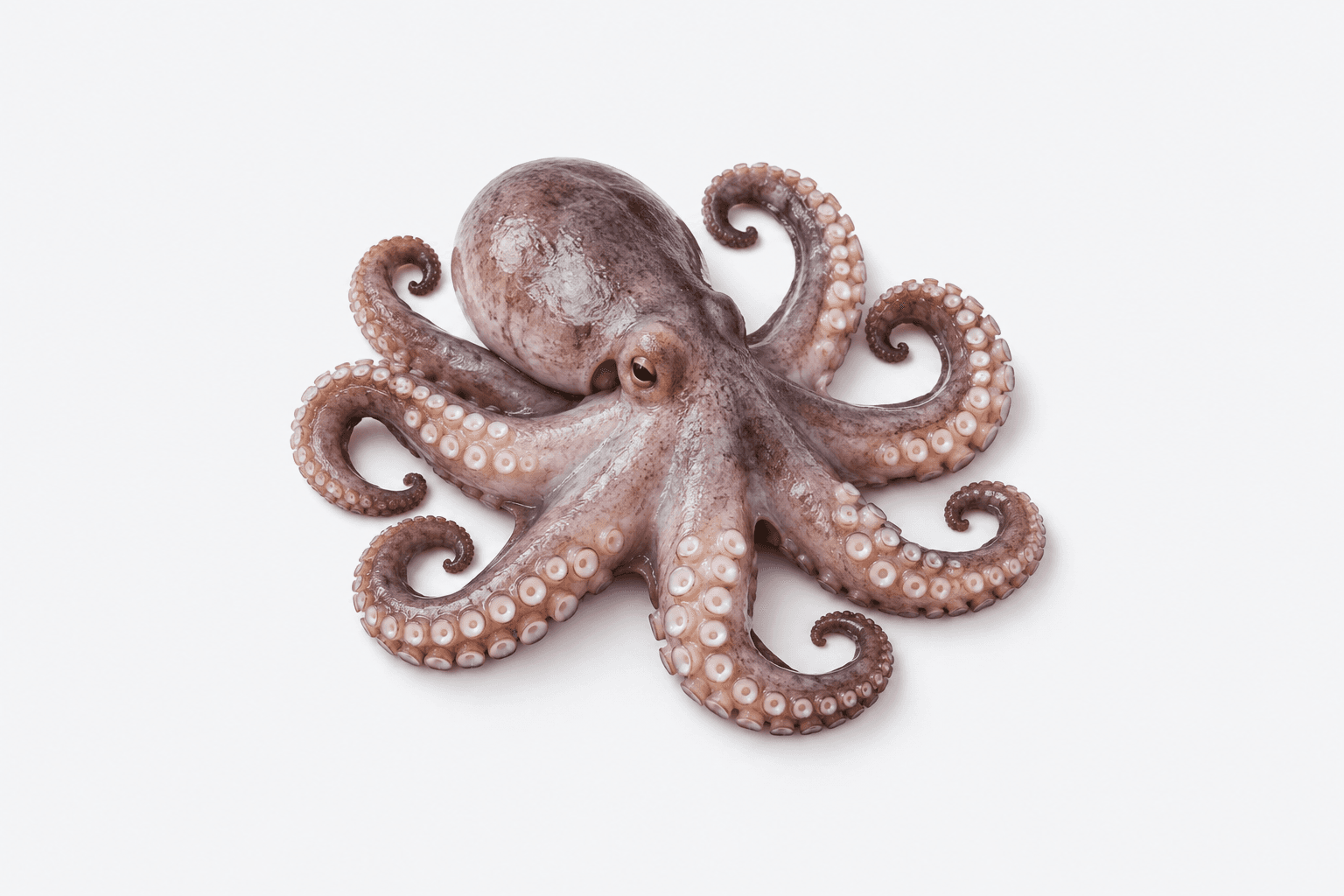
The octopus is an eight-armed cephalopod mollusc. It has no bones at all and is almost entirely muscle, so how it is cooked decides the texture completely: brief blanching leaves it springy, while very long simmering dissolves the collagen and turns it tender. The middle ground between those two is where it is toughest. Radish or vinegar in the pot is widely held to soften it. In Korea it is most often blanched and sliced or stir-fried; around the Mediterranean it is simmered long or grilled.
Octopus appears at Korean memorial tables and celebrations — blanched and sliced with chilli-vinegar sauce, simmered into a soup, or served as sukhoe.
The number that stands out in the composition table is vitamin B12. 20.0 µg per 100 g — 833% of the adult requirement of 2.4 µg. Molluscs and shellfish share this trait.
Fat is only 1.04 g, with 14.9 g of protein and 82 kcal. The texture is meaty, but there is almost no fat.
Selenium at 44.8 µg is 81% of the requirement; iron at 5.3 mg is 66% for adult men.
Yet the thing most often said about octopus is not a nutrient but a warning — that it is high in cholesterol. Octopus holds 48 mg per 100 g. How to read that number is treated separately below.
And one thing must be stated plainly. There is a lot of talk about taurine and fatigue, but this site could not find a randomised trial in which feeding people octopus changed a health outcome. The first and third entries on this page are about composition and its limits, not clinical efficacy.
Key benefits
- Nutrition data
20.0 µg of vitamin B12 — 833% of the requirement, with 1.04 g of fat
Per 100 g of raw octopus:
- 82 kcal, protein 14.9 g, fat 1.04 g, carbohydrate 2.2 g
- Vitamin B12 20.0 µg — 833% of the requirement (2.4 µg)
- Selenium 44.8 µg — 81% of the requirement
- Iron 5.30 mg — 66% of the adult male requirement
- Copper 0.435 mg — 48% of the requirement
- Phosphorus 186 mg, vitamin E 1.20 mg
- Omega-3 (EPA+DHA) 0.157 g
- Sodium 230 mg
The 20 µg of B12 is what this food is. Molluscs and shellfish are extraordinarily high in it. B12 occurs naturally only in animal foods, which is why deficiency shows up in people who eat none.
But eating a lot does not mean absorbing a lot. Human B12 absorption depends on intrinsic factor, and a single meal saturates at roughly 1.5–2 µg. Eating 20 µg does not put 20 µg into you. What it does mean is that one serving reliably covers the requirement.
The 1.04 g of fat is unusual next to meat — lower even than chicken breast (3.6 g). Omega-3 at 0.157 g falls far short of oily fish, but then there is barely any fat to begin with.
The 5.3 mg of iron is worth noting, with the caveat that not all of it is haem iron and that mollusc iron is not absorbed identically to beef's.
The 230 mg of sodium is for raw octopus, and it comes from seawater. Cooking is where the problem starts — chilli-vinegar sauce, soy sauce and soup broth multiply that figure quickly.
Boiling shrinks it. It loses 30–40% of its weight, so 100 g of cooked octopus means roughly 1.5 times the table above.
- Moderate evidence
The "high in cholesterol" warning — the randomised trials say something else
[1]Octopus holds 48 mg of cholesterol per 100 g.
Look at the number first. One egg (about 50 g) holds 186 mg. 100 g of octopus is a quarter of one egg. It is also nothing like squid (233 mg) or shrimp (189 mg). "Molluscs are high in cholesterol" fits octopus poorly.
And there is evidence about dietary cholesterol itself.
A 2020 meta-analysis in Nutrients pooled randomised controlled trials of egg consumption and cholesterol concentration — trials, not observational studies.
An important caveat. Those trials used eggs, not octopus. This is not direct evidence but indirect evidence about a shared component, dietary cholesterol. Read it with that in mind.
Even so, the direction is clear. In 2015 the US Dietary Guidelines Advisory Committee stated that cholesterol is not a nutrient of concern for overconsumption and dropped the 300 mg daily limit. Several countries, Korea among them, followed. The reason is that dietary cholesterol's effect on blood cholesterol is smaller than assumed and varies a great deal between people.
That is not a licence for unlimited intake. A limit was removed; cholesterol was not declared harmless. There are still people with familial hypercholesterolaemia and hyper-responders who react strongly to dietary cholesterol.
Most guidelines agree that saturated fat is the greater cardiovascular problem. By that standard, octopus, with 1.04 g of total fat, is nowhere near the issue.
In short — octopus's 48 mg is a quarter of one egg, the cap on dietary cholesterol has been dropped in several guidelines, and octopus has effectively no saturated fat. The old warning sticks to octopus out of habit rather than composition.
- Not established
Taurine and fatigue — no clinical trial has fed people octopus
This entry sorts through claims that lack evidence.
You hear several things about octopus — that it is rich in taurine, that it relieves fatigue, that it is good for the liver, that it restores vigour.
That it contains taurine is true. Analyses report high taurine in octopus and other molluscs, and the white residue that appears when it is blanched is often explained as taurine crystals.
But three steps are being skipped.
First, USDA does not list taurine. This site does not print numbers without a source, so it cannot tell you how many mg of taurine are in 100 g of octopus. The figures circulating online come from scattered sources and disagree with one another.
Second, containing a compound is not the same as having an effect. Trials of taurine supplements exist, but their doses are typically 1–6 g — a different scale from what food delivers.
Third, this site found no randomised trial in people fed octopus. If there were a trial showing octopus improved fatigue markers or liver values, this would be a different entry; there is not.
The "good for the liver" claim deserves particular caution. Telling someone with liver disease that a food helps can delay treatment.
Does that mean there is no reason to eat it? No. 15 g of protein in 1 g of fat, 20 µg of B12, 45 µg of selenium is reason enough on its own. But that is nutrition, not efficacy — and this site keeps the two apart.
How to eat it well
- Blanch it briefly. For a large octopus, dip the legs into boiling water and lift them out three times to set the shape, then cook.
- Time is the fork in the road. Either pull it out within 30–60 seconds or simmer it 40 minutes or more. Everything in between is the toughest.
- Boiling it with daikon is said to tenderise it — a widely used kitchen practice, not a clinical question.
- Let it cool in its cooking water, and it shrinks less and stays moist.
- Salt and sesame oil instead of chilli-vinegar sauce cuts a lot of sodium and sugar.
- Drinking the soup raises the sodium. Stick mainly to the solids.
- If you are only after B12, you do not need much. A single meal saturates around 2 µg.
- Frozen octopus is actually more tender, because freezing breaks up the tissue.
How to read the grades
Each benefit carries a label showing how far research on people supports it. Grades differ between items even within the same ingredient.
- Nutrition data
- A fact verifiable from food composition databases or health authorities. This is a different kind of statement from a clinical effect.
- Strong evidence
- Consistently confirmed across randomised controlled trials or meta-analyses.
- Moderate evidence
- Human studies exist, but effect sizes are small or results are mixed.
- Early research
- Cell or animal work, or small preliminary studies.
- Not established
- Commonly claimed, but not confirmed in studies on people.
What to watch out for
- This site identified no randomised trial in people fed octopus. Claims about taurine, fatigue and liver health are not established.
- The trials in the cholesterol entry were done with eggs and are not direct evidence about octopus.
- Dropping the limit does not make dietary cholesterol harmless. Some people have familial hypercholesterolaemia, and some respond strongly.
- With gout, molluscs are relatively high in purines.
- Shellfish and mollusc allergy is common and reactions can be severe.
- The 230 mg of sodium is for raw octopus. Sauces and broth push it much higher.
- It is a choking risk — octopus is chewy, and children and older adults can choke on it. Cut it small enough.
- Eating it raw carries a risk of Vibrio and other infections. Avoid it in particular with liver disease or a weakened immune system.
Nutrition
Per 100 g of raw octopus. Boiling shrinks it by 30–40%, so 100 g of cooked octopus corresponds to roughly 150 g raw.
- Calories
- 82 kcal4%
- Protein
- 14.9 g30%
- Fat
- 1.04 g1%
- Carbohydrates
- 2.2 g<1%
- Vitamin B12
- 20.0 µg833%
- Selenium
- 44.8 µg81%
- Iron
- 5.30 mg29%
- Copper
- 0.435 mg48%
- Phosphorus
- 186 mg15%
- Vitamin E
- 1.20 mg8%
- Omega-3
- 0.157 g
- Sodium
- 230 mg10%
Percentages are of the US FDA Daily Value for adults and children 4 and over. National reference intakes differ by sex and age.
Calculate this alongside other ingredients →
Key nutrients
By health concern
Dishes with this ingredient
Sources
The databases and health authorities this article's nutrition figures and health statements draw on.
- 1Association between egg consumption and cholesterol concentration: a systematic review and meta-analysis of randomized controlled trialsMeta-analysisLi MY, Chen JH, Chen C, Kang YN Nutrients 2020PMID 32635569
- 2USDA FoodData CentralFood composition database
- 3NIH Office of Dietary SupplementsHealth authority
- 4PubMedResearch literature