Contents
What it is
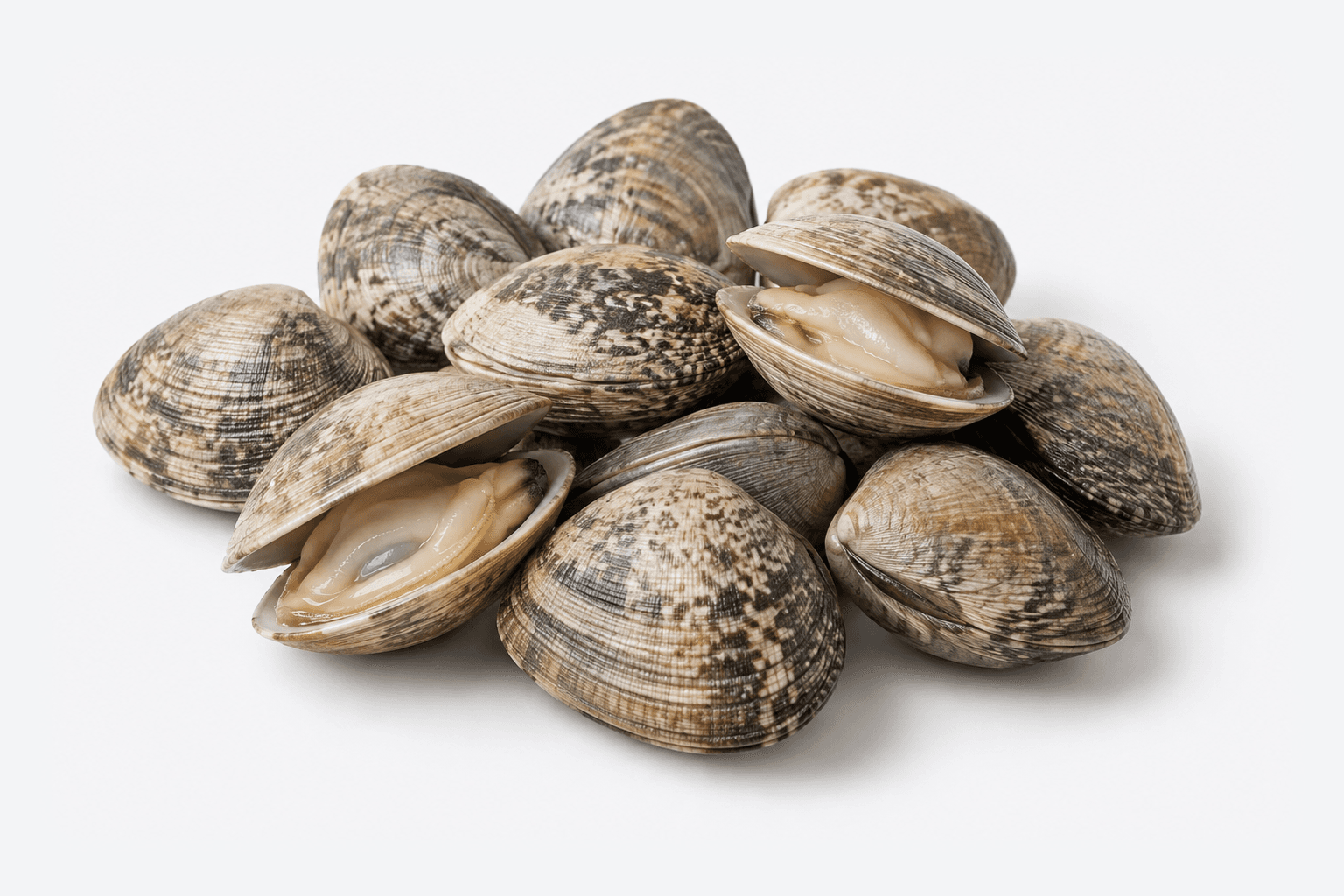
Clams are bivalve molluscs that sit buried in sand and mud with their body between two shells. They feed by drawing in water and filtering out plankton, and sand comes in with it, which is why they are left in salted water to purge before cooking. Their main culinary value is the savoury depth they give a broth, carried chiefly by glutamate and succinate. A clam is done the moment it opens; boiling it beyond that only makes it rubbery.
100 g of clam meat carries 11.3 µg of vitamin B12 — 471% of the adult daily requirement of 2.4 µg.
Among foods, only liver and shellfish reach that. And clams do not bring liver's problem: excess vitamin A. Clams hold 90 µg per 100 g, a thirty-seventh of chicken liver's 3,300 µg.
But there is no clinical trial to write about here. No randomised controlled trial has looked at what happens when people eat clams. This page is built from the composition table and safety information, and that is stated up front.
And the sodium is 601 mg. That is why clam broth is salty. More on it below.
Key benefits
- Nutrition data
Very high in vitamin B12 and selenium
Per 100 g of raw clam meat, against adult daily requirements:
- Vitamin B12 11.3 µg — 471%
- Selenium 30.6 µg — 56%
- Protein 14.7 g, for only 86 kcal
- Phosphorus 198 mg, choline 65 mg, iron 1.62 mg
- Vitamin A 90 µg, magnesium 19 mg, calcium 39 mg
- Fat 0.96 g, cholesterol 30 mg
Vitamin B12 is effectively only in animal foods. It runs short in long-term vegetarians, after gastric surgery, and with long-term metformin or acid-suppressing medication.
How to read 471%. B12 is water-soluble, the excess leaves in urine, and no upper limit has been set. 471% is not a danger. It does mean one meal can cover several days, because the body stores B12 in the liver.
Selenium at 30.6 µg is also high — though nothing like Brazil nuts (around 1,900 µg per 100 g), so excess is not a concern here.
Protein per calorie is good. 14.7 g in 86 kcal is 17 g per 100 kcal, the same as cottage cheese.
Iron at 1.62 mg is lower than the reputation suggests. "Clams equal iron" is a common impression, but raw clams carry 1.62 mg per 100 g. Canned clams are concentrated and higher.
- Nutrition data
601 mg of sodium — and that salt is in the broth
601 mg of sodium per 100 g of raw clam meat — 30% of a 2,000 mg daily ceiling.
It is not added salt; it is seawater. Clams hold seawater inside the shell, and it soaks into the meat.
In cooking, that sodium goes into the broth.
- Clam noodle soup, clam and seaweed soup, vongole — all of them use the liquor the clams release. That is what the savour is.
- Adding salt or soy sauce on top stacks seasoning onto salt the clams already delivered.
One practical rule follows — season a clam broth last, after tasting. Following the salt quantity in a recipe will almost always oversalt it.
The purging water is not the broth. Match seawater strength (30 g of salt per litre), leave the clams in the dark for 30 minutes and they spit out their sand. That water has sand in it and is discarded. The broth you cook with is the liquor released as the shells open over heat.
With high blood pressure or on a reduced-sodium diet, lean towards eating the meat and taking less of the broth. Much of the 601 mg in 100 g of meat has already moved into the liquid.
- Not established
No clinical trials — and the season matters
No randomised controlled trial has examined what eating clams does. That is why this page stops at the composition table.
The common claims, sorted:
"Good for the liver." Taurine and betaine are the usual reasons given. Both are present in clams, but no human trial shows liver markers improving from eating them. The same goes for hangovers.
"Good for anaemia." The B12 content is real, and it matters for B12-deficiency anaemia. But for iron-deficiency anaemia, clam iron is 1.62 mg per 100 g — not remarkable. Which anaemia it is has to come first.
And clams are a food where season and source have to be checked.
- Shellfish toxins — in spring (roughly March to June), paralytic shellfish poison can exceed limits along southern coasts. Food safety authorities publish closed harvesting areas. Cooking does not destroy it.
- Vibrio vulnificus — the risk rises as summer sea temperatures climb. It can be fatal in liver disease, diabetes, alcohol dependence and immunosuppression, and those groups should avoid raw shellfish in summer.
- Norovirus — winter outbreaks are associated with oysters and clams. Thorough cooking prevents most of it.
In sum: clams are a low-calorie protein food outstanding in vitamin B12 and selenium, nothing beyond that is established, and the safety information matters more here than the benefit information.
How to eat it well
- Purge them first. Dissolve 30 g of salt per litre of water to match seawater, cover the clams and leave them somewhere dark for 30 minutes to an hour. Darkness makes them open more readily.
- Throw the purging water away — it holds the sand. Rinse before cooking.
- Kill the heat the moment they open. Cooked longer they turn rubbery. Two to three minutes is enough.
- Before cooking, discard any that gape and do not close when tapped. Those are already dead.
- Any that stay shut after cooking are safer left alone than forced open.
- Season at the end. The salt the clams released is already in the broth.
- One day refrigerated; freeze only after cooking. Keep live clams under a damp cloth in the fridge and use them the same day.
How to read the grades
Each benefit carries a label showing how far research on people supports it. Grades differ between items even within the same ingredient.
- Nutrition data
- A fact verifiable from food composition databases or health authorities. This is a different kind of statement from a clinical effect.
- Strong evidence
- Consistently confirmed across randomised controlled trials or meta-analyses.
- Moderate evidence
- Human studies exist, but effect sizes are small or results are mixed.
- Early research
- Cell or animal work, or small preliminary studies.
- Not established
- Commonly claimed, but not confirmed in studies on people.
What to watch out for
- 601 mg of sodium per 100 g. With high blood pressure or on a reduced-sodium diet, manage how much broth you take.
- With liver disease, diabetes, alcohol dependence or immunosuppression, avoid raw shellfish in summer. Vibrio vulnificus has a high fatality rate.
- Shellfish toxins survive cooking. In spring, check the closed-harvest notices and do not eat clams you gathered yourself.
- Shellfish allergy can be separate from crustacean allergy, though cross-reaction occurs.
- With gout, shellfish are high in purines.
- In pregnancy, cook them thoroughly because of listeria and vibrio.
- This page has no clinical trial evidence behind it. It is composition and safety information.
Nutrition
Per 100 g of raw clam meat, shells excluded. A 1 kg bag of clams yields roughly 200–300 g of meat.
- Calories
- 86 kcal4%
- Protein
- 14.7 g29%
- Vitamin B12
- 11.3 µg471%
- Selenium
- 30.6 µg56%
- Sodium
- 601 mg26%
- Phosphorus
- 198 mg16%
- Choline
- 65 mg12%
- Vitamin A
- 90 µg10%
- Iron
- 1.62 mg9%
- Magnesium
- 19 mg5%
- Calcium
- 39 mg3%
Percentages are of the US FDA Daily Value for adults and children 4 and over. National reference intakes differ by sex and age.
Calculate this alongside other ingredients →
Key nutrients
Dishes with this ingredient
Sources
The databases and health authorities this article's nutrition figures and health statements draw on.