Contents
What it is
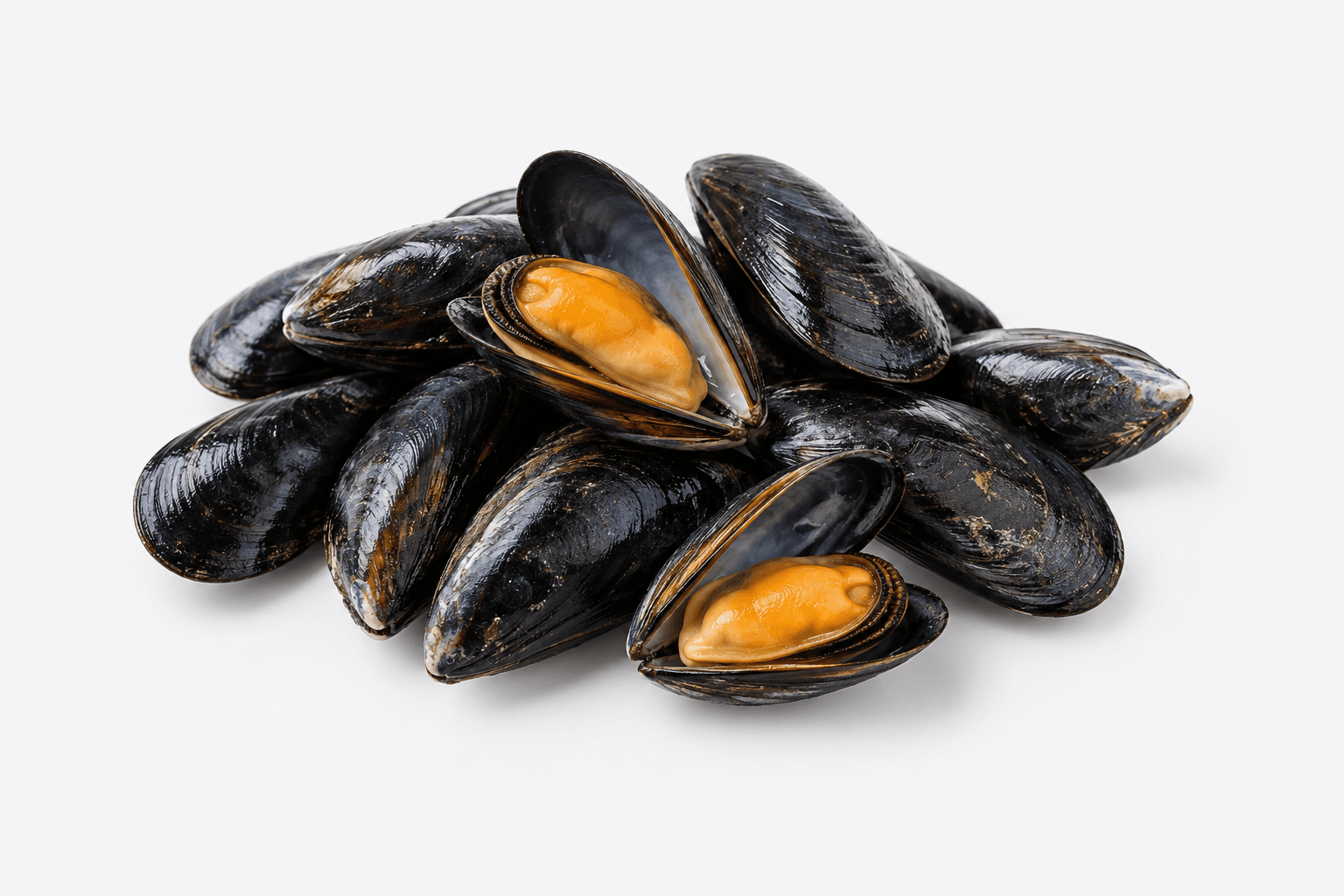
The mussel is a bivalve that lives fastened to rock. It anchors itself with tough threads called the byssus, and preparing one means pulling that beard out from between the shells. Unlike clams it does not take in sand, so it needs no purging; instead the shells are scrubbed to remove barnacles and growth. It gives a broth a powerful savoury depth. Choose ones whose shells are shut, or that close when tapped, and discard any that stay shut after cooking.
Scientific name Mytilus
The most certain thing about mussels is the composition table. 100 g of raw meat carries 12 µg of vitamin B12 — 500% of the 2.4 µg adult requirement. Outside oysters, that is close to the top of any common ingredient.
Add selenium at 44.8 µg (81% of the requirement) and manganese at 3.4 mg, which clears the adequate intake in 100 g.
The arthritis story is separate. A large 2018 meta-analysis in the British Journal of Sports Medicine names green-lipped mussel extract. But three things have to be stated plainly: a different species (the New Zealand green-lipped mussel, Perna canaliculus), a different form (an extract), and a limited window (medium term only).
And the most important sentence in that meta-analysis is this: no supplement was identified with clinically important effects on pain reduction at long term.
The mussels in your pot are not what that research studied.
Key benefits
- Early research
Green-lipped mussel extract: effective at medium term, while nothing worked at long term
[1]2018, British Journal of Sports Medicine. A systematic review with random-effects meta-analysis of randomised trials comparing oral supplements with placebo in hand, hip or knee osteoarthritis. Databases were searched from inception to April 2017, covering 69 eligible studies and 20 supplements.
Split by time window, the results run like this.
Short term — seven showed large and clinically important effects on pain (effect size > 0.80): collagen hydrolysate, passion fruit peel extract, Curcuma longa extract, Boswellia serrata extract, curcumin, pycnogenol and L-carnitine.
Six showed statistically significant improvement of unclear clinical importance: undenatured type II collagen, avocado soybean unsaponifiables, methylsulfonylmethane, diacerein, glucosamine and chondroitin.
Medium term — only two kept clinically important effects on pain: green-lipped mussel extract and undenatured type II collagen.
Long term — no supplement was identified with clinically important effects on pain reduction.
Physical function followed a similar pattern. On structure, only chondroitin was statistically significant, and not clinically important (effect size −0.30, −0.42 to −0.17). On safety there were no differences between supplements and placebo except for diacerein. GRADE placed the certainty across a wide range.
Three cautions before applying this to mussels.
First, the species differs. The trials used the New Zealand green-lipped mussel (Perna canaliculus), not the blue mussel (Mytilus) on your plate.
Second, the form differs. It is an extract, frequently one concentrating the lipid fraction. A bowl of steamed mussels is not the same thing.
Third, the window is narrow. Nothing clinically important at short term, something at medium term, and gone at long term.
The honest summary: green-lipped mussel extract matters because it is one of only two of twenty supplements still standing at medium term. It is not evidence that eating mussels improves arthritis.
- Nutrition data
12 µg of B12, 44.8 µg of selenium, 3.4 mg of manganese
Per 100 g of raw blue mussel meat:
- 86 kcal, protein 11.9 g, fat 2.24 g, cholesterol 28 mg
- Vitamin B12 12.0 µg — 500% of the 2.4 µg requirement
- Selenium 44.8 µg — 81% of the 55 µg requirement
- Manganese 3.4 mg — above the 2.3 mg adequate intake
- Iron 3.95 mg, zinc 1.6 mg
- Folate 42 µg, choline 65 mg, vitamin A 48 µg
- EPA 0.188 g + DHA 0.253 g — 0.44 g together
- Sodium 286 mg
The 12 µg of B12 is this food's first feature. Five days' worth in 100 g. B12 occurs meaningfully only in animal foods, which is why deficiency is common among people who do not eat them.
Manganese at 3.4 mg is the second. High even among shellfish, and past the adequate intake in 100 g. But manganese deficiency is rare, so there is no evidence that this figure changes anything clinically.
Omega-3 at 0.44 g is mid-range. Nowhere near mackerel (2.6 g) or salmon, but above white fish.
With fat at 2.24 g against protein at 11.9 g, the protein share of the calories is high — and 86 kcal is low to begin with.
Sodium at 286 mg is what you expect from the sea. The salt in the broth is added on top.
Subtract the shells. Half a kilo in the shell yields about 100–150 g of meat, and the figures above are for meat.
- Not established
Shellfish toxin is a question of season and water — read this
This entry is about safety, not benefit, and it is the most important item on this page.
Mussels and other bivalves feed by filtering water. When toxic plankton bloom, the toxin accumulates in the meat. This is paralytic shellfish poisoning.
In Korea it is mainly a spring problem. As water warms from March to June, levels exceed the limit along the south coast, and harvesting bans follow for the affected waters.
One fact matters above all: cooking does not destroy it. Boiling, steaming and frying make no difference. That is what separates it from bacterial food poisoning.
Symptoms begin with numbness of the lips and tongue, spread to the hands and feet, and in severe cases reach breathing difficulty. They appear 30 minutes to 3 hours after eating.
So:
- Do not harvest them yourself. Commercial stock is tested.
- In spring, check the shellfish toxin advisories from the Ministry of Food and Drug Safety and local authorities.
- Do not eat anything from waters under a harvesting ban.
- If your lips go numb, stop eating immediately and seek medical care.
Other safety points:
- Discard any that gape open and do not close when tapped. They are already dead.
- Discard any that stay shut after cooking.
- Remove the beard just before cooking. Removing it early kills the mussel.
- Norovirus is a winter problem with raw shellfish. Thorough cooking removes it — unlike the shellfish toxin, it is heat-sensitive.
How to eat it well
- Debeard just before cooking. Do it early and the mussel dies and starts to spoil.
- Scrub the shells against each other, or with a brush if you have one.
- Five to seven minutes covered over high heat is enough. Longer and the meat toughens.
- Take them out as they open. Waiting for the last one toughens the first.
- Sand settles in the broth. Leave the bottom behind when you pour.
- Salt at the end. The mussels hold 286 mg per 100 g and give more up to the broth.
- Vitamin B12 is water-soluble, so drinking the broth loses less of it — just count the sodium too.
- Eating them for arthritis is not worth doing: the trials used an extract of a different species.
How to read the grades
Each benefit carries a label showing how far research on people supports it. Grades differ between items even within the same ingredient.
- Nutrition data
- A fact verifiable from food composition databases or health authorities. This is a different kind of statement from a clinical effect.
- Strong evidence
- Consistently confirmed across randomised controlled trials or meta-analyses.
- Moderate evidence
- Human studies exist, but effect sizes are small or results are mixed.
- Early research
- Cell or animal work, or small preliminary studies.
- Not established
- Commonly claimed, but not confirmed in studies on people.
What to watch out for
- Check spring shellfish toxin advisories. Cooking does not destroy the toxin. Do not harvest your own, and avoid anything from banned waters. If your lips go numb, stop and seek care.
- Discard dead ones, and any that stay shut after cooking.
- Avoid them with a shellfish allergy. Mollusc allergy is common in adults and reactions can be severe.
- The arthritis result studied an extract of the New Zealand green-lipped mussel, a different species in a different form from the mussels you cook.
- In that meta-analysis no supplement reduced pain meaningfully at long term.
- With gout, shellfish are high in purines. Avoid during an attack.
- In pregnancy, cook them thoroughly and avoid raw or undercooked shellfish.
- Sodium is 286 mg before the salt in the broth. If you manage blood pressure, do not finish the liquid.
Nutrition
Per 100 g of raw blue mussel meat, shells excluded. Half a kilo in the shell yields roughly 100–150 g of meat. What the trial below tested was an extract of the New Zealand green-lipped mussel.
- Calories
- 86 kcal4%
- Protein
- 11.9 g24%
- Fat
- 2.24 g3%
- Vitamin B12
- 12.0 µg500%
- Selenium
- 44.8 µg81%
- Manganese
- 3.4 mg148%
- Iron
- 3.95 mg22%
- Folate
- 42 µg11%
- Choline
- 65 mg12%
- Sodium
- 286 mg12%
- Potassium
- 320 mg7%
- Vitamin A
- 48 µg5%
Percentages are of the US FDA Daily Value for adults and children 4 and over. National reference intakes differ by sex and age.
Calculate this alongside other ingredients →
Key nutrients
Dishes with this ingredient
Sources
The databases and health authorities this article's nutrition figures and health statements draw on.
- 1Dietary supplements for treating osteoarthritis: a systematic review and meta-analysisMeta-analysisLiu X, et al. British Journal of Sports Medicine 2018PMID 29018060
- 2USDA FoodData CentralFood composition database
- 3NIH Office of Dietary SupplementsHealth authority
- 4World Health Organization · Healthy dietHealth authority
- 5PubMedResearch literature