Contents
What it is
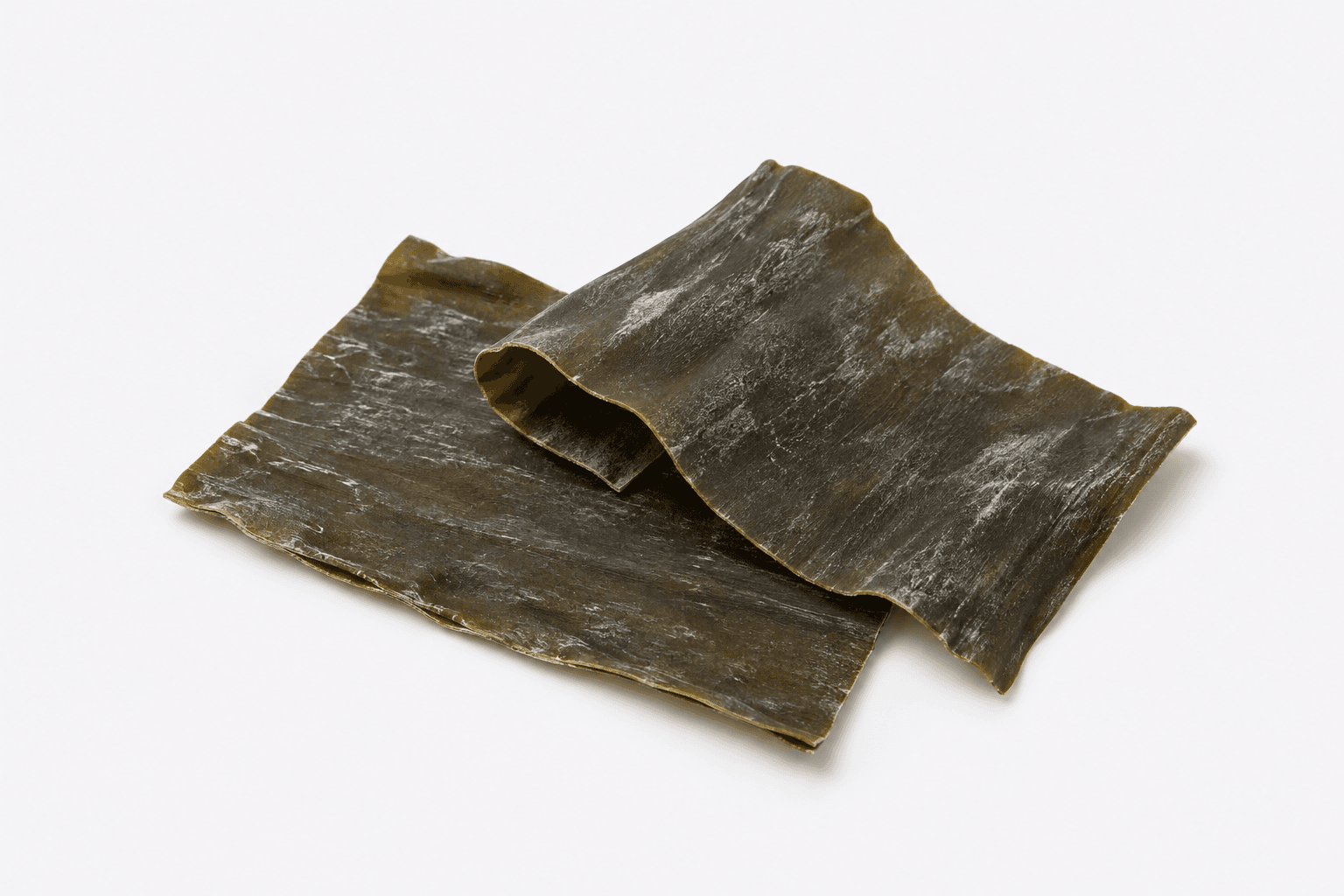
Kelp is a brown alga that anchors to rock in cold seas, growing in long, broad, thick blades. It is farmed along Korea's East and South Seas and in northern Japan. The white powder on the surface of a dried sheet is not mould but mannitol and related compounds that have migrated out, so it is better left alone than wiped off. It is rich in glutamate and is used to build savoury depth in stock; boiled too long it releases sticky alginate and clouds the broth, so it is lifted out just before the water boils. Its iodine content is very high.
Scientific name Saccharina japonica
Kelp is the most concentrated iodine source in the Korean diet. When Korea's food safety ministry analysed samples from across the country, dried kelp carried about seven times the iodine of sea mustard.
But the more useful finding in that study is elsewhere.
- Iodine from eating kelp — 115.58 µg a day on average
- Iodine from kelp broth — 347.57 µg a day
The broth carries three times more. It is easy to assume that kelp dropped into boiling water and lifted back out leaves nothing behind. The iodine comes out into the water. The stock is what carries it.
Koreans take an average of 559.16 µg of iodine a day from brown seaweed in total — more than three times the recommended intake of 150 µg.
This page is not telling you to avoid kelp. It is recording that this is not a country with an iodine shortfall; it is one with a surplus worth checking.
Key benefits
- Nutrition data
The iodine density is extreme, and the broth carries more of it
[1]A 2024 analysis in Nutrition Research and Practice by Korea's Ministry of Food and Drug Safety. It combined intake data from the Korea National Health and Nutrition Examination Survey (2016–2021) with iodine measured by ICP-MS on nationwide brown seaweed samples prepared the way Koreans actually cook them.
Measured content, dry weight:
- Kelp 1,484.08 ± 257.12 mg/kg — about 148,000 µg per 100 g
- Sea mustard 204.09 ± 39.31 mg/kg — about 20,400 µg per 100 g
Kelp holds roughly seven times as much.
Samples vary widely. City means for kelp ran from 1,272.11 mg/kg in Suwon to 1,870.42 in Seoul — a 1.5-fold spread within the same food.
And what Koreans actually take in:
- From sea mustard: 96.01 ± 2.36 µg/day
- From kelp, excluding broth: 115.58 ± 7.71 µg/day
- From kelp broth: 347.57 ± 10.03 µg/day
- From brown seaweed in total: 559.16 ± 13.15 µg/day
Broth outweighs the kelp itself three to one. That is the habit of building soups, stews and braises on a kelp stock, showing up as a number.
The paper adds its own caveat. The median was zero, because only 37.6% of people had eaten brown seaweed on the survey day. Koreans do not eat it daily, and the authors note that recalculating on usual intake would tighten the distribution considerably and lower the share exceeding the upper limit.
In short: the mean is over three times the recommendation, but it is concentrated into the days people eat it.
- Moderate evidence
Excess iodine tracked with hypothyroidism
[2]A 1994 study in the Journal of Clinical Endocrinology and Metabolism surveyed 1,061 adults across five coastal areas of Japan that produce iodine-rich kelp.
- Hyperthyroidism (TSH < 0.15 mU/L) was similar across the areas
- Hypothyroidism (TSH > 5.0 mU/L) ranged from 0% to 9.7%
- The share of people with high morning urinary iodide (≥ 75 µmol/L) ranged from 3.7% to 30.3%
The two moved together. Including a non-coastal city, the frequency of high urinary iodide correlated with the frequency of hypothyroidism in people negative for thyroid autoantibodies (r = 0.829, n = 6, P < 0.05).
It did not correlate with autoantibody-positive hypothyroidism (r = 0.278), nor with hyperthyroidism (r = 0.038).
That distinction is the finding. What emerged was the shape of hypothyroidism caused by iodine itself, rather than by autoimmunity.
Among the autoantibody-negative:
- Hypothyroidism in the high-iodide group 12.1% versus 2.3% with normal iodide (P < 0.001)
- TSH 21.9 versus 9.6 mU/L
- Thyroglobulin 288 versus 123 µg/L
- Free T4 9.9 versus 14.2 pmol/L — all P < 0.05
The authors concluded that excessive iodine intake should be considered a cause of hypothyroidism in these areas, alongside chronic thyroiditis.
This is cross-sectional, and it is Japan in 1994. It does not transfer to Korea unaltered. That the two countries have similar iodine intake patterns is what makes it worth reading.
- Not established
Thyroid cancer prevention is not established for kelp
[3]"Seaweed protects against thyroid cancer" circulates widely in Korea. For kelp specifically, the data do not support it.
A 2022 case-control study in Endocrinology and Metabolism (Seoul) compared 117 thyroid cancer cases with 173 controls from the National Cancer Center's Cancer Screenee Cohort (2002–2014).
- Gim (laver) — inversely associated. OR 0.50 (95% CI 0.30–0.83)
- Iodine intake — OR 0.57 (0.35–0.95)
- Sea mustard / kelp — not significant
- Total seaweed — not significant
What reached significance was gim and iodine. Kelp did not.
The study then added a genetic layer: the rs77277498 polymorphism of SLC5A5, which codes the sodium/iodide symporter. Against people with the C/C genotype and low intake, those carrying the G allele with high intake had lower risk — gim OR 0.25 (0.10–0.56), sea mustard/kelp OR 0.31 (0.12–0.77), total seaweed 0.26 (0.10–0.62), iodine 0.30 (0.12–0.73).
Do not read those as conclusions. 117 cases and 173 controls is small. Splitting by genotype makes each cell smaller still, which is why the intervals run as wide as 0.10 to 0.56. And case-control designs are vulnerable to recall bias, since diet is reconstructed after a cancer diagnosis.
The honest position on kelp: no preventive effect has been shown, and no harm has been shown either.
How to eat it well
- After making stock, think about how much broth you are drinking. The iodine stays in the liquid, not in the piece you lift out.
- Thirty minutes in cold water draws out the savoury compounds without boiling. Boiling releases the slime and clouds the stock.
- Five to ten minutes in hot water is enough. The longer it boils, the more iodine comes out.
- Do not wash off the white powder on the surface. It is mannitol, a sugar alcohol, and part of the flavour. Wipe lightly with a damp cloth.
- To eat the kelp itself, rehydrate and shred it for a salad, or use it as a wrap. The amount is much easier to judge that way than in stock.
- Do not use it every day. In the survey above, 63% of Koreans had eaten no brown seaweed on the day in question. Two or three times a week is realistic.
- Kelp pills, powders and teas are a different matter — the doses do not compare to cooking.
How to read the grades
Each benefit carries a label showing how far research on people supports it. Grades differ between items even within the same ingredient.
- Nutrition data
- A fact verifiable from food composition databases or health authorities. This is a different kind of statement from a clinical effect.
- Strong evidence
- Consistently confirmed across randomised controlled trials or meta-analyses.
- Moderate evidence
- Human studies exist, but effect sizes are small or results are mixed.
- Early research
- Cell or animal work, or small preliminary studies.
- Not established
- Commonly claimed, but not confirmed in studies on people.
What to watch out for
- If you have thyroid disease, discuss it with your clinician. Hashimoto's, Graves', nodules, past thyroid surgery — all of these mean iodine intake needs checking.
- Upper limits differ by country: 2,400 µg a day for Korean adults, 1,100 µg in the US, 600 µg in Europe (EFSA). That the standards diverge this much means the boundary of safety is still being argued over.
- Pregnancy and breastfeeding raise the requirement but not the ceiling's importance. A fetal thyroid is sensitive to maternal iodine excess.
- Before thyroid function tests or radioactive iodine treatment, seaweed including kelp has to be stopped in advance. It interferes with both.
- Be particularly careful with kelp supplements. Products with inaccurate label content have been reported, and the doses differ from culinary use.
- Heavy metals can be an issue. Seaweed concentrates arsenic and cadmium from the waters it grows in. Check the origin.
- Sodium is 233 mg per 100 g of raw kelp. Dried kelp is far higher.
Nutrition
Per 100 g of raw kelp (USDA). Iodine is the exception: USDA has no figure, so this applies Korea's MFDS measurement that kelp holds about seven times the iodine of sea mustard to this site's sea mustard value. Dried kelp itself measures about 148,000 µg per 100 g, ranging 127,000–187,000 µg by sample.
- Calories
- 43 kcal2%
- Carbohydrates
- 9.57 g3%
- Fiber
- 1.3 g5%
- Protein
- 1.68 g3%
- Iodine
- ~11,000 µg999%+
- Calcium
- 168 mg13%
- Magnesium
- 121 mg29%
- Folate
- 180 µg45%
- Vitamin K
- 66 µg55%
- Iron
- 2.85 mg16%
- Sodium
- 233 mg10%
Percentages are of the US FDA Daily Value for adults and children 4 and over. National reference intakes differ by sex and age.
Calculate this alongside other ingredients →
Key nutrients
Dishes with this ingredient
Compare with
Sources
The databases and health authorities this article's nutrition figures and health statements draw on.
- 1Iodine intake from brown seaweed and the related nutritional risk assessment in KoreansResearch literatureKwon SO, et al. Nutr Res Pract 2024PMID 38854470
- 2Association between dietary iodine intake and prevalence of subclinical hypothyroidism in the coastal regions of JapanResearch literatureKonno N, et al. J Clin Endocrinol Metab 1994PMID 8106628
- 3Seaweed and Iodine Intakes and SLC5A5 rs77277498 in Relation to Thyroid CancerResearch literatureHoang T, et al. Endocrinol Metab (Seoul) 2022PMID 35607818
- 4USDA FoodData CentralFood composition database
- 5MFDS Food Composition Database · 식품안전나라Food composition database
- 6NIH Office of Dietary SupplementsHealth authority
- 7World Health Organization · Healthy dietHealth authority
- 8European Food Safety Authority (EFSA)Health authority
- 9PubMedResearch literature