Contents
What it is
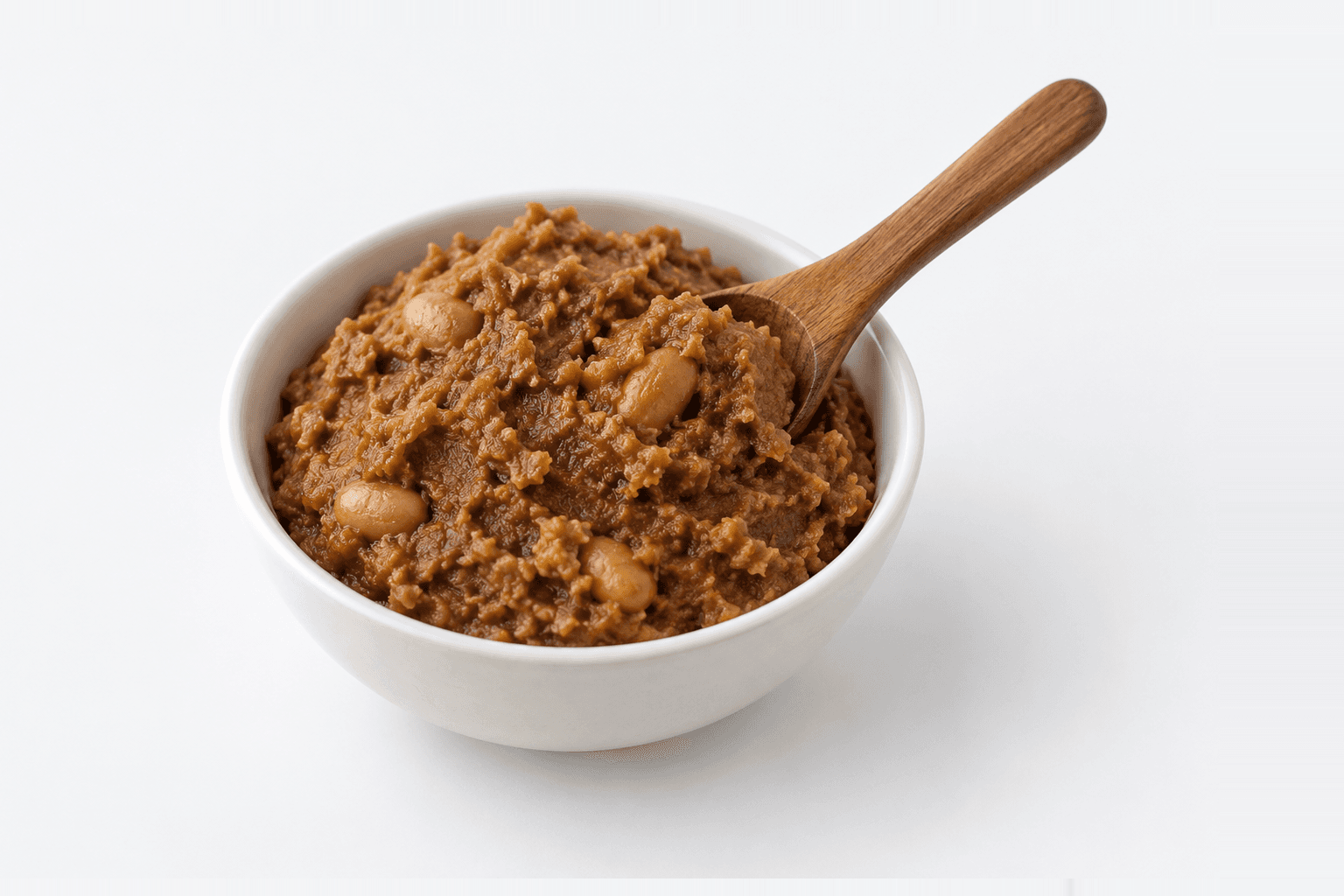
Doenjang is a Korean fermented soybean paste: boiled soybeans are formed into blocks, left to culture, then steeped in brine for months or years. Soy sauce is ladled off the same crock and what remains behind is doenjang, so the two come out of a single steeping. Over the long ferment, microbes break the soy protein down into amino acids, and that is where the savoury depth comes from. It shares its roots with Japanese miso, but miso usually brings in rice or barley koji while doenjang is more often soybean alone, which is why they taste different. It is preserved by salt, so the sodium is high.
Doenjang is the backbone of Korean cooking — stews, soups, dipping paste, dressed vegetables.
One study is cited almost every time someone says doenjang helps with weight: a 12-week double-blind randomised trial published in 2014 in the Journal of Medicinal Food. It needs reading carefully.
The design. Sixty overweight Koreans randomised to 9.8 g/day of doenjang or placebo for 12 weeks. Fifty-one completed (26 doenjang, 25 placebo).
The results.
- Visceral fat area decreased — but in subjects carrying the mutant T allele of PPAR-γ2, compared with those carrying the C allele
- Meanwhile, free fatty acids, insulin and HOMA-IR rose significantly in the doenjang group
- The doenjang group tended to eat less carbohydrate and less sodium than the placebo group
Read those three lines again.
The fat reduction came from a genotype subgroup, not the whole sample. T-allele carriers were 25.9% (15) plus 3.4% (2) — around seventeen people out of fifty-one completers. And the insulin resistance markers moved in the wrong direction.
And the most practical number on this page is a different one — sodium.
Key benefits
- Early research
Visceral fat did fall — in the subset of 51 people with the right genotype
[1]2014, Journal of Medicinal Food, Obesity Research Center, Chonbuk National University. A 12-week double-blind randomised clinical trial.
Design.
- Sixty overweight subjects randomised to 9.8 g/day of doenjang or placebo
- Twelve weeks, given in pill form
- 51 completed — 26 doenjang, 25 placebo
- Anthropometry, metabolic parameters, abdominal fat distribution and PPAR-γ2 polymorphisms measured before and after
PPAR-γ2 C1431T genotype distribution.
Genotype Frequency n CC 70% 41 TC 25.9% 15 TT 3.4% 2 By allele: C 81.6%, T 18.4%.
Results.
- Visceral fat area (VFA) — significantly decreased with doenjang in subjects with the mutant T allele, compared with C-allele carriers, after adjusting for age, sex and BMI
- Free fatty acids, insulin and HOMA-IR — significantly increased in the doenjang group
- Radical clearance capacity (ORAC, DNA tail length) — activated in C-allele subjects
- Catalase activity — doubled in C-allele carriers, reversed in T-allele carriers
- The doenjang group tended to eat less carbohydrate and sodium than placebo
How to read this.
First, it is a subgroup analysis. The finding is not that visceral fat fell across the participants, but that it fell in one genotype. T-allele carriers were 17 of the original 60, and fewer among completers. A subgroup result at that scale is a hypothesis, not a conclusion.
Second, insulin resistance got worse. The same paragraph of the same paper states that free fatty acids, insulin and HOMA-IR increased significantly in the doenjang group. For a food eaten to lose weight, a rise in insulin resistance markers is the opposite of the benefit. Carrying over only "the fat went down" and dropping this line distorts the result.
Third, the diets differed. The doenjang group tended to eat less carbohydrate and less sodium. If visceral fat fell, this design cannot separate doenjang from eating fewer carbohydrates.
Fourth, the antioxidant findings split. Catalase doubled in C-allele carriers and went the other way in T-allele carriers. That means the fat reduction and the antioxidant change happened in different genotypes.
Fifth, 9.8 g was given as a pill, which is not the same as doenjang stirred into a stew.
The honest conclusion: there is one result in which eating doenjang reduced visceral fat. But it was in a small genotype subgroup, insulin resistance markers worsened in the same trial, and the diets differed. That cannot be carried over as "doenjang is good for weight loss".
- Nutrition data
3,730 mg of sodium per 100 g — the biggest number here
Per 100 g of fermented soybean paste:
- Sodium 3,730 mg — 187% of the WHO daily recommendation (2,000 mg)
- 198 kcal, protein 12.8 g, fat 6.01 g
- Of 25.4 g of carbohydrate, 5.4 g is fibre, sugar 6.2 g
- Potassium 210 mg, iron 2.49 mg, zinc 2.56 mg
- Magnesium 48 mg, choline 72.2 mg, selenium 7.0 µg
The 3,730 mg is what this food is. It comes before every other number.
Per tablespoon (18 g):
100 g 1 tbsp (18 g) Sodium 3,730 mg 671 mg Energy 198 kcal 36 kcal Protein 12.8 g 2.3 g Fibre 5.4 g 1.0 g One tablespoon is 34% of the WHO daily figure.
A pot of doenjang stew for two or three people takes two or three tablespoons. Add the other ingredients in the broth, plus kimchi and salted seafood, and passing a day's sodium in one meal is not difficult.
Korean sodium intake has long run well above the recommendation, and soups, stews and kimchi are the main routes.
And a limit of the table above should be stated plainly.
USDA's "Miso" entry is Japanese miso. Korean doenjang is made from meju blocks, with different fermentation and salt levels, and is generally saltier than miso. Which means 3,730 mg may be an underestimate.
So the most useful advice this page can give is this — read the nutrition label on the doenjang you actually buy. The sodium per 100 g printed there is more accurate than the table above.
The 12.8 g of protein and 5.4 g of fibre come from the soybeans. But a tablespoon gives 2.3 g of protein and 1.0 g of fibre — not meaningful amounts in a meal. Doenjang is not a protein source; it is a seasoning.
Practical ways to cut the sodium:
- Drink less of the broth. Stay with the solids
- Use less paste and fill the savouriness with shiitake, kelp and dried anchovy
- Look for reduced-sodium products
- Add potassium-rich vegetables (spinach, courgette, potato) to help the sodium-potassium balance. With kidney disease, the opposite applies
- Not established
"It's fermented, so it's good for your gut" — boiling leaves nothing alive
This entry sorts through a common generalisation.
The things said most often about doenjang are that "it's a fermented food, so it's good for gut health" and that "it contains lactic acid bacteria".
The starting point is true. Doenjang is made by moulds and bacteria breaking down soy protein, producing the amino acids and peptides that are its savouriness.
But several points follow.
First, boiling kills the microbes. Doenjang stew is boiled. In the main way doenjang is eaten in Korea, no living micro-organisms remain. To talk about doenjang as a probiotic you would need the unheated forms — dipping paste or raw doenjang — and the evidence there is a separate question.
Second, "fermented" does not mean "probiotic". A probiotic means a specific strain, in a sufficient dose, shown to produce a health benefit. The strain and the amount have to be specified, and there has to be a trial of that strain. The microbial composition of doenjang varies with the maker and the fermentation conditions.
Third, this site did not identify any randomised trial in people where eating doenjang changed gut flora or digestive symptoms. The trial above looked at visceral fat and metabolic and antioxidant markers, not gut health.
Fourth — and this matters. Even if doenjang carried beneficial microbes, 671 mg of sodium comes with every tablespoon. Eating more doenjang for your gut is also eating more sodium.
The salt in doenjang cannot be separated out. It is not there only for flavour: it is what suppresses unwanted organisms and makes long fermentation possible. That is also why low-sodium doenjang is difficult to make.
A word on stomach cancer. Observational studies have repeatedly reported associations between salty foods and gastric cancer, discussed alongside the high incidence in Korea and Japan. But that is evidence about sodium in general rather than causal evidence naming doenjang, and studies disagree. This site will not write that doenjang causes gastric cancer, nor that it is safe. What is clear is that reducing sodium is recommended.
The honest conclusion: doenjang is the backbone of Korean food, and its savouriness lets you use less of other seasonings. But there is no basis for eating more of it because "fermented foods are healthy" — and eating more brings sodium with it.
How to eat it well
- Read the sodium on your own product's label. The per-100 g figure differs by maker.
- Drink less of the broth. Most of the sodium is in it.
- Use less paste and build savouriness with shiitake, kelp and dried anchovy; you will need less salt overall.
- One tablespoon (18 g) is 671 mg of sodium — 34% of the WHO daily figure.
- Add plenty of vegetables to bring potassium alongside. With kidney disease, the opposite applies.
- Boiling leaves no live microbes. If you want a probiotic, doenjang is not the right choice.
- Ssamjang is doenjang plus gochujang and sugar. The sodium goes higher.
- Do not count doenjang as a protein source. A tablespoon is 2.3 g.
How to read the grades
Each benefit carries a label showing how far research on people supports it. Grades differ between items even within the same ingredient.
- Nutrition data
- A fact verifiable from food composition databases or health authorities. This is a different kind of statement from a clinical effect.
- Strong evidence
- Consistently confirmed across randomised controlled trials or meta-analyses.
- Moderate evidence
- Human studies exist, but effect sizes are small or results are mixed.
- Early research
- Cell or animal work, or small preliminary studies.
- Not established
- Commonly claimed, but not confirmed in studies on people.
What to watch out for
- A tablespoon carries 671 mg of sodium on the miso figures, and Korean doenjang is often higher. Check the label.
- With hypertension, kidney disease or heart failure, the sodium has to enter the arithmetic.
- The fat reduction above was a subgroup result in one genotype (the PPAR-γ2 T allele), and insulin and HOMA-IR rose in the same trial.
- That trial used 9.8 g/day in pill form, not doenjang in a stew.
- Boiled doenjang contains no live micro-organisms. No probiotic effect can be expected.
- Avoid it with a soy allergy.
- On warfarin, be aware of vitamin K in fermented soy products. Check the label.
- The table is based on USDA's Japanese miso and does not match Korean doenjang exactly.
Nutrition
Per 100 g of fermented soybean paste. The USDA entry is for Japanese miso, and Korean doenjang is made differently and is often saltier. Treat the figures as indicative rather than exact, and check the label of the product you actually use for sodium. One tablespoon is about 18 g.
- Calories
- 198 kcal10%
- Sodium
- 3730 mg162%
- Protein
- 12.8 g26%
- Fat
- 6.01 g8%
- Carbohydrates
- 25.4 g9%
- Fiber
- 5.4 g19%
- Potassium
- 210 mg4%
- Iron
- 2.49 mg14%
- Zinc
- 2.56 mg23%
- Magnesium
- 48 mg11%
- Choline
- 72.2 mg13%
- Selenium
- 7.0 µg13%
Percentages are of the US FDA Daily Value for adults and children 4 and over. National reference intakes differ by sex and age.
Calculate this alongside other ingredients →
Key nutrients
Dishes with this ingredient
Sources
The databases and health authorities this article's nutrition figures and health statements draw on.
- 1Doenjang, a Korean fermented soy food, exerts antiobesity and antioxidative activities in overweight subjects with the PPAR-γ2 C1431T polymorphism: 12-week, double-blind randomized clinical trialClinical trialCha YS, et al. Journal of Medicinal Food 2014PMID 24456362
- 2USDA FoodData CentralFood composition database
- 3PubMedResearch literature
- 4World Health Organization · Healthy dietHealth authority
- 5NIH Office of Dietary SupplementsHealth authority