Contents
What it is
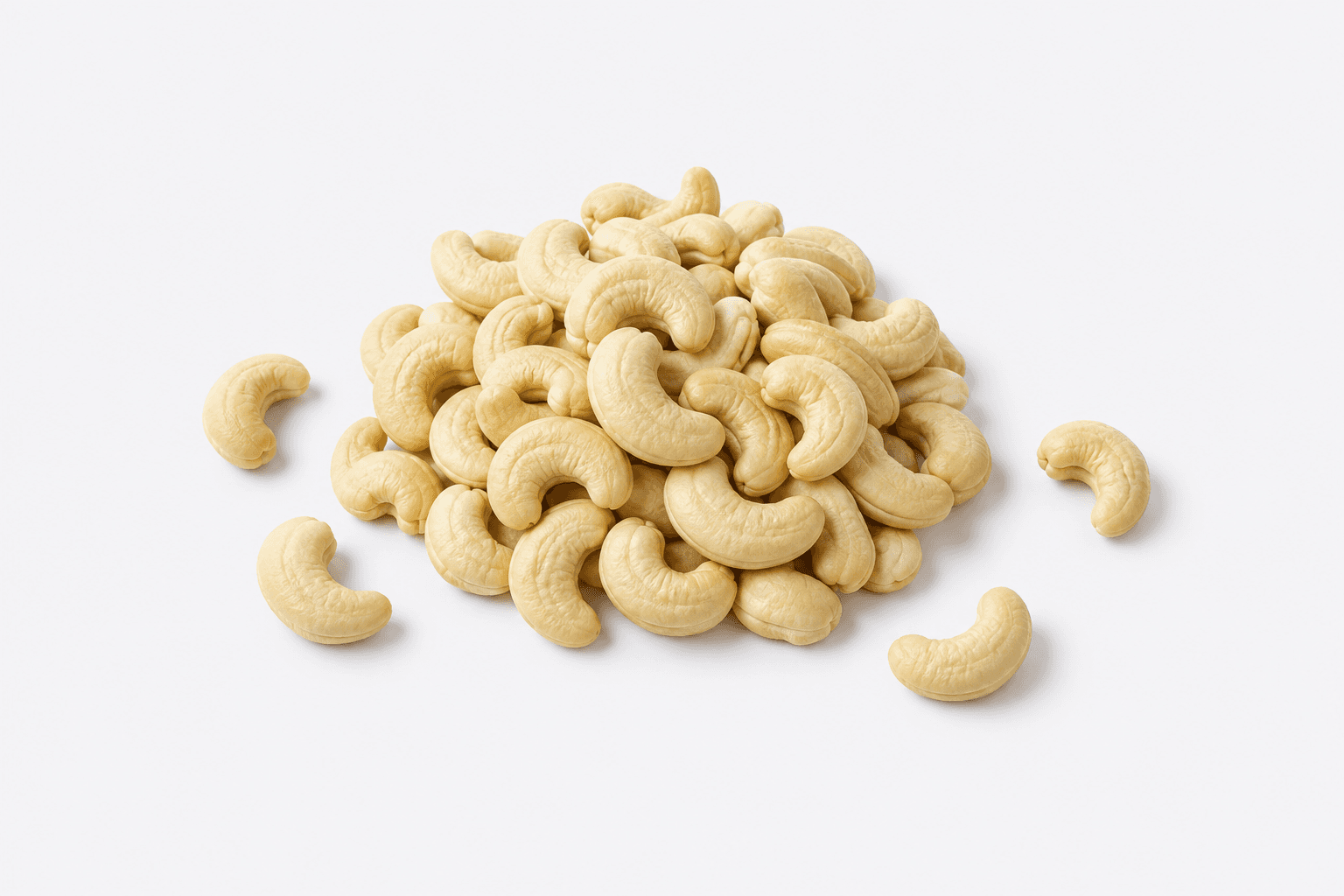
The cashew is the seed of a tree native to northeastern Brazil, and it grows in an unusual place — hanging kidney-shaped from the end of a swollen apple-like false fruit, outside it rather than within. Its shell contains a caustic oil related to the one in poison ivy, so it has to be heated before the kernel can be freed; that is why truly raw cashews are almost never sold and the nuts you buy have already been processed. They hold more starch than other nuts, which makes them less oily and softer in the mouth.
Scientific name Anacardium occidentale
Nuts usually sit in the "good for cholesterol" slot, and for walnuts, almonds and pistachios that broadly matches the evidence.
Cashews were different.
A 2020 meta-analysis in Complementary Therapies in Medicine pooled randomised controlled trials covering 392 participants. The results:
- Total cholesterol, LDL, HDL, triglycerides — no significant change
- Diastolic pressure — no significant change
- Systolic pressure — down 3.39 mmHg (95% CI −6.13 to −0.65, p=0.01, I²=0.0%)
That is the point of this page. Carrying "nuts are good for cholesterol" straight over to cashews gets it wrong.
There is a compositional difference that might explain it. Cashews carry more saturated fat than most nuts (7.78 g/100 g) and 30.2 g of carbohydrate, high for a nut. But that is an explanation, not proof.
The composition itself is excellent. Copper at 2.20 mg is more than twice the requirement, with 292 mg of magnesium and 5.78 mg of zinc.
Key benefits
- Moderate evidence
Lipids unchanged, systolic pressure down 3.39 mmHg — from 392 people
[1]2020, Complementary Therapies in Medicine. The authors searched PubMed, Embase, Scopus, Web of Science and the Cochrane Library to 15 November 2019 for randomised controlled trials of cashew intake, pooling weighted mean differences under a random-effects model.
392 participants.
Results:
- Lipid indices (total cholesterol, LDL, HDL, triglycerides) — no significant effect
- Diastolic pressure — no significant effect
- Systolic pressure — WMD −3.39 mmHg (95% CI −6.13 to −0.65, p=0.01)
The blood-pressure finding is solid in several respects:
- I² = 0.0% — no heterogeneity between studies. The included trials agreed with each other in direction and size
- No significant publication bias (Egger's test)
- Sensitivity analysis: dropping any single study kept the result significant
What is −3.39 mmHg? The interval runs from −6.13 to −0.65. So it could be as much as 6 mmHg, or as little as 0.65. Less than a blood-pressure tablet, but not a negligible figure for a food.
Still, 392 people. Blood pressure is sensitive to measurement conditions, and 392 is not a number that settles a question. The authors wrote "might reduce" in their conclusion.
Why the null on lipids matters.
The evidence on nuts in general is fairly good, which builds an automatic link from "nuts" to "cholesterol". But treating nuts as one block erases the differences between them.
- Walnuts are high in alpha-linolenic acid, a plant omega-3
- Almonds carry most of their fat as monounsaturated
- Cashews carry relatively more saturated fat and more carbohydrate
Sharing a supermarket aisle does not make them the same food. The reason to eat cashews is not cholesterol — it is the copper and magnesium, and the blood pressure.
- Nutrition data
2.20 mg of copper — 244% of the requirement, and what a handful really gives
Per 100 g of raw cashews:
- 553 kcal, protein 18.2 g, fat 43.8 g
- Of 30.2 g of carbohydrate, 3.3 g is fibre
- Copper 2.20 mg — 244% of the requirement (0.9 mg)
- Magnesium 292 mg — 70% of the requirement
- Zinc 5.78 mg, iron 6.68 mg, phosphorus 593 mg
- Thiamin 0.423 mg, selenium 19.9 µg
- Saturated fat 7.78 g
Copper is what defines this nut. 2.20 mg is very high even among nuts. Copper is involved in iron metabolism, connective tissue and nerve function, and deficiency is rare but real.
But nobody eats 100 g. Converted to a 30 g handful (about 18 nuts):
100 g 30 g (a handful) Energy 553 kcal 166 kcal Fat 43.8 g 13.1 g Copper 2.20 mg 0.66 mg (73% of the requirement) Magnesium 292 mg 88 mg Zinc 5.78 mg 1.73 mg Iron 6.68 mg 2.0 mg Protein 18.2 g 5.5 g Even a handful delivers 73% of the copper requirement — impressive for what one handful of anything provides.
The 166 kcal belongs in the same view. A handful is close to half a bowl of rice. Added on top of everything else rather than in place of something, it raises your intake.
30.2 g of carbohydrate is high for a nut — more than almonds (21.6 g) or walnuts (13.7 g). It is part of why cashews taste softer and sweeter.
The 6.68 mg of iron is non-haem, so absorption is low. Eat them alongside something with vitamin C.
"Raw" cashews are not truly raw. The cashew shell carries irritant compounds typical of its plant family (anacardic acids), so even cashews sold as "raw" have been heat-treated during shelling. Genuinely unprocessed cashews do not reach the market.
- Not established
"Nuts are good for cholesterol" — that does not transfer to cashews
[1]This entry sorts through a common generalisation.
The most widespread sentence about nuts is "nuts lower cholesterol", and it is not baseless: analyses pooling several nuts do show LDL falling.
But as shown above, looked at on their own, cashews did not move lipids.
Three points follow.
First, a pooled analysis is not an answer about an individual food. Bundled as "nuts", the ones with clear effects — walnuts, almonds — pull the average up and the ones without get buried inside it. The analysis that named cashews returned "no effect".
Second, "showed no effect" is not "has no effect". 392 is a small number, and a larger trial could still surface a small effect. But on the evidence that exists, it cannot be written that cashews lower cholesterol.
Third, none of this makes cashews a poor food. Systolic pressure fell, and the copper, magnesium and zinc are substantial. But if cholesterol is the goal, walnuts or almonds sit closer to the evidence.
And one thing about what is on the shelf. Most retail cashews are roasted with salt, or coated with honey or butter. That is not what the trials used. Expecting a blood-pressure benefit from salted cashews does not add up — the sodium comes with them.
The honest summary: cashews are a good food. The reason just is not cholesterol.
How to eat it well
- A handful — 30 g, about 18 nuts — is the reference. That is 166 kcal.
- Choose unsalted and unsweetened. Eating salted cashews for blood pressure is self-defeating.
- Put them in place of something, not on top of it. Added to existing snacks they only add calories.
- If cholesterol is the goal, walnuts or almonds are closer to the evidence.
- For the iron, eat them with vitamin C. Non-haem iron absorbs poorly.
- Store them sealed and cool. At 43.8 g of fat they go rancid quickly; refrigerate or freeze for longer keeping.
- Toasting wakes up the aroma. Three or four minutes in a dry pan over low heat is enough.
- Blended they turn creamy. Soaked and blended, they make a sauce without dairy.
How to read the grades
Each benefit carries a label showing how far research on people supports it. Grades differ between items even within the same ingredient.
- Nutrition data
- A fact verifiable from food composition databases or health authorities. This is a different kind of statement from a clinical effect.
- Strong evidence
- Consistently confirmed across randomised controlled trials or meta-analyses.
- Moderate evidence
- Human studies exist, but effect sizes are small or results are mixed.
- Early research
- Cell or animal work, or small preliminary studies.
- Not established
- Commonly claimed, but not confirmed in studies on people.
What to watch out for
- No lipid benefit was established. The meta-analysis found no significant change in total cholesterol, LDL, HDL or triglycerides.
- The blood-pressure result comes from 392 participants, and the authors wrote "might reduce". It does not replace medication.
- Nut allergy can cause severe reactions, and cashew is among the nuts with reports of serious reactions.
- 553 kcal per 100 g. A 30 g handful is 166 kcal, which adds up fast when eaten absent-mindedly.
- Most retail products have added salt, sugar or oil and differ from the table above.
- Cashew shells carry irritant compounds typical of their plant family, which is why genuinely raw cashews are not sold. Do not try to shell foraged ones yourself.
- If you restrict phosphorus or potassium for kidney disease, phosphorus is 593 mg per 100 g.
- If you take a copper supplement, watch the total. The adult upper limit is 10 mg a day.
Nutrition
Per 100 g of raw cashews. A handful is about 30 g (roughly 18 nuts), so a real serving is under a third of the figures below.
- Calories
- 553 kcal28%
- Protein
- 18.2 g36%
- Fat
- 43.8 g56%
- Carbohydrates
- 30.2 g11%
- Fiber
- 3.3 g12%
- Copper
- 2.20 mg244%
- Magnesium
- 292 mg70%
- Zinc
- 5.78 mg53%
- Iron
- 6.68 mg37%
- Phosphorus
- 593 mg47%
- Vitamin B1
- 0.423 mg35%
- Selenium
- 19.9 µg36%
Percentages are of the US FDA Daily Value for adults and children 4 and over. National reference intakes differ by sex and age.
Calculate this alongside other ingredients →
Key nutrients
By health concern
Dishes with this ingredient
Sources
The databases and health authorities this article's nutrition figures and health statements draw on.
- 1The effects of cashew nut intake on lipid profile and blood pressure: A systematic review and meta-analysis of randomized controlled trialsMeta-analysisJalali M, Karamizadeh M, Ferns GA, Zare M, Moosavian SP, Akbarzadeh M Complementary Therapies in Medicine 2020PMID 32444052
- 2USDA FoodData CentralFood composition database
- 3PubMedResearch literature
- 4NIH Office of Dietary SupplementsHealth authority