Contents
What it is
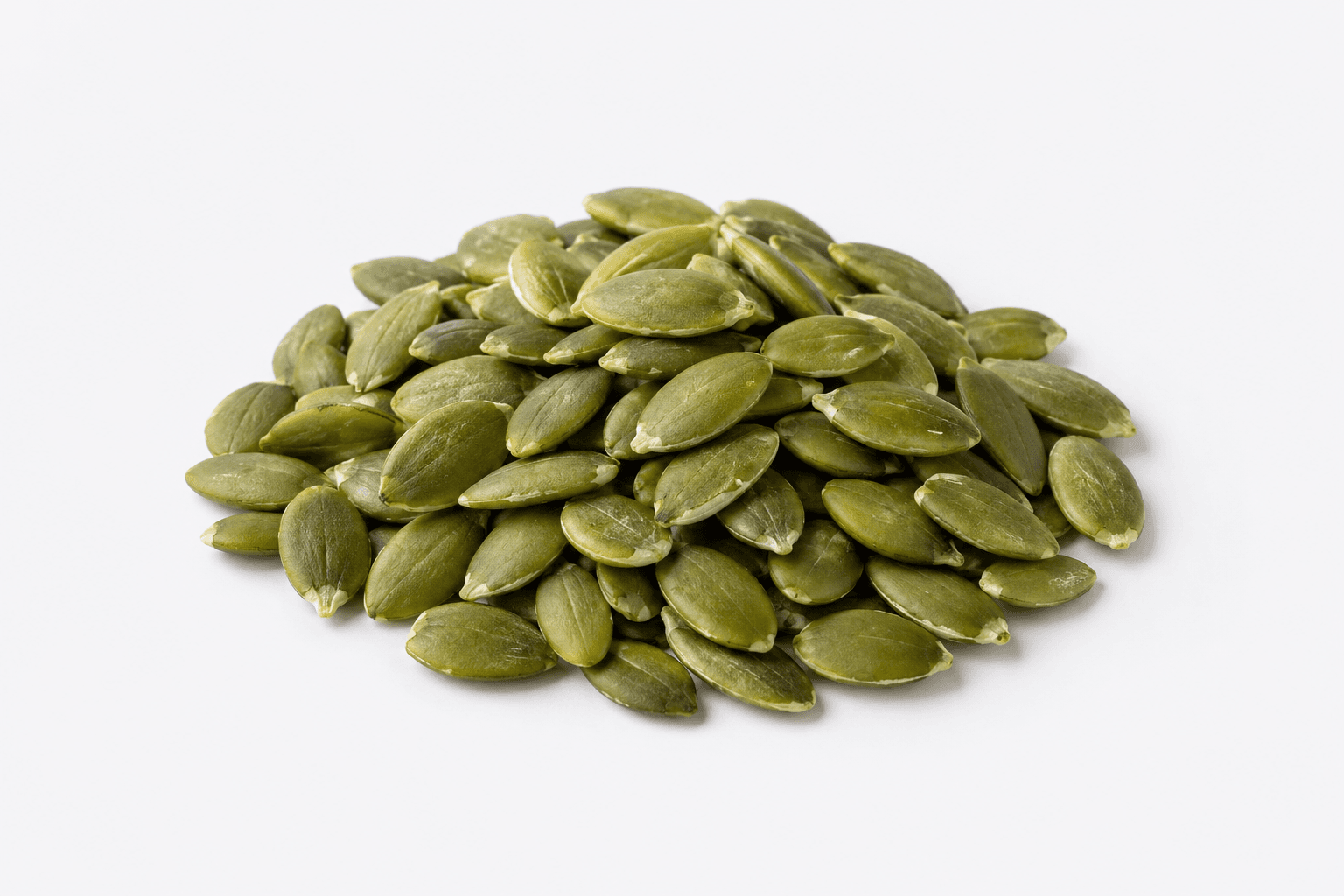
Pumpkin seeds are the seeds from inside a pumpkin or squash. Usually what is eaten is the green kernel with the white husk removed, though they are also roasted in the shell. Most of the green seeds sold in shops come from dedicated hull-less varieties rather than from the seeds you scoop out of a courgette or kabocha. They originate in Central and South America. They are high in fat and protein and concentrate magnesium and zinc, which is why they appear so often near the top of the rankings on this site. They go rancid quickly, so keep them cool.
Scientific name Cucurbita
Pumpkin seeds get treated as a holiday-table nut that disappears again by January. The composition table tells a different story.
550 mg of magnesium. Higher than any other ingredient on this site — twice an almond's 270 mg or a cashew's 292 mg. Adult requirements run 350–400 mg for men and 280–310 mg for women, so 100 g clears the daily target easily.
But 100 g is 574 kcal. The realistic portion is a handful, 20–30 g, which brings 110–165 mg — around a third of the requirement. That alone is worth having.
Key benefits
- Nutrition data
550 mg of magnesium — top of the nut-and-seed table
Roasted hulled pumpkin seeds carry 550 mg of magnesium per 100 g. A 30 g handful is 165 mg, 40–55 % of an adult's daily requirement.
Magnesium is a cofactor in over 300 enzyme reactions and sits in muscle and nerve excitability, bone structure and glucose handling. It is among the minerals most often short in a Western diet.
Alongside it: 7.6 mg of zinc (most of the 8–11 mg requirement), 8.1 mg of iron and 1,170 mg of phosphorus. A seed is an organ for storing the minerals a sprout will need, which is where the density comes from.
That iron is non-haem and sits next to phytate, so real absorption falls short of the figure.
- Moderate evidence
Magnesium and blood pressure — but only when it is already high
[1]A 2025 meta-analysis of 38 randomised controlled trials (2,709 people). Magnesium supplementation (median 365 mg a day, median 12 weeks) lowered systolic pressure by 2.81 mmHg (95 % CI −4.32 to −1.29) and diastolic by 2.05 mmHg.
The split is what matters. In hypertensive people already on blood-pressure medication, systolic fell 7.68 mmHg; in those with low blood magnesium, 5.97 mmHg. In normotensive groups the effect did not reach significance.
Heterogeneity was high, and no dose–response relationship appeared (all P ≥ 0.20).
And these trials used supplements, not pumpkin seeds. There is no direct evidence that meeting magnesium from food produces the same effect. If your blood pressure is normal, blood pressure is not a reason to eat them.
- Early research
Prostate symptoms — one oil trial, weaker than the drug
[2]Pumpkin seeds have long carried a prostate reputation. The human evidence turns out to be small.
A 2021 single-blind randomised trial in Iran enrolled 73 men aged 50 and over with benign prostatic hyperplasia, split into tamsulosin 0.4 mg nightly (34) and pumpkin seed oil 360 mg twice daily (39).
At three months both groups improved significantly on the International Prostate Symptom Score and on quality of life. But the improvement was significantly larger with tamsulosin (P = 0.048 at one month, P = 0.020 at three).
No side effects were reported in the pumpkin group, while the tamsulosin group had dizziness (5.9 %), headache (2.9 %) and retrograde ejaculation (2.9 %).
In short: what was tested was pumpkin seed oil at 720 mg a day, single-blind, in 73 men, and it worked less well than the drug. This is not evidence for replacing medication.
How to eat it well
- A handful (20–30 g) is the realistic portion — 110–165 mg of magnesium, 115–172 kcal.
- Toasting brings out the flavour; do not take it far. They are fatty and go rancid easily. Low heat, short time.
- Scattering them over salad, yoghurt or porridge is the easiest route. Sprinkled beats set-aside for staying power.
- If you are after the iron, pair it with vitamin C. Non-haem iron absorbs poorly alone.
- Keep them sealed in the fridge or freezer. Left out at room temperature they start to smell of oil.
How to read the grades
Each benefit carries a label showing how far research on people supports it. Grades differ between items even within the same ingredient.
- Nutrition data
- A fact verifiable from food composition databases or health authorities. This is a different kind of statement from a clinical effect.
- Strong evidence
- Consistently confirmed across randomised controlled trials or meta-analyses.
- Moderate evidence
- Human studies exist, but effect sizes are small or results are mixed.
- Early research
- Cell or animal work, or small preliminary studies.
- Not established
- Commonly claimed, but not confirmed in studies on people.
What to watch out for
- They are calorie-dense — 574 kcal per 100 g. Past a sprinkle, an emptied bag is a meal's worth of energy.
- Phosphorus is very high at 1,170 mg. That matters on a phosphorus-restricted renal diet.
- Phytate blocks part of the iron and zinc. You do not absorb everything the table lists.
- Salted or sugar-coated versions are a different food. The figures above are unsalted.
- See a doctor about prostate symptoms first. Urinary symptoms have several causes besides hyperplasia, and there is no reason to lose time to seeds.
- Adverts claim hair-growth effects. I could not find reliable human evidence for that.
Nutrition
Approximate values per 100 g edible portion.
- Calories
- 574 kcal29%
- Protein
- 29.8 g60%
- Fat
- 49.0 g63%
- Carbohydrates
- 14.7 g5%
- Fiber
- 6.5 g23%
- Magnesium
- 550 mg131%
- Zinc
- 7.6 mg69%
- Iron
- 8.1 mg45%
- Phosphorus
- 1170 mg94%
- Potassium
- 788 mg17%
- Manganese
- 4.5 mg196%
Percentages are of the US FDA Daily Value for adults and children 4 and over. National reference intakes differ by sex and age.
Calculate this alongside other ingredients →
Key nutrients
By health concern
Dishes with this ingredient
Sources
The databases and health authorities this article's nutrition figures and health statements draw on.
- 1Magnesium Supplementation and Blood Pressure: A Systematic Review and Meta-Analysis of Randomized Controlled TrialsMeta-analysisArgeros Z, et al. Hypertension 2025PMID 41000008
- 2Pumpkin seed oil (Cucurbita pepo) versus tamsulosin for benign prostatic hyperplasia symptom relief: a single-blind randomized clinical trialClinical trialZerafatjou N, et al. BMC Urol 2021PMID 34666728
- 3USDA FoodData CentralFood composition database
- 4NIH Office of Dietary SupplementsHealth authority
- 5PubMedResearch literature