Contents
What it is
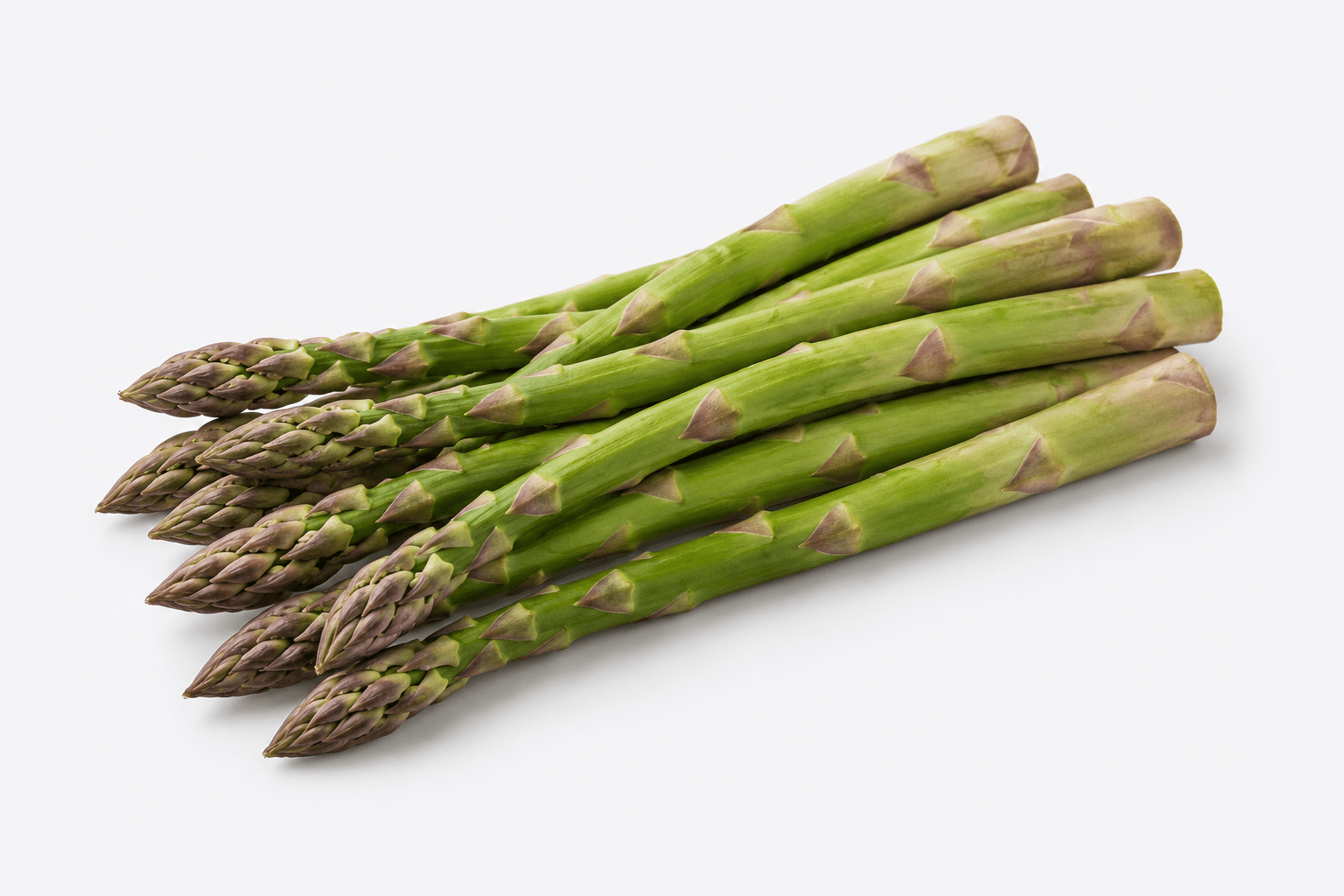
Asparagus is the young shoot of a perennial plant. In spring the shoots push up from the underground crown, and those are what is cut and eaten. The plant is native to Europe and western Asia. Spears grown in daylight are green; those mounded with soil to keep the light out are white — the same plant, grown differently. The base is woody, so it is snapped off where it breaks naturally or peeled away. Asparagus is blanched or grilled, and overcooking collapses both aroma and texture fast.
Scientific name Asparagus officinalis
Asparagus is 20 kcal per 100 g, carrying 52 µg of folate (13% of the requirement) and 41.6 µg of vitamin K (35%).
But this vegetable is famous for something else — the distinctive smell in urine afterwards.
And people divide into those who smell it and those who do not.
In 2016, the BMJ analysed the genomes of 6,909 people. Anyone who strongly agreed with "after eating asparagus, you notice a strong characteristic odor in your urine" was a smeller; everyone else was anosmic.
- 58.0% of men (1,449 of 2,500)
- 61.5% of women (2,712 of 4,409)
More than half cannot smell it. And it is not a matter of attention — it is the olfactory receptor genes.
Key benefits
- Nutrition data
Folate and vitamin K inside 20 kcal
Per 100 g of raw asparagus, against adult daily requirements:
- Vitamin K 41.6 µg — 35%
- Folate 52 µg — 13%
- Vitamin E 1.13 mg — 8%
- Thiamine 0.143 mg — 12%, riboflavin 0.141 mg — 11%
- Fibre 2.1 g, protein 2.2 g, potassium 202 mg
- Beta-carotene 449 µg, copper 0.189 mg
That it is 20 kcal is the premise of this table. A full 100 g is a fifth of half an apple.
1.13 mg of vitamin E is high for a vegetable. Vitamin E usually comes from oils and nuts, not from vegetables. Spinach is higher at 2.03 mg; broccoli lower at 0.78 mg.
Iron at 2.14 mg is also high for a vegetable — but it is non-haem, absorbed at 2–10%. Vitamin C in the same meal raises that.
Green and white are the same plant. White asparagus is grown banked with soil to keep the light off. No chlorophyll forms, and nor do some of the compounds that form alongside it. The table above is for green.
The compounds concentrate towards the tip. The lower stem is fibrous and the vitamins sit higher up, near the bud. Trimming the base is about texture, not about discarding nutrition.
- Moderate evidence
60% cannot smell it — the genes decided
[1]A 2016 genome-wide association study in the BMJ, drawing on the Nurses' Health Study and Health Professionals Follow-up Study cohorts: 6,909 people of European-American descent with genome-wide data.
First the proportions.
- 58.0% of men (1,449 of 2,500) were anosmic
- 61.5% of women (2,712 of 4,409) were anosmic
Then the genetics. Around nine million single nucleotide polymorphisms were tested, and 871 reached genome-wide significance (P < 5×10⁻⁸).
All 871 sat in one place — a region on chromosome 1, 1q44 (248,139,851–248,595,299), containing multiple genes of the olfactory receptor 2 (OR2) family.
Conditional analysis narrowed it to three independent markers: rs13373863, rs71538191 and rs6689553.
What this result says has to be read precisely.
What the study measured is the ability to smell. Participants were sorted by one self-reported statement. It did not measure whether the odorous metabolites appear in the urine.
So "anosmic" is a fact about the nose — most people do produce the compounds (sulphur compounds from the breakdown of asparagusic acid), and more than half of us lack the receptor to detect them.
This is also one population. Only European-American participants were analysed. Whether the proportions hold in other ancestry groups is not something this study answers.
The authors' conclusion is plain: a large proportion of people have asparagus anosmia, and genetic variation near multiple olfactory receptor genes is associated with the ability to smell asparagus metabolites in urine.
- Not established
The hangover and diuretic claims are not established
Two claims attach to asparagus regularly.
"Good for a hangover." A widely cited cell study reported that asparagus extract affects alcohol-metabolising enzymes in liver cells. There is no randomised trial measuring hangover symptoms in people. What happens in a dish of cells and what happens the morning after are different questions.
"It is a diuretic." It has been used traditionally as one, and the amino acid asparagine is offered as the explanation. Controlled trials measuring urine output in people are hard to find.
The purine content is genuinely moderate. Asparagus turns up regularly in gout advice. But as data accumulate that plant purines do not raise urate the way animal purines do, recent guidance treats vegetable purines less strictly than it used to.
So: the reasons to eat asparagus are the taste, and the vitamin K and folate packed into 20 kcal. Hangovers and diuresis are unestablished territory.
And in Europe it is a spring vegetable. In season, thick and firm, it is far better. That claim needs no evidence.
How to eat it well
- Snap the base off by hand. It breaks naturally at the line between woody and tender. Cutting with a knife tells you nothing about where that line is.
- Peel the lower third of thick spears. A vegetable peeler over the bottom third transforms the texture.
- High heat, short time. Two to three minutes blanched, three to four grilled. The moment the colour turns vivid green, it is done.
- Eat it with fat. Vitamin K, vitamin E and beta-carotene are all fat-soluble. Roasting in olive oil suits it.
- Vitamin C alongside raises iron absorption — squeeze lemon over it.
- Steaming or roasting beats boiling. Folate and vitamin C leach into the water.
- Store it standing up. Trim the base and stand the spears in a little water in the fridge and they keep for days longer.
How to read the grades
Each benefit carries a label showing how far research on people supports it. Grades differ between items even within the same ingredient.
- Nutrition data
- A fact verifiable from food composition databases or health authorities. This is a different kind of statement from a clinical effect.
- Strong evidence
- Consistently confirmed across randomised controlled trials or meta-analyses.
- Moderate evidence
- Human studies exist, but effect sizes are small or results are mixed.
- Early research
- Cell or animal work, or small preliminary studies.
- Not established
- Commonly claimed, but not confirmed in studies on people.
What to watch out for
- On warfarin, note 41.6 µg of vitamin K per 100 g. You do not have to avoid it, but keep your intake steady.
- With gout, the purine content is moderate — though the effect of plant purines is smaller than that of animal purines.
- With IBS, asparagus is high-FODMAP. Its fructans can cause bloating.
- If you restrict potassium for kidney disease, 100 g holds 202 mg.
- The urine smell is normal. It is not a sign that anything is wrong. Not smelling it is also normal — more than half of us do not.
- The hangover and diuretic claims have not been confirmed in human trials.
Nutrition
Per 100 g of raw asparagus — about five thick spears.
- Calories
- 20 kcal1%
- Folate
- 52 µg13%
- Vitamin K
- 41.6 µg35%
- Vitamin E
- 1.13 mg8%
- Fiber
- 2.1 g8%
- Protein
- 2.2 g4%
- Potassium
- 202 mg4%
- Iron
- 2.14 mg12%
- Beta-carotene
- 449 µg
- Vitamin B1
- 0.143 mg12%
- Copper
- 0.189 mg21%
Percentages are of the US FDA Daily Value for adults and children 4 and over. National reference intakes differ by sex and age.
Calculate this alongside other ingredients →
Key nutrients
Dishes with this ingredient
Sources
The databases and health authorities this article's nutrition figures and health statements draw on.
- 1Sniffing out significant "Pee values": genome wide association study of asparagus anosmiaResearch literatureMarkt SC, et al. BMJ 2016PMID 27965198
- 2USDA FoodData CentralFood composition database
- 3NIH Office of Dietary SupplementsHealth authority
- 4European Food Safety Authority (EFSA)Health authority
- 5PubMedResearch literature