Contents
What it is
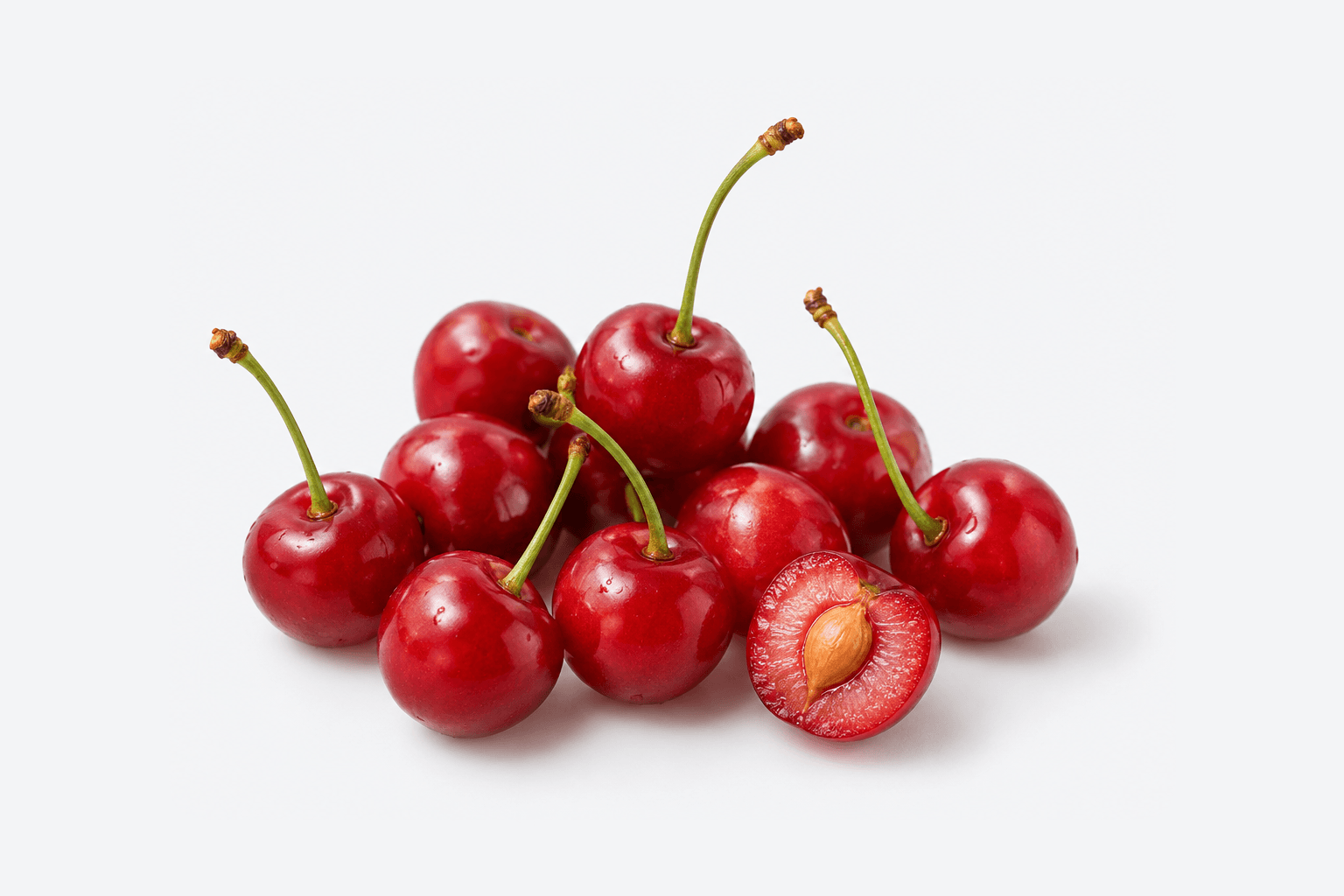
Tart cherry is the collective name for sour cherry varieties, a different species from the sweet cherries eaten fresh. It is native to Europe and western Asia. It is too sour for most people to eat raw, so almost all of it is dried, juiced, or baked into pies and jams — which is why English also calls it the pie cherry. Montmorency and Balaton are the best-known varieties. What separates it from other fruit is that it contains melatonin, and that is why the research on this ingredient clusters around sleep.
Scientific name Prunus cerasus
Tart cherry is sold as "natural melatonin". The evidence comes in two strands, pointing opposite ways.
The positive one — 2012, European Journal of Nutrition. Twenty healthy adults, randomised, double-blind, placebo-controlled crossover, juice concentrate for seven days. Urinary melatonin rose significantly, and time in bed, total sleep time and sleep efficiency all increased significantly.
The negative one — 2024, Nutrients. Thirty-four people with sleep problems and overweight or obesity, randomised crossover, 500 mg Montmorency tart cherry powder capsules for fourteen days, one hour before bed. The result is one sentence: "No significant effects of MTC supplementation were observed for any of the measures of interest (p > 0.05 for all)."
The difference between them is form and dose. Juice concentrate in one; a 500-milligram capsule in the other. The authors of the null trial say so themselves: studies in overweight and obese people should test higher doses than those currently recommended.
Neither one settles this.
Key benefits
- Early research
Juice concentrate, seven days: total sleep time and efficiency rose
[1]2012, European Journal of Nutrition. Randomised, double-blind, placebo-controlled crossover trial in 20 healthy adults.
Participants took tart cherry juice concentrate or placebo for seven days, with sleep measured by actigraphy (wrist movement) and subjective questionnaires, and urine collected over 48 hours to measure melatonin's main metabolite, 6-sulfatoxymelatonin.
The results:
- Total melatonin content rose significantly (P < 0.05), with no difference between baseline and placebo.
- Time in bed, total sleep time and sleep efficiency all increased significantly (P < 0.05).
- The timing of the melatonin rhythm did not change. Only a trend toward a higher mean level and amplitude.
The strength of this design is the actigraphy. It was not only a self-report questionnaire; the wrist-measured numbers moved too.
Its weakness is the number 20. And the participants were healthy adults, so whether any of it applies to people with insomnia is not something this trial answers.
The proposed mechanism is melatonin. Tart cherries contain it, and the trial reads its result as melatonin supplied from outside. But think about the amount — the melatonin in cherries is nowhere near the 1–5 mg tablets sold as sleep supplements. Drinking a concentrate is an attempt to close that gap.
- Moderate evidence
A 500 mg capsule, fourteen days: nothing changed
[2]This entry records an absence, not a benefit.
2024, Nutrients. A randomised controlled crossover trial in 34 people with sleep problems and overweight or obesity (BMI 32.1 ± 7.0). 500 mg Montmorency tart cherry powder capsules or placebo, one hour before bed for 14 days.
They measured a great deal.
- Objective sleep — total sleep time, deep and REM duration, nap duration and nocturnal sleep duration, by Zmachine and Fitbit Inspire 3
- Subjective sleep — Pittsburgh Sleep Quality Index, Sleep Quality Scale, Insomnia Severity Index
- Inflammation — CRP, TNF-α, IL-6, IL-8, IL-10, IL-17A
The result is one line: "No significant effects of MTC supplementation were observed for any of the measures of interest (p > 0.05 for all)."
Not the objective sleep, not the subjective sleep, not the inflammatory markers.
The authors' conclusion matters here — studies in individuals with overweight and obesity should test higher doses of tart cherry than those currently recommended.
So this trial shows "not at this dose", not "tart cherry does not work". A 500 mg powder capsule and a glass of juice concentrate do not deliver the same amount.
The honest tally:
- 20 people · juice concentrate · 7 days · healthy adults → improved
- 34 people · 500 mg capsule · 14 days · overweight/obese → nothing changed
Both small, different populations, different products. That is the state of the evidence.
- Nutrition data
The composition is ordinary — with twenty times the beta-carotene of sweet cherries
Per 100 g of raw tart cherries:
- 50 kcal, sugar 8.49 g, fibre 1.6 g
- Beta-carotene 770 µg, vitamin A 64 µg
- Vitamin C 10.0 mg — 11% of the requirement
- Potassium 173 mg, copper 0.104 mg, manganese 0.112 mg, magnesium 9 mg
Beta-carotene is where they part from sweet cherries. 770 µg against 38 µg — twenty times. The colour of the flesh is the difference.
Sugar at 8.49 g is lower than sweet cherries' 12.8 g. The name is accurate.
Juice and fruit are not the same. The concentrate used in trials is cherries boiled down several-fold, and the sugar concentrates with it. A cup (240 ml) of shop tart cherry juice routinely exceeds 30 g of sugar — about a can of soft drink.
Anthocyanins are the pigment here. There are also several trials on muscle soreness after exercise, but the results split and most enrol 20–30 people. Like the two trials on this page, it is a literature where positive and null sit side by side.
Gout claims circulate too. Observational studies link cherries to lower urate, but randomised evidence on gout flares is thin.
How to eat it well
- Fresh is best in season — June to August. Outside that, frozen, then dried, then juice.
- If you choose juice, check for unsweetened 100%. Many reconstituted products have sugar added.
- The positive trial's condition was juice concentrate for seven days, taken once or twice daily diluted in water.
- One hour before bed is the timing both trials used.
- Dried tart cherries concentrate the sugar, and are usually sweetened before drying. Read the label.
- Frozen loses little. Frozen at harvest can beat fresh fruit that has spent days in transit.
- Before raising the dose because nothing happened, look at your sleep habits — the evidence there is far stronger.
How to read the grades
Each benefit carries a label showing how far research on people supports it. Grades differ between items even within the same ingredient.
- Nutrition data
- A fact verifiable from food composition databases or health authorities. This is a different kind of statement from a clinical effect.
- Strong evidence
- Consistently confirmed across randomised controlled trials or meta-analyses.
- Moderate evidence
- Human studies exist, but effect sizes are small or results are mixed.
- Early research
- Cell or animal work, or small preliminary studies.
- Not established
- Commonly claimed, but not confirmed in studies on people.
What to watch out for
- It does not replace insomnia treatment. One of the two trials above found no change on any sleep measure.
- Count the sugar in juice. A cup of shop tart cherry juice often passes 30 g. With diabetes, use fresh or frozen fruit.
- If you restrict potassium for kidney disease, 100 g holds 173 mg.
- On sleeping pills or sedatives, check with your clinician about overlapping melatonergic effects.
- With IBS, cherries are high-FODMAP. The sorbitol can cause gas and diarrhoea.
- Supplement doses vary by trial. A 500 mg capsule cannot be expected to reproduce the positive result above — the trial that failed used exactly that dose, and it is on this page.
- Claims about muscle soreness and gout are not established.
Nutrition
Per 100 g of raw tart (sour) cherries — a handful, about 20–25 cherries. The trials mostly used juice concentrate or powder.
- Calories
- 50 kcal3%
- Carbohydrates
- 12.2 g4%
- Sugars
- 8.49 g
- Fiber
- 1.6 g6%
- Vitamin C
- 10.0 mg11%
- Potassium
- 173 mg4%
- Beta-carotene
- 770 µg
- Vitamin A
- 64 µg7%
- Copper
- 0.104 mg12%
- Manganese
- 0.112 mg5%
- Magnesium
- 9 mg2%
Percentages are of the US FDA Daily Value for adults and children 4 and over. National reference intakes differ by sex and age.
Calculate this alongside other ingredients →
Key nutrients
By health concern
Sources
The databases and health authorities this article's nutrition figures and health statements draw on.
- 1Effect of tart cherry juice (Prunus cerasus) on melatonin levels and enhanced sleep qualityClinical trialHowatson G, et al. Eur J Nutr 2012PMID 22038497
- 2Commonly Used Dose of Montmorency Tart Cherry Powder Does Not Improve Sleep or Inflammation Outcomes in Individuals with Overweight or ObesityClinical trialTucker RM, et al. Nutrients 2024PMID 39683518
- 3USDA FoodData CentralFood composition database
- 4NIH Office of Dietary SupplementsHealth authority
- 5European Food Safety Authority (EFSA)Health authority
- 6PubMedResearch literature