Contents
What it is
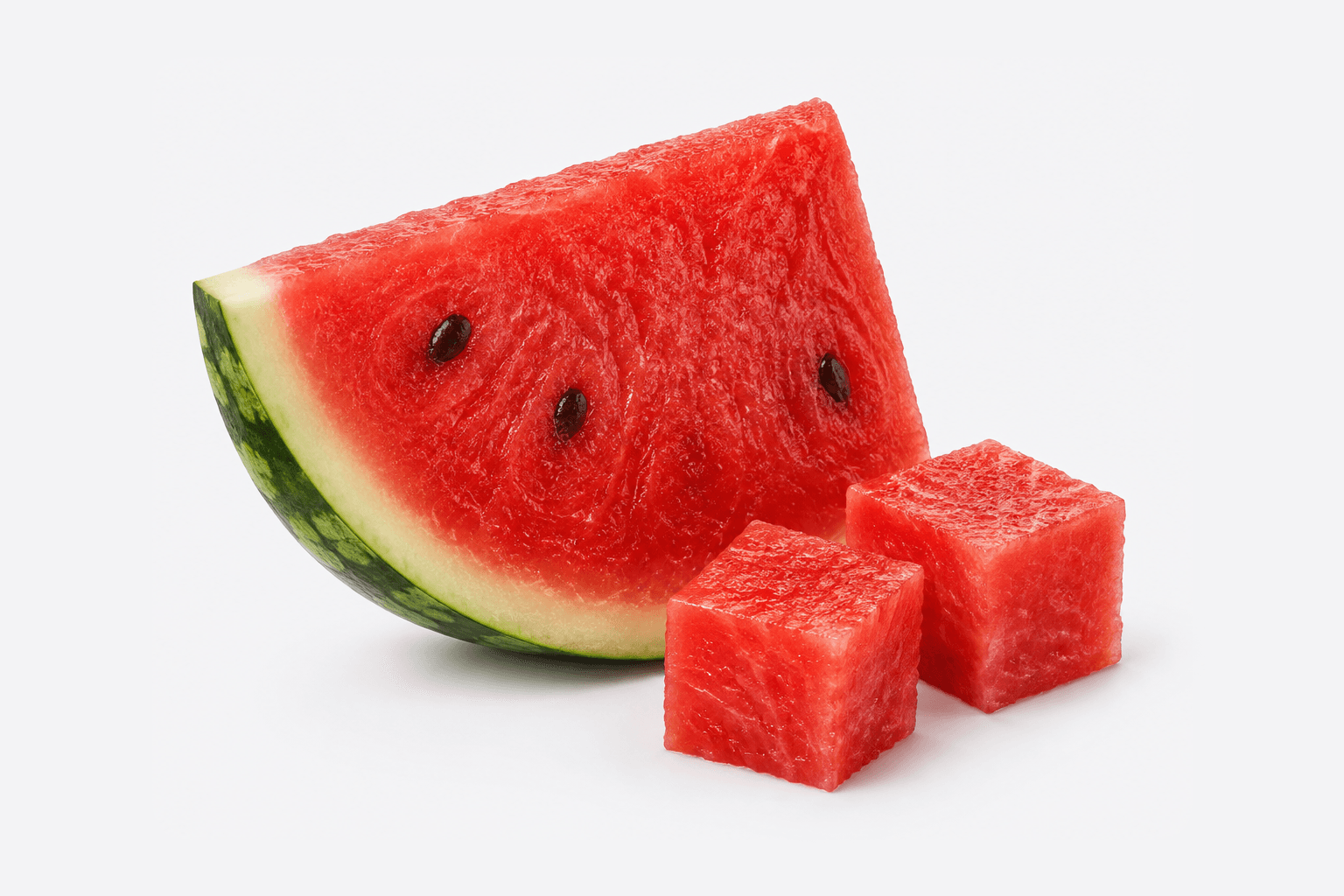
The watermelon is the fruit of a vine in the gourd family, a relative of cucumber, pumpkin and melon, native to Africa. More than 90 percent of its weight is water, and that fact defines it — it is not especially high in sugar, but people eat it in large volumes. The red is lycopene, the same pigment as in tomato, and the sweetest part is the centre, around the seeds. Cut melon spoils fast, so it is wrapped and refrigerated, while a whole one keeps longer somewhere cool. The white rind is edible too, pickled or stir-fried.
Scientific name Citrullus lanatus
Watermelon is 91.4% water, which makes it easy to write off as empty.
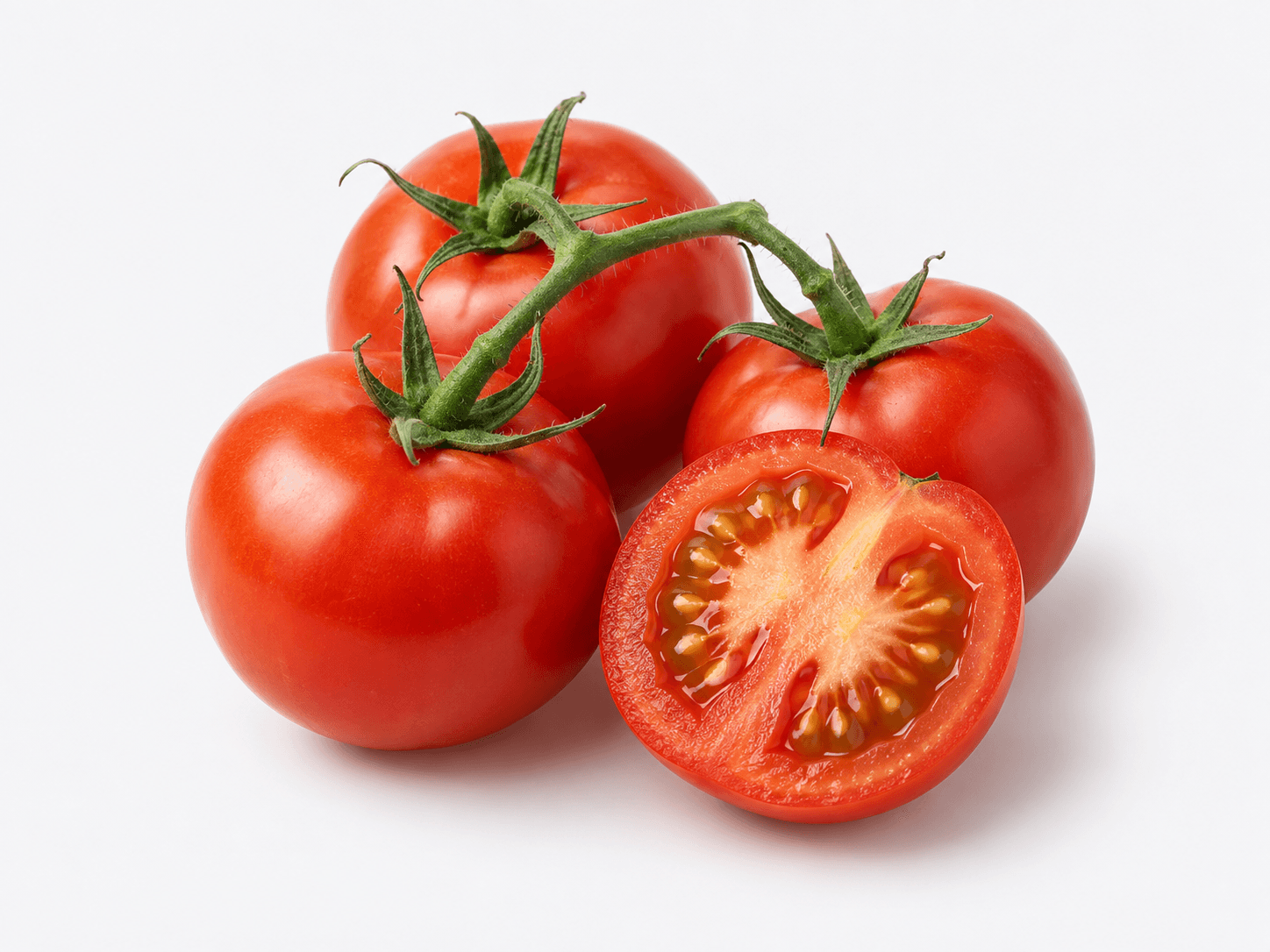
On one compound it is not. Per 100 g it carries 4,530 µg of lycopene — 1.8 times the raw tomato on this site (2,573 µg). That red flesh is what the number is.
There is a blood pressure analysis as well. In 2025, Clinical Nutrition ESPEN pooled 15 randomised controlled trials and 415 people and reported systolic −4.02 mmHg and diastolic −2.54 mmHg.
But that analysis is not about watermelon alone. Its title says "L-citrulline supplementation and watermelon intake". And the largest effect came from the subgroup taking citrulline together with arginine — systolic −10.44 mmHg. The authors write that the combination is "superior to L-citrulline or watermelon supplementation alone."
You cannot read that −4 mmHg as watermelon's work.
Key benefits
- Moderate evidence
Blood pressure fell — but not on watermelon's own account
[1]A 2025 systematic review and meta-analysis in Clinical Nutrition ESPEN, in middle-aged and older adults: 15 randomised controlled trials, 24 datasets, 415 participants.
- Systolic −4.02 mmHg (95% CI −6.54 to −1.50), P = 0.002
- Diastolic −2.54 mmHg (95% CI −4.27 to −0.81), P = 0.004
Stopping there, those are decent numbers — larger than hibiscus or cocoa on this site.
The subgroup analysis changes the story.
- With L-citrulline and L-arginine supplemented together — systolic −10.44 mmHg (−13.57 to −7.31), diastolic −4.86 mmHg
The authors' conclusion says it outright: the combination is superior to L-citrulline or watermelon supplementation alone.
So the large effect came from a supplement combination. The overall −4.02 mmHg has those trials mixed into it.
The scale matters too. Fifteen trials with 415 participants is an average of 28 each. And the population was middle-aged and older, so whether any of this applies to younger people is not something this analysis answers.
One more thing is worth knowing about this field. A 2019 meta-analysis of citrulline and blood pressure in the Journal of Human Hypertension was retracted. This site does not cite retracted papers. That such a retraction happened here is itself worth recording.
The mechanism is plausible enough. Watermelon contains citrulline, an amino acid the body converts to arginine, which makes nitric oxide, which widens blood vessels. But a plausible mechanism and eating watermelon lowering your blood pressure are two different claims.
- Nutrition data
More lycopene than a raw tomato
4,530 µg of lycopene per 100 g of watermelon.
Against USDA's figure for the same site's tomato:
- Watermelon 4,530 µg
- Raw tomato 2,573 µg
1.8 times. Lycopene is the carotenoid behind red flesh, and watermelon carries it at a higher concentration than tomato does.
Absorption is a separate matter. Lycopene is fat-soluble, so it absorbs better eaten with fat. And with tomato, heating is known to raise absorption — watermelon is eaten raw. The same 4,530 µg does not mean the same amount arrives.
What lycopene itself does is on this site's tomato page. There are studies of prostate cancer, the results split, and much of it is observational.
Per 100 g, also:
- Vitamin C 8.1 mg — 9% of the requirement
- Potassium 112 mg
- Beta-carotene 303 µg, vitamin A 28 µg
- Magnesium 10 mg
Vitamin C is on the low side for a fruit. Kiwi (93 mg), strawberry (59 mg) and orange (53 mg) are not comparable. Watermelon is not a vitamin C source.
Fibre is 0.4 g per 100 g — among the lowest of any fruit. Even 200 g gives 0.8 g, a sixth of one apple's 4.8 g.
- Nutrition data
91% water, and 6.2 g of sugar
91.4 of every 100 g is water. Energy is 30 kcal.
That is watermelon's practical use.
- It is one of the cheapest ways to answer a craving for something sweet. A 200 g wedge is 60 kcal, against a cup of ice cream at roughly 200 kcal or a soft drink at about 100.
- It contributes to hydration — which does not make it better than water, which is 0 kcal.
Sugar is 6.2 g per 100 g, low for a fruit. Banana is 12.2 g, grapes 15.5 g, apple 10.4 g.
Yet its glycaemic index is known to be high. The reason is simple: the sugar is dissolved in water and there is only 0.4 g of fibre, so it absorbs fast.
Here GI and GL have to be separated. Glycaemic index measures the speed for a fixed amount of carbohydrate; glycaemic load accounts for how much you actually eat. Watermelon is the textbook food with a high GI and a low GL, because 100 g holds only 7.55 g of carbohydrate.
With diabetes, fix the portion in advance. Watermelon is not a fruit that stops at one slice.
Potassium is 112 mg per 100 g, low for a fruit. But because people eat a lot at once, count it if you restrict potassium for kidney disease.
How to eat it well
- Serve it cold — though very cold mutes the sweetness, and you eat more.
- You do not have to spit out the seeds. Black seeds carry magnesium and protein. White ones are immature and harmless to chew.
- The white rind is edible. Citrulline is reported to be more concentrated there than in the red flesh. Shred it for a salad or stir-fry it.
- A pinch of salt brings the sweetness forward, though there is no reason to if you are cutting sodium.
- Cut watermelon keeps two to three days refrigerated. The wide cut surface grows bacteria easily. Wrap it and trim the face before eating.
- Deciding on 200–300 g at a time keeps the sugar between 12 and 19 g.
- Eating it with fat lifts lycopene absorption — which is why feta or nuts alongside works.
How to read the grades
Each benefit carries a label showing how far research on people supports it. Grades differ between items even within the same ingredient.
- Nutrition data
- A fact verifiable from food composition databases or health authorities. This is a different kind of statement from a clinical effect.
- Strong evidence
- Consistently confirmed across randomised controlled trials or meta-analyses.
- Moderate evidence
- Human studies exist, but effect sizes are small or results are mixed.
- Early research
- Cell or animal work, or small preliminary studies.
- Not established
- Commonly claimed, but not confirmed in studies on people.
What to watch out for
- It does not replace blood pressure medication. The −4 mmHg above includes citrulline supplement trials and is not watermelon's result on its own.
- If you restrict potassium for kidney disease, count it. 112 mg per 100 g, but people eat a lot at once.
- With diabetes, the glycaemic index is high. Decide the portion in advance.
- With IBS, watermelon is high-FODMAP. Its fructose can cause bloating and diarrhoea.
- Do not leave it cut for long. Bacteria grow on the cut face. Eat within two hours anything left at room temperature.
- Citrulline supplements are not watermelon. The large effect in the analysis above came from a supplement combination.
Nutrition
Per 100 g of raw watermelon. A thick wedge is usually around 200 g.
- Calories
- 30 kcal2%
- Carbohydrates
- 7.55 g3%
- Sugars
- 6.2 g
- Fiber
- 0.4 g1%
- Lycopene
- 4,530 µg
- Vitamin C
- 8.1 mg9%
- Potassium
- 112 mg2%
- Beta-carotene
- 303 µg
- Vitamin A
- 28 µg3%
- Magnesium
- 10 mg2%
Percentages are of the US FDA Daily Value for adults and children 4 and over. National reference intakes differ by sex and age.
Calculate this alongside other ingredients →
Key nutrients
By health concern
Dishes with this ingredient
Sources
The databases and health authorities this article's nutrition figures and health statements draw on.
- 1Does l-citrulline supplementation and watermelon intake reduce blood pressure in middle-aged and older adults? A systematic review and meta-analysis of randomized controlled trialsMeta-analysisLuo P, et al. Clin Nutr ESPEN 2025PMID 40789388
- 2USDA FoodData CentralFood composition database
- 3European Food Safety Authority (EFSA)Health authority
- 4NIH Office of Dietary SupplementsHealth authority
- 5PubMedResearch literature