Contents
What it is
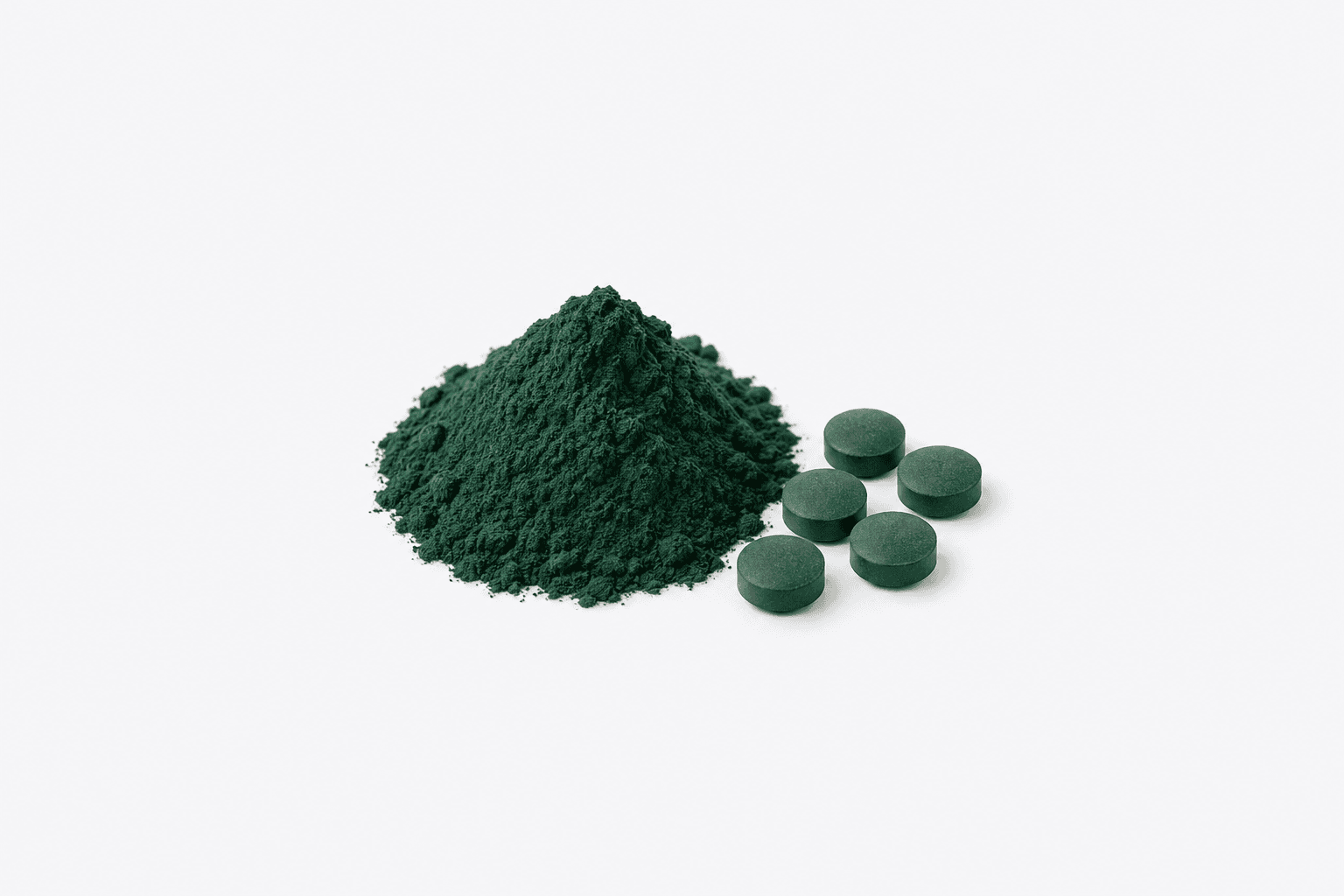
Spirulina is a cyanobacterium that grows in warm, strongly alkaline lakes. It is commonly called an alga, but strictly it belongs among the bacteria, and it photosynthesises. There are records of it being eaten around Lake Chad in Africa and Lake Texcoco in Mexico long before modern cultivation. The name comes from the spiral shape in which it grows. It is farmed, dried and sold as powder or tablets, blue-green in colour with a distinctive marine smell. Most people meet it as a supplement rather than as an ingredient.
Scientific name Arthrospira platensis
Spirulina is a cyanobacterium dried into powder or tablets. It is closer to a supplement than to a food.
Protein is 57.5 g per 100 g — higher than beef. That single number is what earned it the word "superfood".
But nobody eats 100 g. A serving is 3–5 g, which works out to 1.7–2.9 g of protein — about half an egg. The third entry on this page is about that division.
The clinical evidence is interesting. Two meta-analyses appeared in 2025, and they answer the same question very differently.
- One found only diastolic blood pressure −0.42 mmHg significant, with lipids unmoved. The authors wrote that the effect is "small and of uncertain clinical significance"
- The other pooled 35 trials and found almost everything significant: total cholesterol −11.5 mg/dL, systolic pressure −3.85 mmHg, weight −1.78 kg
Both are 2025 meta-analyses of randomised trials. Why they differ, and what to make of it, is below.
And one thing must be flagged — USDA lists spirulina's vitamin B12 as 0 µg.
Key benefits
- Early research
Two meta-analyses, one year: diastolic pressure −0.42 versus −3.09
[1][2]First, 2025, Nutrients. A meta-analysis of randomised trials covering both chlorella and spirulina. Depending on the outcome, the spirulina arm held 101 to 299 participants.
- Diastolic blood pressure −0.42 mmHg (95% CI −0.81 to −0.02, p=0.04)
- Lipid indices were not significant. Total cholesterol was −0.17 (95% CI −0.39 to 0.06, p=0.15) — a trend only
- Chlorella was neutral on both blood pressure and lipids
The authors' conclusion: it can serve as an adjuvant, but "the magnitude of this effect is small and of uncertain clinical significance" and "further randomised trials are needed".
It helps to picture −0.42 mmHg. One tick on a sphygmomanometer is 2 mmHg. This is a quarter of one tick — smaller than measurement error.
Second, 2025, Complementary Therapies in Medicine. This one pooled 35 trials (45 effect sizes).
- Total cholesterol −11.5 mg/dL (p<0.001), LDL −7.69 mg/dL (p<0.001), triglycerides −14.75 mg/dL (p<0.001), HDL +1.9 mg/dL (p<0.001)
- Systolic pressure −3.85 mmHg (p=0.002), diastolic −3.09 mmHg (p<0.001)
- Fasting glucose −5.51 mg/dL (p=0.001), HOMA-IR −0.68 (p<0.001)
- Weight −1.78 kg (p=0.003), BMI −0.58 (p=0.001)
- Inflammatory markers (TNF-α, IL-6, hs-CRP) all down
Almost everything was significant. But the authors also rated certainty with GRADE, and there: LDL, fasting glucose and HbA1c were "low quality", weight was "high quality", the rest "moderate".
Diastolic pressure is −0.42 in one and −3.09 in the other. More than sevenfold apart.
Why? The largest reason is how many trials were included — 101 to 299 participants per outcome in one, 35 trials in the other. Different inclusion criteria give different answers. And spirulina trials are mostly small, concentrated in a few countries, and include work close to the supplement industry. Where there are many small studies, publication bias — the tendency for positive results to get published — can inflate a pooled estimate.
This site's honest conclusion:
- The direction is broadly consistent. Both analyses pointed downward on blood pressure
- There is no agreement on the size. By one, it is negligible; by the other, it is meaningful
- So the grade here is "early research". It cannot be written as an established effect
- Either way it does not replace medication. A single blood-pressure tablet usually moves more than 10 mmHg
- Not established
"57.5 g of protein" and "vitamin B12" — two numbers to be careful with
This entry sorts through labelling that is easy to misread.
First, vitamin B12.
USDA lists spirulina's vitamin B12 as 0 µg. Yet spirulina has long been sold as "a B12 source for vegetarians", and some product labels carry a B12 figure.
Behind that discrepancy is pseudo-B12 (corrinoid analogues). Much of what spirulina contains is an analogue humans cannot use, and routine assays cannot tell it apart from real B12, so they count it in.
Why this matters. B12 deficiency can cause irreversible neurological damage. Trusting spirulina as your B12 source and stopping a supplement is dangerous. If you eat no animal foods, cover B12 separately with a B12 supplement or fortified foods.
Second, 57.5 g of protein.
The figure is right — per 100 g. Converted to a serving:
- 5 g gives 2.9 g of protein — half an egg (6 g)
- 3 g gives 1.7 g
Taking spirulina for protein is inefficient. One egg, half a block of tofu or a glass of milk gives far more, for far less money.
Third, every other number needs the same division.
100 g 5 g (one serving) Energy 290 kcal 14.5 kcal Iron 28.5 mg 1.4 mg Copper 6.1 mg 0.31 mg Magnesium 195 mg 9.8 mg Riboflavin 3.67 mg 0.18 mg Sodium 1050 mg 53 mg 1.4 mg of iron is a meaningful amount — around 17% of the daily requirement. But it is plant non-haem iron, so absorption is lower, and the effect of spirulina's other constituents is not settled.
The 1050 mg of sodium per 100 g looks alarming, but at 5 g it is 53 mg and hardly matters. It only enters the arithmetic for anyone taking 10 g a day or more.
- Nutrition data
The growing water is the product — heavy metals and toxins
This entry is about manufacture rather than composition.
Spirulina is a micro-organism grown in water. Whatever is in that water comes with it.
First, microcystins. Spirulina harvested from open water, or grown in loosely managed facilities, can be contaminated with other cyanobacteria, some of which produce microcystins — liver toxins. Several countries therefore set microcystin limits for spirulina products.
Second, heavy metals. Lead, cadmium and mercury come from the culture water. The gap between a managed facility and an unmanaged one is wide.
Third, the label may not match the contents. In many countries supplements, unlike medicines, face no pre-market approval.
So look for:
- Controlled cultivation rather than wild-harvested
- A manufacturer that publishes third-party test results for heavy metals and microcystins
- In Korea, whether it carries health-functional-food certification
And to be clear — this entry does not say spirulina is dangerous. It says the gap between a well-made product and a poorly made one is wider here than for most foods. An apple is an apple wherever you buy it; spirulina is not.
Avoid it with phenylketonuria (PKU). The high protein content means a lot of phenylalanine.
With an autoimmune condition, note that this is a product often sold with "stimulates immunity" claims. There is no clinical evidence for them, but absence of evidence is not proof of safety.
How to eat it well
- 3–5 g at a time is the usual amount. More than that is marketing, not evidence.
- Stirred into plain water the taste is strongly marine. Fruit smoothies and juice hide it.
- Tablets are easier than powder if you want to skip the flavour.
- Do not add it to anything hot. Colour and some constituents change. Cold, as in a smoothie, is the right use.
- If you are after the iron, take it with vitamin C. That helps non-haem absorption.
- Cover B12 separately. Spirulina cannot stand in for it.
- Choose a product with third-party test results. The growing water is the quality.
- If protein is the point, eggs, tofu and milk are far more efficient.
How to read the grades
Each benefit carries a label showing how far research on people supports it. Grades differ between items even within the same ingredient.
- Nutrition data
- A fact verifiable from food composition databases or health authorities. This is a different kind of statement from a clinical effect.
- Strong evidence
- Consistently confirmed across randomised controlled trials or meta-analyses.
- Moderate evidence
- Human studies exist, but effect sizes are small or results are mixed.
- Early research
- Cell or animal work, or small preliminary studies.
- Not established
- Commonly claimed, but not confirmed in studies on people.
What to watch out for
- Do not use it as a vitamin B12 source. USDA lists 0 µg, and much of what is present is an analogue humans cannot use. Deficiency can cause irreversible neurological damage.
- The two 2025 meta-analyses differ greatly in effect size — diastolic pressure −0.42 versus −3.09. This cannot be treated as an established effect.
- Whichever result you take, it does not replace blood-pressure or lipid medication.
- Microcystin and heavy-metal contamination depend on how it was grown. Avoid wild-harvested products.
- Avoid it with phenylketonuria (PKU).
- With an autoimmune condition or on immunosuppressants, speak to your doctor first.
- On warfarin, note 25.5 µg of vitamin K per 100 g. At 5 g that is 1.3 µg, which is little, but larger amounts belong in the arithmetic.
- Do not read the 100 g figures as a serving. A real serving is a twentieth to a thirtieth of them.
Nutrition
Per 100 g of dried spirulina. A single serving is 3–5 g, so every number below should be divided by 20 to 30.
- Calories
- 290 kcal14%
- Protein
- 57.5 g115%
- Fat
- 7.72 g10%
- Carbohydrates
- 23.9 g9%
- Fiber
- 3.6 g13%
- Iron
- 28.5 mg158%
- Copper
- 6.1 mg678%
- Magnesium
- 195 mg46%
- Potassium
- 1360 mg29%
- Sodium
- 1050 mg46%
- Vitamin B2
- 3.67 mg282%
- Vitamin B12
- 0 µg0%
Percentages are of the US FDA Daily Value for adults and children 4 and over. National reference intakes differ by sex and age.
Calculate this alongside other ingredients →
Key nutrients
By health concern
Sources
The databases and health authorities this article's nutrition figures and health statements draw on.
- 1The Role of Chlorella and Spirulina as Adjuvants of Cardiovascular Risk Factor Control: A Systematic Review and Meta-Analysis of Randomised Controlled TrialsMeta-analysisPinto-Leite M, Martins D, Ferreira AC, Silva C, Trindade F, Saraiva F, et al. Nutrients 2025PMID 40289965
- 2Spirulina's impacts on cardiovascular health: Insights from a systematic meta-analysis of RCTMeta-analysisShiri H, Soleimani AA, Omidi Sarajar B, Talebi Taheri A, Esmaeili F, Nematollahi MH, et al. Complementary Therapies in Medicine 2025PMID 40953712
- 3USDA FoodData CentralFood composition database
- 4PubMedResearch literature
- 5NIH Office of Dietary SupplementsHealth authority
- 6European Food Safety Authority (EFSA)Health authority