Contents
What it is
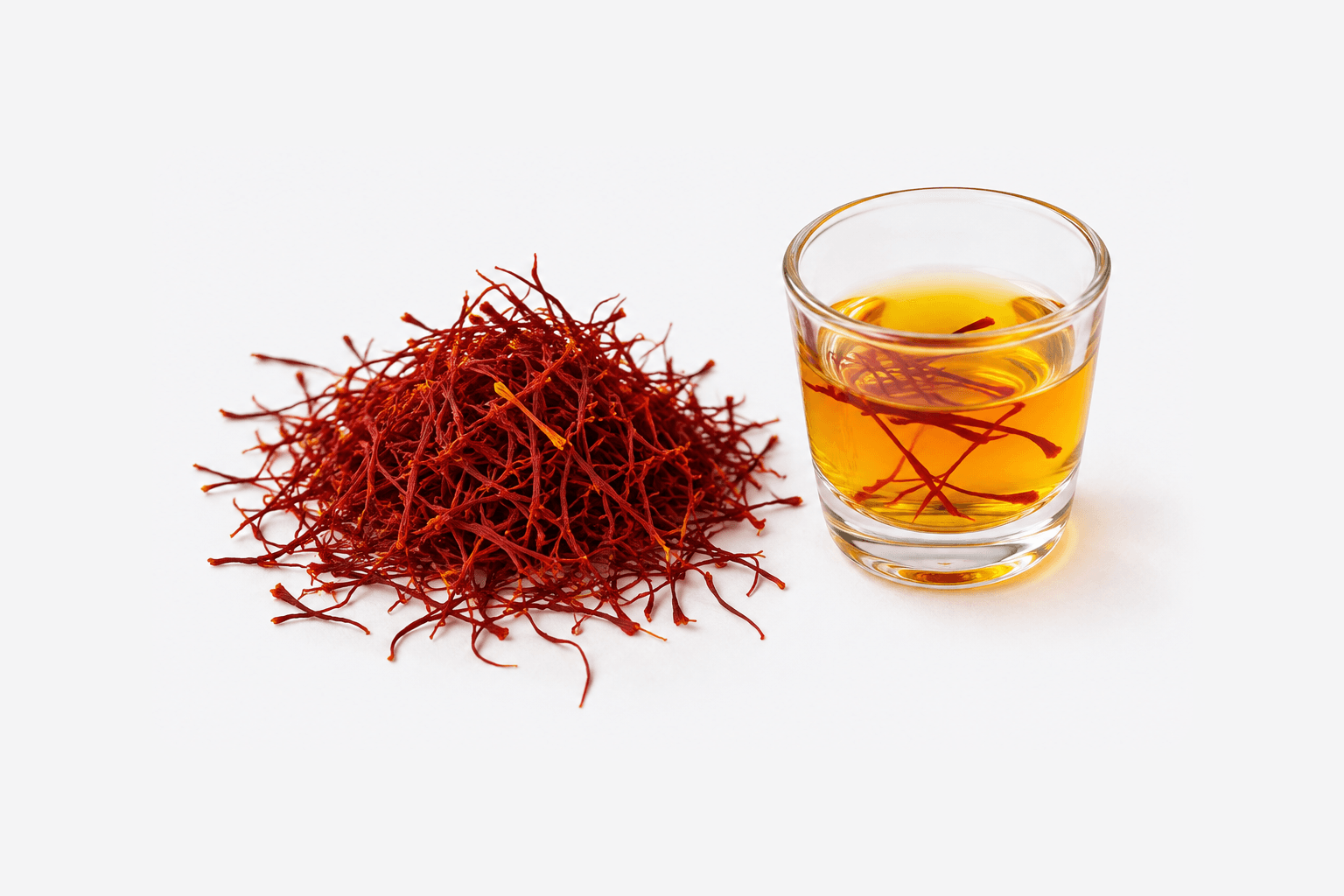
Saffron is the dried stigma of a crocus flower. Each flower carries only three stigmas and every one must be picked by hand, so a single gram takes roughly 150 flowers — which is why it is the most expensive spice in the world. It is native to western Asia and Iran grows most of it. A pigment called crocin dissolves in water and gives an intense yellow, while the aroma comes from safranal. It is used in tiny amounts; too much turns the dish bitter and medicinal.
Scientific name Crocus sativus
Saffron is a rare spice with 34 randomised trials behind it for depression. In 2026, Nutritional Neuroscience pooled all 34 and 1,769 participants, and graded the evidence with GRADE.
The result splits in two.
- Scales the participant fills in — Beck Depression Inventory −4.39 points, Beck Anxiety Inventory −5.06 points. Both significant.
- Scales a clinician rates — Hamilton Depression, Hamilton Anxiety, Profile of Mood States. No significant effect on any of the three.
That split is the point of this page. Inside the same trials, the scores participants wrote about themselves moved, and the scores trained raters gave them did not.
The authors put it in their conclusion: the lack of clinician-rated effects underscores the need for high-quality trials.
And the heterogeneity was I² 92–95%.
Key benefits
- Moderate evidence
Self-reported depression and anxiety fell
[1]A 2026 systematic review and meta-analysis in Nutritional Neuroscience. Following PRISMA, SCOPUS, PubMed and Web of Science were searched to July 2025, including only randomised placebo-controlled trials in adults, at least four weeks long, with saffron as the sole difference between arms. Risk of bias by Cochrane tools; certainty by GRADE.
34 trials, 1,769 participants.
- BDI (Beck Depression Inventory) — 14 trials, 817 participants. Weighted mean difference −4.39 (95% CI −6.64 to −2.15), p < 0.001, I² = 92.3%
- BAI (Beck Anxiety Inventory) — 6 trials, 339 participants. −5.06 (95% CI −8.44 to −1.68), p = 0.003, I² = 94.8%
- HDRS, HARS, POMS — no significant effects
- GRADE certainty: moderate
Three things need saying.
First, I² of 92–95% is very high. The trials gave substantially different answers, and why was not explained.
Second, self-report and clinician rating came apart. BDI and BAI are questionnaires the participant answers; HDRS and HARS are scored by a trained rater in interview. Which of those is more open to expectation is not a hard question. The authors say so in their conclusion.
Third, convert the size into the scale. The BDI runs 0–63, with the boundary of mild depression usually around 14. 4.39 points is not nothing, but it falls short of what trials usually call a response, which is typically a halving of the score.
The honest summary — the direction is favourable, 34 trials is not a small body of evidence, and the most objective measures showed nothing.
- Not established
What the trials used is not culinary saffron
Those 34 trials mostly used standardised extract capsules. The common dose is 30 mg a day — not 30 milligrams of ground saffron, but 30 mg of a preparation standardised for crocin and safranal content.
Against what cooking uses:
- A paella for four takes 0.1–0.2 g of saffron
- How much active compound that carries varies a great deal with variety, growing region, drying method and how long it has been stored
- A capsule has that content fixed. A jar of threads does not.
So "putting saffron in your cooking lifts your mood" is not what the evidence above says. What it says is that a standardised saffron preparation taken for four weeks or more lowered self-reported scores.
There is a market problem on top of this. Saffron is the most expensive spice by weight, and adulteration is common — safflower petals, turmeric, dyed fibres, even corn silk. It is a repeat offender in European and Iranian quality controls.
How to tell:
- Soak a few threads in cold water. Real saffron releases yellow slowly while the threads stay red. Dyed material bleeds fast and the thread turns white.
- Real threads are three-pronged stigmas flaring from one base, trumpet-shaped. Safflower is a flat petal.
- Buy threads, not powder. In powder you cannot see what was mixed in.
- Nutrition data
The table is spectacular, and you use 0.1 g
Per 100 g of dried saffron the figures are startling.
- Manganese 28.4 mg — 1,235% of the adult requirement
- Potassium 1,720 mg, magnesium 264 mg
- Iron 11.1 mg, vitamin C 80.8 mg, vitamin B6 1.01 mg
- Folate 93 µg, phosphorus 252 mg, protein 11.4 g
But a pinch is 0.1 g — a thousandth of 100 g. Which gives:
- Manganese 0.028 mg — 1.2% of the requirement
- Potassium 1.7 mg, magnesium 0.26 mg
- Iron 0.011 mg
Effectively zero. That is why this site excludes saffron from the nutrient rankings. Line foods up per 100 g and saffron tops manganese — on a quantity nobody eats.
You use saffron for colour and aroma. Crocin gives the yellow, safranal the smell, picrocrocin the bitterness. That 0.1 g colours a whole pot is what the spice is worth.
Do not count it as nutrition. That is all this table says.
How to eat it well
- Steep it in warm water or milk for 10–20 minutes first. Crocin is water-soluble; dry threads dropped in release less than half their colour and aroma.
- Add the steeping liquid too. Fishing out the threads and leaving the liquid behind is backwards.
- Crumbling the threads between your fingers increases the surface area and draws more out.
- Add it partway through cooking. Boiled from the start for a long time, the aroma leaves.
- 0.1–0.2 g for four portions of rice. More turns bitter — that is the picrocrocin.
- Store it sealed, dark and dry. Light and moisture break crocin down. Past two years the aroma is much diminished.
- Buy threads and avoid powder. You cannot inspect powder for adulteration.
How to read the grades
Each benefit carries a label showing how far research on people supports it. Grades differ between items even within the same ingredient.
- Nutrition data
- A fact verifiable from food composition databases or health authorities. This is a different kind of statement from a clinical effect.
- Strong evidence
- Consistently confirmed across randomised controlled trials or meta-analyses.
- Moderate evidence
- Human studies exist, but effect sizes are small or results are mixed.
- Early research
- Cell or animal work, or small preliminary studies.
- Not established
- Commonly claimed, but not confirmed in studies on people.
What to watch out for
- Avoid it in pregnancy. It has a recorded traditional use for inducing uterine contraction and abortion, and high-dose safety is not established.
- On antidepressants, check with your clinician. Saffron has been proposed to act on serotonergic pathways, so overlap is possible.
- It does not replace prescribed antidepressants. In the analysis above, the clinician-rated scales did not move significantly.
- High doses are toxic. Poisoning has been reported above 5 g, and fatalities at higher amounts. Culinary quantities (0.1–0.2 g) are nowhere near that, but check the total if you stack supplements.
- It may affect blood clotting. Stop supplements before surgery or if you take anticoagulants.
- Adulterated product is common. The evidence above does not apply to something cut with turmeric or safflower.
- The evidence concerns standardised preparations; culinary amounts cannot be expected to do the same.
Nutrition
Per 100 g of dried saffron. A pinch is about 0.1 g, so what you use is a thousandth of this table.
- Calories
- 310 kcal16%
- Manganese
- 28.4 mg999%+
- Potassium
- 1,720 mg37%
- Magnesium
- 264 mg63%
- Iron
- 11.1 mg62%
- Vitamin C
- 80.8 mg90%
- Vitamin B6
- 1.01 mg59%
- Folate
- 93 µg23%
- Phosphorus
- 252 mg20%
- Calcium
- 111 mg9%
- Protein
- 11.4 g23%
Percentages are of the US FDA Daily Value for adults and children 4 and over. National reference intakes differ by sex and age.
Calculate this alongside other ingredients →
Key nutrients
Dishes with this ingredient
Sources
The databases and health authorities this article's nutrition figures and health statements draw on.
- 1Effect of saffron on depression, anxiety and mood disorder: a GRADE assessed systematic review and meta-analysis of 34 randomized controlled trialsMeta-analysisMahmoudi R, et al. Nutr Neurosci 2026PMID 41693488
- 2USDA FoodData CentralFood composition database
- 3European Food Safety Authority (EFSA)Health authority
- 4NIH Office of Dietary SupplementsHealth authority
- 5PubMedResearch literature