Contents
What it is
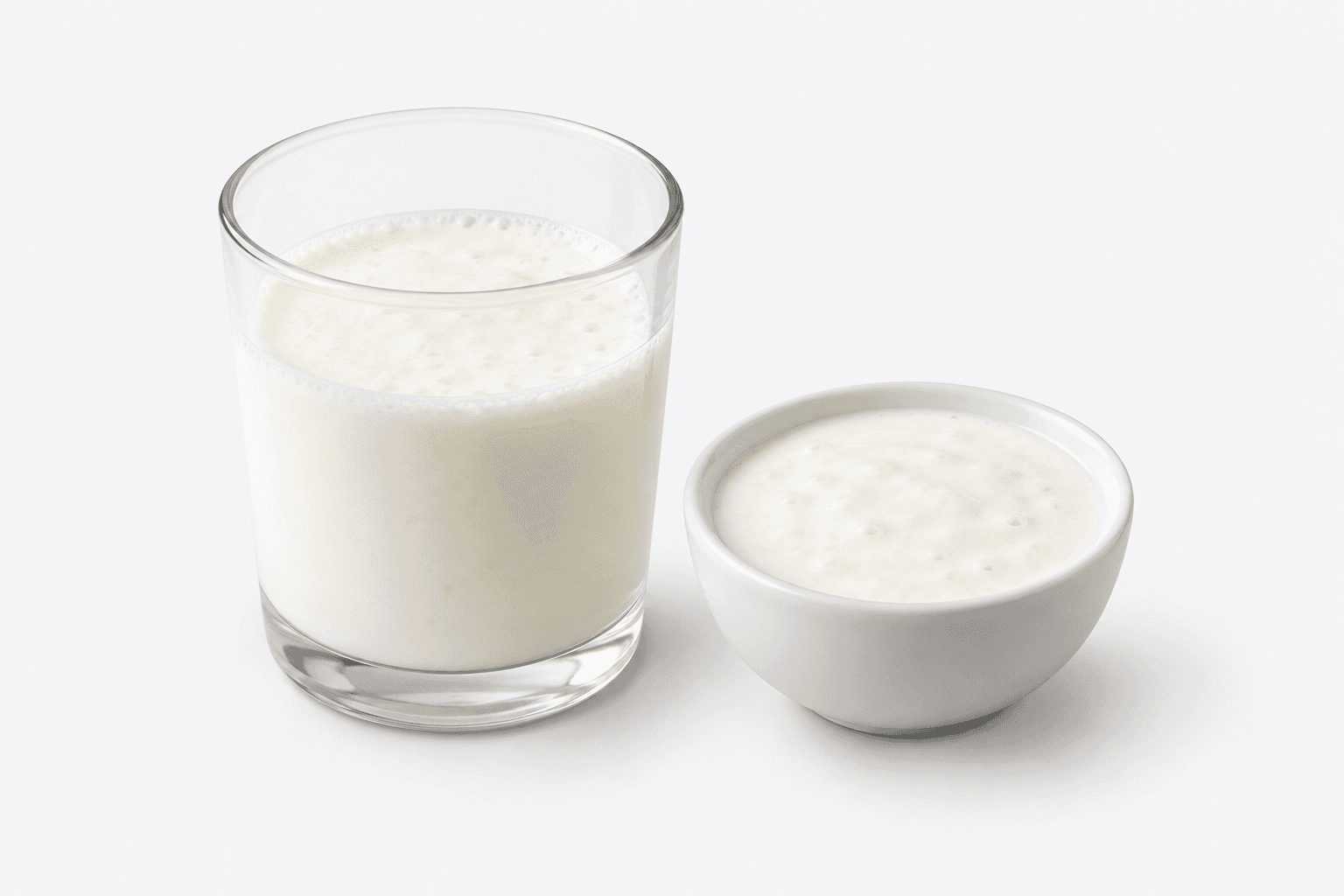
Kefir is a drink made by fermenting milk with kefir grains. The grains are not cereal at all but cauliflower-like lumps in which lactic acid bacteria and yeasts grow together on a polysaccharide matrix. They are strained out at the end and reused, so one batch leads to the next indefinitely. What distinguishes kefir from yoghurt is that the yeasts work alongside the bacteria, producing a slight fizz and a very small amount of alcohol. It is thin enough to drink and markedly sour. It originates in the northern Caucasus.
Kefir is milk fermented with kefir grains — a symbiotic mass of bacteria and yeasts. That it carries more species than yoghurt is always the headline.
What that changes is this page's question. Two meta-analyses of randomised trials exist.
- Cardiometabolic markers — 6 trials, 314 people. Total cholesterol, triglycerides, HDL, LDL, fasting glucose, HbA1c and body weight: all seven unchanged.
- Blood pressure and CRP — 7 trials, 385 people. Systolic, diastolic and CRP: unchanged.
Two things did move. Fasting insulin and insulin resistance (HOMA-IR) fell, and in people who cannot digest lactose, breath hydrogen dropped.
There are reasons to drink kefir. They stop where that list stops.
Key benefits
- Early research
For lactose maldigesters, it sat better than milk
[1]A 2003 trial in the Journal of the American Dietetic Association. Fifteen adults with lactose maldigestion, fasted twelve hours, then given portions containing 20 g of lactose as milk, plain kefir, flavoured kefir, plain yoghurt and flavoured yoghurt, measured hourly for eight hours.
Breath hydrogen area under the curve — the amount of undigested lactose fermenting in the colon:
- Milk 224 ± 39 ppm·h
- Plain kefir 87 ± 37 (P < .001)
- Plain yoghurt 76 ± 14 (P < .001)
- Flavoured kefir 156 ± 26 — intermediate
Symptoms eased too. Both yoghurts and both kefirs cut perceived flatulence severity by 54–71% relative to milk. Abdominal pain and diarrhoea were negligible across all five.
Two things have to be said plainly.
First, this is a single trial in fifteen people. That is why the grade here is early.
Second, flavoured kefir was clearly worse than plain — 156 against 87. The strawberry product may retain more lactose, or empty from the stomach faster. If lactose is why you are choosing kefir, it has to be plain.
- Moderate evidence
Fasting insulin and insulin resistance did fall
[2]A 2023 meta-analysis in Current Drug Targets. Six randomised controlled trials, 314 subjects.
- Fasting insulin −3.69 µIU/mL (95% CI −6.30 to −1.07, p = .006, I² = 0.0%)
- HOMA-IR −2.56 (95% CI −3.82 to −1.30, p < .001, I² = 19.4%)
Near-zero heterogeneity (I² 0%) means the trials were not contradicting each other, which is a good sign.
But the size is hard to take at face value. HOMA-IR normally moves within a range of roughly 1 to 3. A drop of 2.56 would be most of the index, and it comes from six trials and 314 people. Baseline states almost certainly differed a great deal — obesity, diabetes — and that moves the starting point.
Everything else was unchanged, exactly as the paper lists it:
- Total cholesterol p = .088
- Triglycerides p = .824
- HDL p = .491
- LDL p = .910
- Fasting glucose p = .267
- HbA1c p = .339
- Body weight p = .439
The authors' own conclusion: kefir has a beneficial effect on insulin resistance, with no effect on weight, fasting glucose, HbA1c or the lipid profile.
- Moderate evidence
Blood pressure and CRP did not change
[3]This entry records an absence, not a benefit. The grade describes how good the evidence is that there is nothing there.
A 2025 meta-analysis in Endocrinology, Diabetes & Metabolism. Seven randomised controlled trials, 385 subjects, mostly adults taking kefir for at least two weeks.
- Systolic −1.76 mmHg (95% CI −5.21 to 1.69, p = 0.317)
- Diastolic −1.19 mmHg (95% CI −3.40 to 1.03, p = 0.295)
- CRP −0.17 mg/L (95% CI −0.84 to 0.49, p = 0.609)
All three intervals cross zero. There is no effect to report.
One thread remains. In subgroup analysis, CRP did fall significantly in trials running eight weeks or longer. The authors put it no more strongly than that long-term use may improve CRP over time. Subgroups generate hypotheses; they do not confirm them.
Fermented milk lowering blood pressure is a claim you hear often. For kefir, pooling every randomised trial there is does not support it.
- Nutrition data
Milk's nutrition survives fermentation largely intact
Per 100 g of low-fat plain kefir:
- Protein 3.79 g — essentially milk's
- Calcium 130 mg, phosphorus 105 mg, potassium 164 mg
- Vitamin B12 0.29 µg, riboflavin 0.135 mg
- 43 kcal, fat 1.02 g
A cup (240 g) comes to 9.1 g of protein and 312 mg of calcium.
The vitamin A and D in the table are fortified values. The commercial product these figures come from adds both. A kefir without a fortification line on the label has far less of each. It is not a property of kefir.
The cultures only count if they are alive. Heat-treated "kefir drinks" have been fermented, but the organisms are dead. Choose what sits in the chiller with a short date.
Check the sugar. Flavoured products routinely exceed 10 g per 100 g — which connects back to the flavoured kefir performing worse in the lactose trial.
How to eat it well
- Buy plain. For lactose or for sugar, flavoured products are not what the evidence on this page is about.
- A cup a day (240 g) is close to the dose those trials used.
- Chilled, short-dated products are the ones with live cultures. Shelf-stable usually means pasteurised after fermentation.
- Do not heat it. Boiling kills the cultures and curdles the protein. To cook with it, stir it in off the heat.
- Eight weeks or more — the only CRP signal came from trials that ran past eight weeks.
- Shake it. Whey separating to the top is normal.
- Starting at half a cup is easier. Unaccustomed guts can react with gas.
How to read the grades
Each benefit carries a label showing how far research on people supports it. Grades differ between items even within the same ingredient.
- Nutrition data
- A fact verifiable from food composition databases or health authorities. This is a different kind of statement from a clinical effect.
- Strong evidence
- Consistently confirmed across randomised controlled trials or meta-analyses.
- Moderate evidence
- Human studies exist, but effect sizes are small or results are mixed.
- Early research
- Cell or animal work, or small preliminary studies.
- Not established
- Commonly claimed, but not confirmed in studies on people.
What to watch out for
- It is not lactose-free. In the trial it was better than milk, not zero. Severe intolerance may still react.
- If you are immunosuppressed — on chemotherapy, post-transplant, critically ill — discuss live-culture foods with your clinician. Bacteraemia has been reported, rarely.
- Milk allergy is unaffected by fermentation; the proteins remain.
- It does not replace blood pressure or diabetes medication. In the analysis above, blood pressure did not move significantly.
- It may contain a little alcohol. Yeast fermentation usually leaves under 0.5%, but long home fermentation raises it.
- The benefits above stop at insulin markers and lactose digestion. Other claims are not established.
Nutrition
Per 100 g of low-fat plain kefir; a cup is 240 g. These figures come from a commercial product fortified with vitamins A and D — unfortified kefir has far less of both.
- Calories
- 43 kcal2%
- Protein
- 3.79 g8%
- Fat
- 1.02 g1%
- Carbohydrates
- 4.77 g2%
- Calcium
- 130 mg10%
- Potassium
- 164 mg3%
- Phosphorus
- 105 mg8%
- Magnesium
- 12 mg3%
- Vitamin B12
- 0.29 µg12%
- Vitamin B2
- 0.135 mg10%
- Vitamin D
- 1.0 µg5%
Percentages are of the US FDA Daily Value for adults and children 4 and over. National reference intakes differ by sex and age.
Calculate this alongside other ingredients →
Key nutrients
By health concern
Dishes with this ingredient
Compare with
Sources
The databases and health authorities this article's nutrition figures and health statements draw on.
- 1Kefir improves lactose digestion and tolerance in adults with lactose maldigestionClinical trialHertzler SR, et al. J Am Diet Assoc 2003PMID 12728216
- 2Effects of Kefir Consumption on Cardiometabolic Risk Factors: A Systematic Review and Meta-analysis of Randomized Controlled TrialsMeta-analysisYahyapoor F, et al. Curr Drug Targets 2023PMID 37102491
- 3The Effect of Kefir Consumption on Blood Pressure and C-Reactive Protein: A Systematic Review and Meta-Analysis of Randomised Controlled TrialsMeta-analysisRashidbeygi E, et al. Endocrinol Diabetes Metab 2025PMID 41139305
- 4USDA FoodData CentralFood composition database
- 5European Food Safety Authority (EFSA)Health authority
- 6NIH Office of Dietary SupplementsHealth authority
- 7PubMedResearch literature