Contents
What it is
Cheese is milk protein set firm and drained of water. Add acid or the enzyme rennet to milk and the casein coagulates, splitting it into solid curd and liquid whey; gather the curd, press it and let it age, and you have cheese. Ageing time and the microbes involved separate a fresh mozzarella from a parmesan held for years. The longer the ageing, the more water is lost, so the cheese grows harder and the protein, fat and sodium all climb for a given weight.
Cheese carries 19.2 g of saturated fat per 100 g. On the number alone, it is a food to avoid.
Human trials that matched the fat exactly say otherwise. A 2023 analysis in Advances in Nutrition pooled seven randomised controlled trials in which people ate 135 g of cheese a day for at least two weeks, against the same amount of fat eaten as butter — about 52 g. LDL came out 0.19 mmol/L lower on cheese, roughly 7 mg/dL.
Why would identical saturated fat act differently? The hypothesis is the dairy matrix: in cheese the fat is caught inside a protein network with calcium, and is absorbed differently than free butterfat. Calcium binding fatty acids in the gut, so some leave undigested, is part of the same story.
None of which makes this a page recommending cheese. The trial dose was 135 g a day — more than five slices. Sodium is 654 mg per 100 g. Both are below, unedited.
Key benefits
- Strong evidence
At equal fat, LDL was lower on cheese than on butter
[1]A 2023 systematic review and meta-analysis in Advances in Nutrition. Of 1,491 records screened, 10 articles qualified and seven randomised controlled trials were pooled.
The design is what matters. Energy and fat were matched, one arm taking it as cheese (135 g/day on average), the other as butter (about 52 g), for 14 days or more.
On cheese:
- Total cholesterol −0.24 mmol/L (95% CI −0.34 to −0.15) — about 9 mg/dL
- LDL −0.19 mmol/L (95% CI −0.27 to −0.12) — about 7 mg/dL
- HDL −0.04 mmol/L (95% CI −0.08 to −0.00) — about 1.5 mg/dL
That last line has to stay in. HDL fell too. The size is small, but the direction is not the favourable one.
Replacing cheese with milk showed no benefit — though with only two trials, that is not a conclusion.
The paper states its own limits. Every included trial carried "some concerns" for risk of bias, heterogeneity was substantial (I² 42.8–59.8%), and the trial count is small. The authors' conclusion is that further confirmation is warranted.
- Moderate evidence
In observational data it was not harmful, and slightly on the better side
[2]A 2023 umbrella review in the same journal. It gathered 54 meta-analyses and pooled analyses, recalculated 35, ran four new ones, and covered 47 health outcomes.
Highest versus lowest cheese intake:
- All-cause mortality RR 0.95 (0.92–0.99)
- Cardiovascular mortality RR 0.93 (0.88–0.99)
- Incident cardiovascular disease RR 0.92 (0.89–0.96)
- Stroke RR 0.93 (0.89–0.98)
- Type 2 diabetes RR 0.93 (0.88–0.98)
- Total fracture RR 0.90 (0.86–0.95)
- Dementia RR 0.81 (0.66–0.99)
And everything else was null. In the paper's own words, null associations were found for the other outcomes — cancer mortality, incident hypertension and prostate cancer explicitly among them.
Do not inflate these. RR 0.95 is a 5% difference. These are observational studies, so causation is off the table, and people who eat more cheese differ in ways statistics cannot fully remove. The evidence grade (NutriGrade) was moderate.
Dementia's 0.81 looks large, but its confidence interval reaches 0.99 — it barely cleared 1.
The authors' own summary is the right one: neutral to moderate benefits.
- Nutrition data
Few foods carry calcium this densely
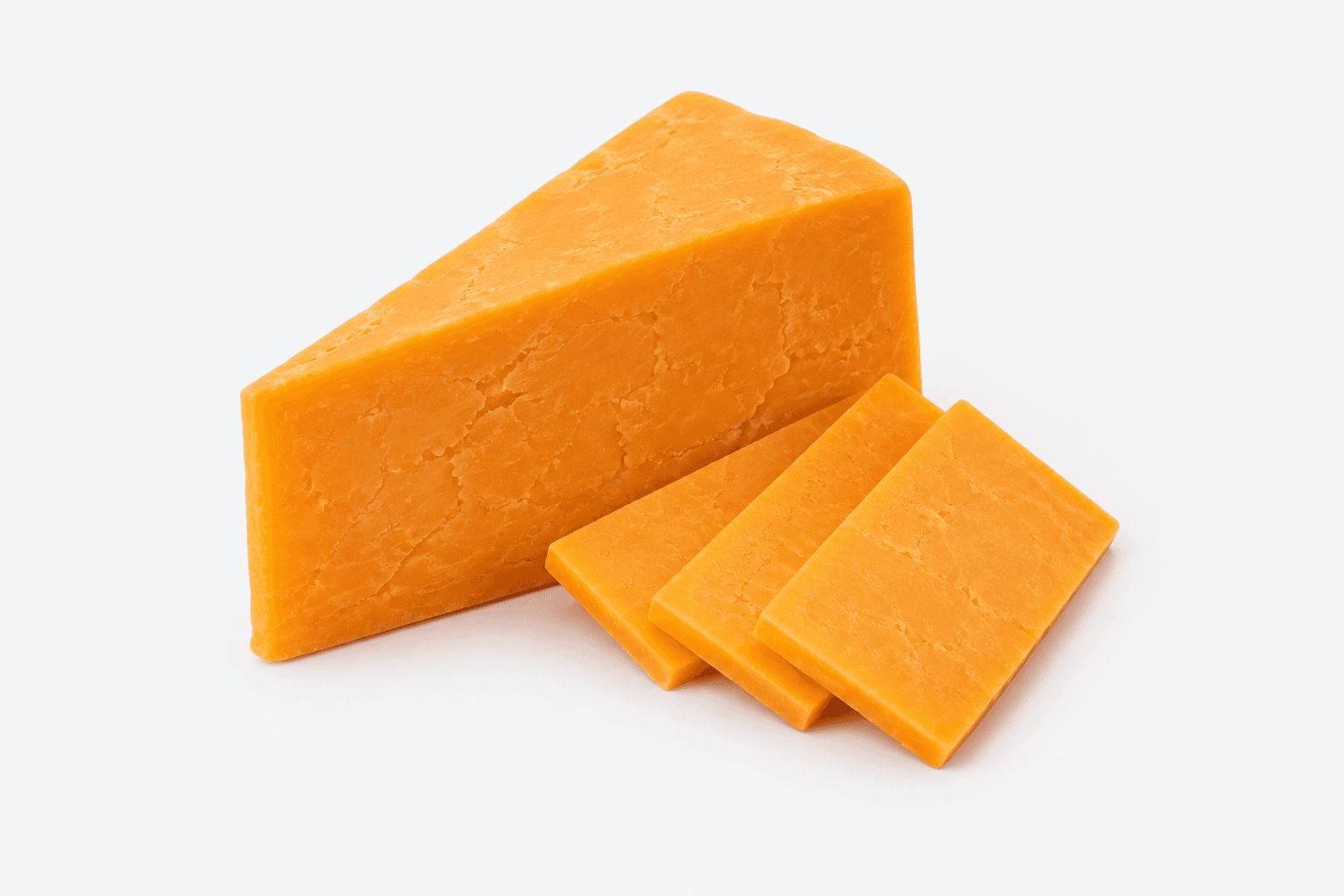
707 mg of calcium per 100 g of cheddar — 71% of the adult requirement of 1,000 mg.
A single slice (28 g) works out to about 198 mg, close to a cup of milk (200 g, around 240 mg). For getting calcium into a small volume, there are not many substitutes.
Per 100 g, also:
- Protein 23.3 g — about as dense as chicken breast
- Phosphorus 458 mg, zinc 3.67 mg, selenium 28.3 µg
- Vitamin B12 1.06 µg — 44% of the requirement
- Vitamin A 316 µg, all of it retinol
Aged cheese has almost no lactose. In hard cheeses like cheddar or parmesan, ageing breaks most of it down, which is why people who cannot drink milk often tolerate them. If lactose is a problem, aged cheese beats fresh cheese like mozzarella or ricotta.
Sodium and saturated fat come with it. Per 100 g: sodium 654 mg, saturated fat 19.2 g, cholesterol 100 mg. One slice is 183 mg of sodium — 9% of a 2,000 mg daily ceiling.
How to eat it well
- Decide the amount first. The 135 g/day in those trials is a study protocol, not a serving. One or two slices — 20 to 56 g — is the realistic figure.
- Swapping butter for cheese is the closest thing to what the evidence actually says. Cheese on the bread instead of butter.
- Tell processed from natural cheese. Many slice products are processed, with more sodium and emulsifiers. Check the natural cheese percentage on the label.
- Aged cheese is nearly lactose-free, which makes it an option when milk is not.
- Heating does nothing to the salt. Melted cheese is just as salty.
- Calcium absorption needs vitamin D, and cheese has almost none. Get that from sunlight or elsewhere.
How to read the grades
Each benefit carries a label showing how far research on people supports it. Grades differ between items even within the same ingredient.
- Nutrition data
- A fact verifiable from food composition databases or health authorities. This is a different kind of statement from a clinical effect.
- Strong evidence
- Consistently confirmed across randomised controlled trials or meta-analyses.
- Moderate evidence
- Human studies exist, but effect sizes are small or results are mixed.
- Early research
- Cell or animal work, or small preliminary studies.
- Not established
- Commonly claimed, but not confirmed in studies on people.
What to watch out for
- It is salty — 654 mg of sodium per 100 g. If you have high blood pressure or are cutting sodium, count the slices.
- Saturated fat 19.2 g, cholesterol 100 mg per 100 g. The trials compared cheese instead of butter. Adding cheese on top of what you already eat is a different experiment.
- In pregnancy, avoid unpasteurised cheeses because of listeria. That covers unpasteurised brie, camembert and blue cheeses.
- If you are lactose intolerant, fresh cheeses — mozzarella, ricotta, cottage — still contain lactose.
- Some people report migraine, attributed to tyramine in aged cheese. Aged cheese is contraindicated with MAO inhibitors.
- The observational findings above are not causal. They do not mean eating more cheese lowers your mortality.
Nutrition
Per 100 g of cheddar. A slice is 20–28 g, so what you actually eat at once is about a quarter of this table.
- Calories
- 409 kcal20%
- Protein
- 23.3 g47%
- Fat
- 34.0 g44%
- Carbohydrates
- 2.44 g<1%
- Calcium
- 707 mg54%
- Phosphorus
- 458 mg37%
- Sodium
- 654 mg28%
- Zinc
- 3.67 mg33%
- Selenium
- 28.3 µg51%
- Vitamin B12
- 1.06 µg44%
- Vitamin A
- 316 µg35%
Percentages are of the US FDA Daily Value for adults and children 4 and over. National reference intakes differ by sex and age.
Calculate this alongside other ingredients →
Key nutrients
By health concern
Dishes with this ingredient
Sources
The databases and health authorities this article's nutrition figures and health statements draw on.
- 1Effect of Isoenergetic Substitution of Cheese with Other Dairy Products on Blood Lipid Markers in the Fasted and Postprandial State: An Updated and Extended Systematic Review and Meta-Analysis of Randomized Controlled Trials in AdultsMeta-analysisPradeilles R, et al. Adv Nutr 2023PMID 37717700
- 2Cheese consumption and multiple health outcomes: an umbrella review and updated meta-analysis of prospective studiesMeta-analysisZhang M, et al. Adv Nutr 2023PMID 37328108
- 3USDA FoodData CentralFood composition database
- 4MFDS Food Composition Database · 식품안전나라Food composition database
- 5NIH Office of Dietary SupplementsHealth authority
- 6European Food Safety Authority (EFSA)Health authority
- 7PubMedResearch literature