Contents
What it is
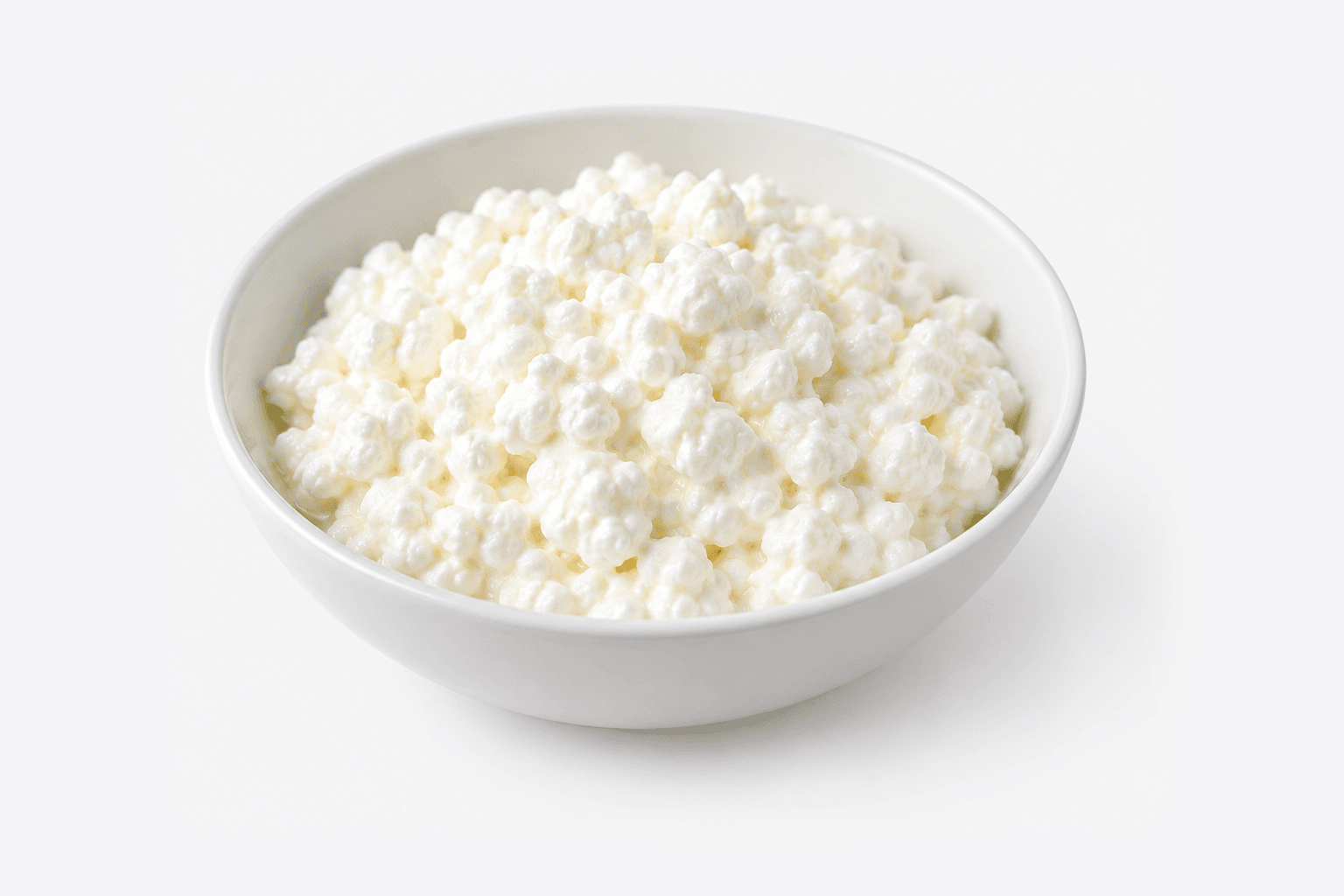
Cottage cheese is a fresh, unripened cheese of loose curds, made by acidifying milk. Because it is not aged, the flavour is mild with a light tang. The curds are left undrained rather than pressed, so it holds a lot of water — which is why, weight for weight, it is lower in calories, fat and sodium than a hard cheese while the share of protein is relatively high. Most is sold with a little cream stirred back in. Unlike aged cheese it does not keep, so it should be eaten soon after opening.
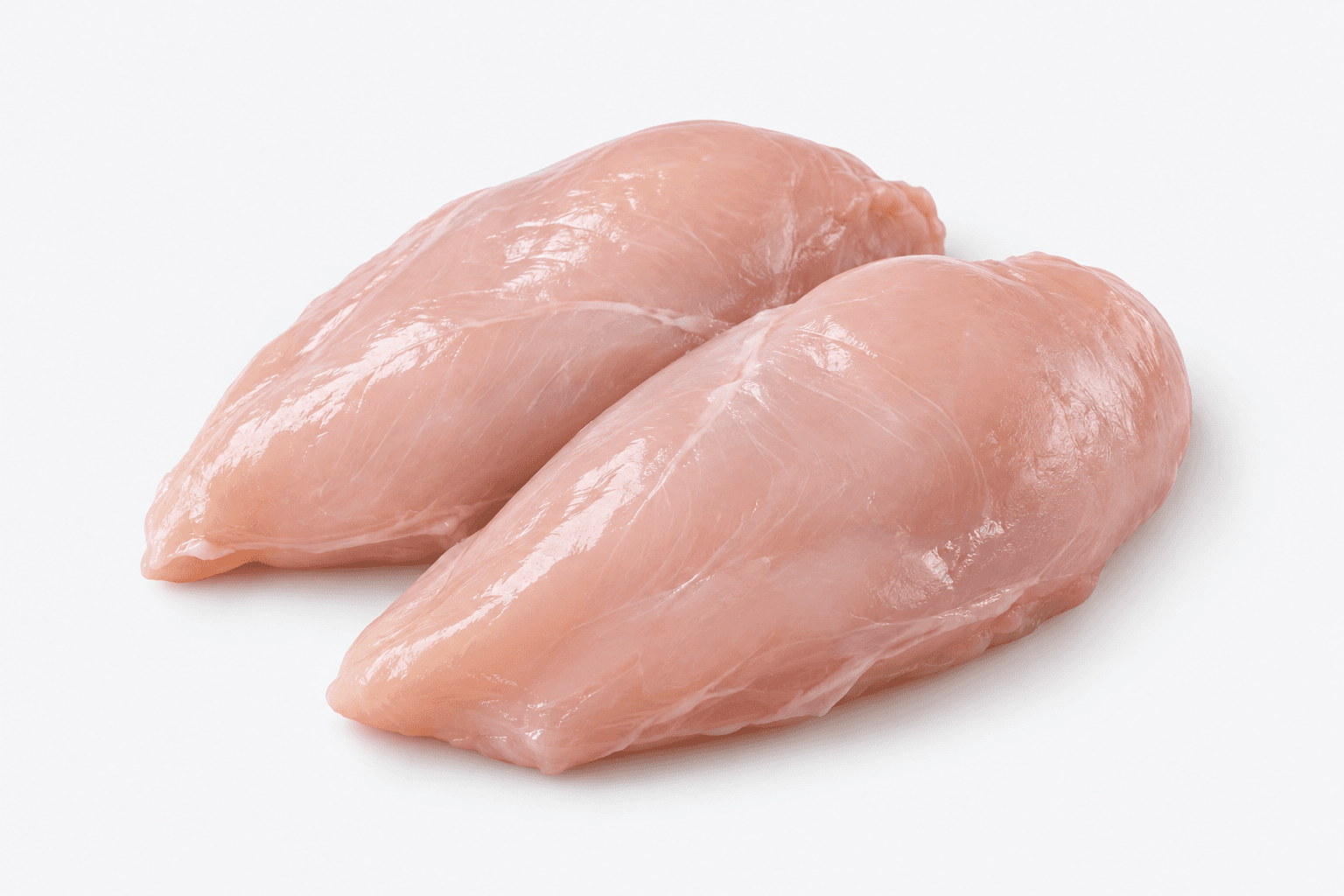
Cottage cheese is about as protein-dense per calorie as food gets. 12.4 g of protein per 100 g at 72 kcal. Per 100 kcal that is 17 g of protein, which puts it alongside chicken breast.
But "it's cheese, so it's calcium" does not hold here.
- Cheddar: 707 mg of calcium
- Cottage cheese: 61 mg
A ninth. The method is why. Cheddar is set with rennet and the calcium stays bound in the curd; cottage cheese is acid-set and the curd is washed. The calcium leaves with the whey.
This page treats cottage cheese as a protein food only. That is what it is good at, and calcium is not.
And sodium is 406 mg per 100 g. Below is why that number matters.
Key benefits
- Moderate evidence
Protein before sleep: 40 g worked, 20 g did not
[1]The case for cottage cheese as a bedtime protein rests on casein — the slow-digesting milk protein, and most of what cottage cheese contains.
A 2017 randomised, double-blind, parallel-group trial in the Journal of Nutrition. Forty-eight men, mean age 72 ± 1, split four ways and fed before sleep:
- 40 g casein (PRO40)
- 20 g casein (PRO20)
- 20 g casein plus 1.5 g leucine (PRO20+LEU)
- Placebo
Overnight myofibrillar protein synthesis was measured with labelled amino acids.
- Placebo 0.033%/h
- PRO20 0.037%/h
- PRO20+LEU 0.039%/h
- PRO40 0.044%/h
Only PRO40 was significantly higher than placebo (P = 0.02).
Twenty grams produced no measurable change, with or without added leucine. Incorporation of amino acids from the ingested protein was also nearly double in PRO40 versus PRO20 (0.033 vs 0.019 MPE, P < 0.001).
Two things have to go alongside that.
First, the second tracer did not reach significance. Calculated from the leucine label, the same trial gave placebo 0.047 and PRO40 0.058, at P = 0.08. Two measurements of the same experiment gave different answers.
Second, the interests. The senior authors disclosed research grants, consulting fees and speaking honoraria from FrieslandCampina, Nutricia Research and PepsiCo, and the paper states that "the industrial partners have contributed to the project through regular discussion." That does not void the result; it is something to read it with.
And work out what 40 g means. Reaching 40 g of protein from cottage cheese takes about 320 g — more than two tubs.
- Moderate evidence
Casein before sleep did not improve sleep
[2]Bedtime casein carries an expectation about sleep too. One trial looked at exactly that.
A 2026 trial in the International Journal of Sport Nutrition and Exercise Metabolism gave resistance-trained people whey protein, casein, or an isocaloric control before sleep after resistance exercise, and compared sleep quality.
The result is in the title: presleep whey, but not casein, improved sleep quality.
That casein was the arm that did not is the part this page needs. Casein is what cottage cheese carries.
Do not over-read it either. It is a single trial in resistance-trained individuals, measuring self-reported sleep quality. It does not say casein worsened sleep — it says casein did not differ from control.
So: what a bedtime bowl of cottage cheese can be expected to do stops at overnight muscle protein synthesis, and then only if you eat enough of it. It will not help you sleep.
- Nutrition data
Top of the table for protein per calorie, bottom for calcium
Per 100 g of low-fat cottage cheese:
- Protein 12.4 g at 72 kcal — 17 g of protein per 100 kcal
- Phosphorus 134 mg, selenium 9.0 µg, vitamin B12 0.63 µg, riboflavin 0.165 mg
- Fat 1.02 g, cholesterol 4 mg
- Carbohydrate 2.72 g — all of it lactose
Seventeen grams of protein per 100 kcal is a strong number. Chicken breast is about 19, Greek yoghurt about 10, egg about 8.
And then calcium is 61 mg.
- Cheddar 707 mg
- Milk, per 100 g about 120 mg
- Cottage cheese 61 mg
Less than milk. Acid setting and washing the curd send the calcium out with the whey. "I had cheese, so calcium is covered" does not work here.
Sodium at 406 mg is the practical ceiling on this food.
Taking the trial's 40 g of protein as cottage cheese means about 320 g, which gives:
- 230 kcal — fine
- 1,299 mg of sodium — 65% of a 2,000 mg daily limit
One meal carrying two thirds of the day's sodium. Look for a no-salt-added version, split the portion, or get some of the protein elsewhere.
The lactose is still there. Unlike aged cheese, cottage cheese keeps its 2.72 g. With lactose intolerance, cheddar or parmesan is the better choice.
How to eat it well
- Buy no-salt-added or reduced-sodium if you can find it. 406 mg is this food's main constraint.
- Split the portion. 150 g in the morning and 150 g in the evening sits better than 320 g at once.
- With fruit or nuts, the sourness softens and the fullness per calorie improves.
- If calcium is the point, eat something else. Milk, aged cheese or small bone-in fish are all far better.
- It curdles when heated. An acid-set curd does not melt well. Spoon it on at the end rather than stirring it in.
- If you are eating it before bed, the trial's condition was 40 g of protein — 320 g. Less than that is a different experiment from the one described above.
- The lactose remains, so if you are intolerant, start small.
How to read the grades
Each benefit carries a label showing how far research on people supports it. Grades differ between items even within the same ingredient.
- Nutrition data
- A fact verifiable from food composition databases or health authorities. This is a different kind of statement from a clinical effect.
- Strong evidence
- Consistently confirmed across randomised controlled trials or meta-analyses.
- Moderate evidence
- Human studies exist, but effect sizes are small or results are mixed.
- Early research
- Cell or animal work, or small preliminary studies.
- Not established
- Commonly claimed, but not confirmed in studies on people.
What to watch out for
- 406 mg of sodium per 100 g. With high blood pressure or on a reduced-sodium diet, this food is saltier than it looks.
- It is not a calcium source — 61 mg, less than milk.
- The lactose is still present. Unlike aged cheese, it can be a problem with lactose intolerance.
- Milk allergy rules it out.
- If you restrict phosphorus or protein for kidney disease, 100 g carries 134 mg and 12.4 g. Discuss it with your clinician.
- Both studies above are small. The first is 48 men; the second a single trial in resistance-trained people.
- The first trial disclosed dairy industry funding and "regular discussion" with industrial partners. Not a reason to dismiss it, but a reason to know.
Nutrition
Per 100 g of low-fat cottage cheese (1% milkfat). A tub is usually 150 g.
- Calories
- 72 kcal4%
- Protein
- 12.4 g25%
- Fat
- 1.02 g1%
- Carbohydrates
- 2.72 g<1%
- Sodium
- 406 mg18%
- Phosphorus
- 134 mg11%
- Calcium
- 61 mg5%
- Selenium
- 9.0 µg16%
- Vitamin B12
- 0.63 µg26%
- Vitamin B2
- 0.165 mg13%
- Potassium
- 86 mg2%
Percentages are of the US FDA Daily Value for adults and children 4 and over. National reference intakes differ by sex and age.
Calculate this alongside other ingredients →
Key nutrients
By health concern
Dishes with this ingredient
Sources
The databases and health authorities this article's nutrition figures and health statements draw on.
- 1Protein Ingestion before Sleep Increases Overnight Muscle Protein Synthesis Rates in Healthy Older Men: A Randomized Controlled TrialClinical trialKouw IW, et al. J Nutr 2017PMID 28855419
- 2Presleep Whey but Not Casein Protein Ingestion Improves Sleep Quality After Resistance Exercise When Compared With an Isocaloric Control in Resistance Trained IndividualsClinical trialAussieker T, et al. Int J Sport Nutr Exerc Metab 2026PMID 42413910
- 3USDA FoodData CentralFood composition database
- 4NIH Office of Dietary SupplementsHealth authority
- 5European Food Safety Authority (EFSA)Health authority
- 6PubMedResearch literature