Contents
What it is
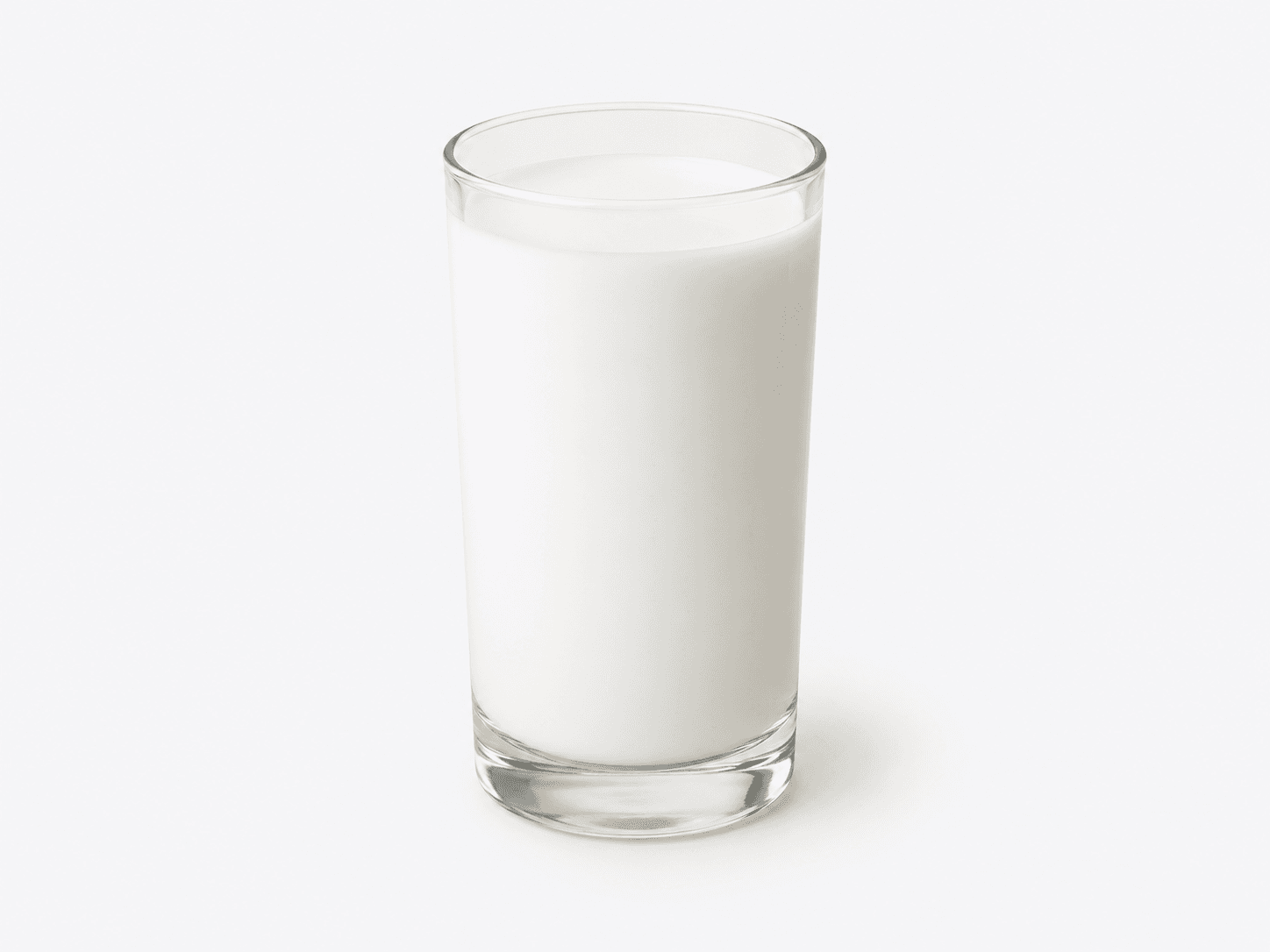
Milk is what a cow secretes to feed a calf. It is water with fat dispersed through it as very fine droplets and casein protein suspended as particles, and the way those scatter light is why it looks white. Most milk on sale is homogenised, a treatment that breaks the fat droplets small enough that they no longer rise. Pasteurisation splits it into low-temperature and ultra-high-temperature types, the latter keeping much longer. People with little of the enzyme that digests lactose may struggle with it, which is why lactose-free versions, pre-split, are sold alongside.
Milk is one of the few foods that supplies calcium in a well-absorbed form with no preparation at all. A 200 ml cup carries about 226 mg, close to a third of an adult's daily requirement.
The catch is lactose. Every infant makes plenty of lactase, but the mammalian default is for that enzyme to decline after weaning. Continuing to produce it into adulthood is the genetic exception — and among East Asian adults that exception is uncommon.
So 'milk upsets my stomach' is not a malfunction. Statistically it is the more common condition.
Key benefits
- Nutrition data
Calcium in a form the body absorbs well
Milk calcium is absorbed at around 30%, higher than most plant sources, helped by the lactose and casein it arrives with — milk's 4.8 g of carbohydrate is essentially all lactose. Vegetables like spinach show high calcium on paper but absorb far less because of oxalate.
- Nutrition data
A protein containing every essential amino acid
About 6.6 g per cup. Not a large amount, but the amino acid profile is complete, and casein and whey digest at different speeds so absorption is drawn out.
- Nutrition data
A principal source of vitamin B2 (riboflavin)
B2 works in energy metabolism, and the foods that carry much of it are limited to dairy and organ meats. Cutting out dairy can quietly leave this nutrient short.
- Moderate evidence
It works as a post-exercise recovery drink
It supplies protein and carbohydrate together, plus fluid, sodium and potassium. Trials have found it no worse than sports drinks for rehydration and glycogen replacement after exercise.[1]
How to eat it well
- If it upsets your stomach, use lactose-free milk. The lactose is pre-split; calcium and protein are untouched.
- Spreading it across the day rather than one large glass reduces symptoms, and drinking it with food helps too.
- Low-fat versus whole depends on the rest of your diet. Cutting the fat lowers calories but takes the fat-soluble vitamins with it.
- If you switch to a plant drink, check that it is calcium-fortified. Unfortified almond or oat drinks carry almost none.
- The milk in your coffee counts. Think in daily totals.
How to read the grades
Each benefit carries a label showing how far research on people supports it. Grades differ between items even within the same ingredient.
- Nutrition data
- A fact verifiable from food composition databases or health authorities. This is a different kind of statement from a clinical effect.
- Strong evidence
- Consistently confirmed across randomised controlled trials or meta-analyses.
- Moderate evidence
- Human studies exist, but effect sizes are small or results are mixed.
- Early research
- Cell or animal work, or small preliminary studies.
- Not established
- Commonly claimed, but not confirmed in studies on people.
What to watch out for
- Lactose intolerance is not a disease so much as the adult default. If it bothers you, switch to lactose-free or fermented dairy rather than pushing through.
- Milk protein allergy is a different thing and lactose-free milk does not solve it.
- Do not give plain cow's milk to infants under one year. It has almost no iron and burdens the kidneys.
- Sweetened flavoured milks carry far more sugar. They are not the same food as plain milk.
- Studies linking milk to various conditions come out mixed. At one or two cups a day there is little basis for particular concern.
Nutrition
Per 100 g of whole milk. A 200 ml cup weighs about 206 g, so roughly double the figures here.
- Calories
- 61 kcal3%
- Carbohydrates
- 4.8 g2%
- Protein
- 3.2 g6%
- Fat
- 3.3 g4%
- Calcium
- 113 mg9%
- Phosphorus
- 84 mg7%
- Vitamin B2
- 0.17 mg13%
- Vitamin B12
- 0.45 µg19%
- Iodine
- 36–40 µg25%
Percentages are of the US FDA Daily Value for adults and children 4 and over. National reference intakes differ by sex and age.
Calculate this alongside other ingredients →
Key nutrients
Dishes with this ingredient
Compare with
Sources
The databases and health authorities this article's nutrition figures and health statements draw on.
- 1A metered intake of milk following exercise and thermal dehydration restores whole-body net fluid balance better than a carbohydrate-electrolyte solution or water in healthy young menClinical trialSeery S, et al. Br J Nutr 2016PMID 27477047
- 2USDA FoodData CentralFood composition database
- 3MFDS Food Composition Database · 식품안전나라Food composition database
- 4NIH Office of Dietary SupplementsHealth authority
- 5European Food Safety Authority (EFSA)Health authority