Contents
What it is
Buckwheat is an annual crop in the knotweed family. The name says wheat, but it is not a grass at all — its relatives are sorrel and knotweed — and it carries no gluten. It spread from Central Asia into East Asia. It grows fast on cool, poor ground, which made it a mountain crop. Without gluten the dough barely holds together, so noodles are usually cut with wheat flour or bound with starch. It is eaten as noodles, as a set jelly, and in thin pancakes.
Scientific name Fagopyrum esculentum
Buckwheat is not wheat. It is the seed of a plant in the knotweed family, unrelated to the grasses that give us wheat, barley and oats. So it has no gluten.
In 2018, Nutrients gathered the evidence on buckwheat and cardiovascular risk markers: 13 randomised controlled human studies, two cross-sectional human studies and 21 animal studies.
Pooling the human work:
- Total cholesterol −0.50 mmol/L (95% CI −0.80 to −0.20) — about 19 mg/dL
- Blood glucose −0.85 mmol/L (95% CI −1.31 to −0.39) — about 15 mg/dL
- Triglycerides −0.25 mmol/L (95% CI −0.49 to −0.02) — about 22 mg/dL
On the numbers alone these are large — nothing like soy protein's LDL −4.76 mg/dL or pistachios' −3.82 mg/dL on this site.
But the authors wrote, in the same passage, that all of these exhibited high unexplained heterogeneity. And they said it remains unclear whether buckwheat benefits LDL cholesterol, blood pressure, insulin or weight.
Total cholesterol fell 19 mg/dL while LDL stayed unclear — that combination tells you what kind of analysis this is.
Key benefits
- Moderate evidence
Cholesterol, triglycerides and glucose fell — with high heterogeneity
[1]A 2018 systematic review and meta-analysis in Nutrients, covering both human and animal work: 13 randomised controlled human studies, two cross-sectional human studies, 21 animal studies.
Pooled human results (random-effects models, weighted mean difference in post-intervention concentrations):
- Blood glucose −0.85 mmol/L (95% CI −1.31 to −0.39) — about 15 mg/dL
- Total cholesterol −0.50 mmol/L (95% CI −0.80 to −0.20) — about 19 mg/dL
- Triglycerides −0.25 mmol/L (95% CI −0.49 to −0.02) — about 22 mg/dL
The two cross-sectional studies showed responses of similar magnitude.
The animal work is more dramatic still. Nineteen of 21 studies showed total cholesterol falling between 12% and 54%, and 14 of 20 showed triglycerides falling between 2% and 74%. A range that wide is itself a signal that the result is not stable.
And then the limits the paper states itself.
- "All exhibited high unexplained heterogeneity." The trials disagreed, and why could not be identified.
- HDL cholesterol was inconsistent in both human and animal studies.
- It remains unclear whether buckwheat benefits weight, blood pressure, insulin or LDL cholesterol.
- The mechanisms behind any effect are unclear.
The missing LDL deserves a moment. If total cholesterol falls 19 mg/dL, LDL usually follows. This analysis could not draw a conclusion about LDL, which means the source of the total cholesterol drop went unexplained.
The honest summary: the direction is consistently favourable, the magnitude came out large, and the confidence is low.
- Nutrition data
Not wheat — but soba noodles contain wheat flour
Buckwheat belongs to the Polygonaceae. Wheat, barley, oats and rye are all grasses; buckwheat sits outside that family entirely, and is unrelated to rice too.
So it contains no gluten — which matters for coeliac disease and wheat allergy.
There is a trap here, though.
Commercial soba usually contains wheat flour. Buckwheat flour alone will not hold a dough together, so wheat goes in as the binder. Buckwheat content ranges from 10% to 100% depending on the product.
With coeliac disease, the ingredient list has to be checked. The word "buckwheat noodle" does not mean gluten-free. Look for 100% buckwheat, or use cooked groats.
The nutrition, per 100 g of cooked groats:
- Magnesium 51 mg — 12% of the requirement
- Fibre 2.7 g — 11%
- Manganese 0.403 mg, copper 0.146 mg, phosphorus 70 mg
- Protein 3.38 g, energy 92 kcal
Against other cooked grains at 100 g, magnesium beats brown rice (43 mg) and fibre is similar. At 92 kcal it is lower in energy than brown rice (123 kcal).
Its protein quality is good for a grain. Buckwheat carries a substantial amount of lysine, the amino acid grains usually lack. Still, a 150 g bowl gives about 5 g of protein, which is not enough to count on.
- Not established
The rutin claims are not established
Most of the stories attached to buckwheat come from a flavonoid called rutin — that it strengthens capillaries, lowers blood pressure, helps varicose veins.
Buckwheat does contain rutin. Tartary buckwheat in particular is known to carry far more of it than common buckwheat.
But the analysis above does not answer for it. That review looked at buckwheat intake and cardiovascular risk markers, and on blood pressure it ended at "remains unclear." What rutin does in people was outside its scope.
Studies of rutin itself are mostly supplement studies. The amount arriving from eating buckwheat is not the amount in a capsule. And rutin is lost in processing and cooking — it is water-soluble, so a good share leaves into the cooking water.
What can honestly be said on a buckwheat page stops here.
- It contains rutin — true
- The amount varies greatly with variety and processing — true
- Eating buckwheat changes blood pressure or blood vessels — not established
The same goes for buckwheat tea. It is water infused with roasted buckwheat, and being caffeine-free makes it an evening drink. Beyond that there is no evidence.
How to eat it well
- Do not throw away the cooking water — drink it. Water-soluble compounds leach into it, which is why soba restaurants serve you the cooking broth afterwards.
- Groats cook in eight to ten minutes. Cooking them with rice means adding them later than the rice.
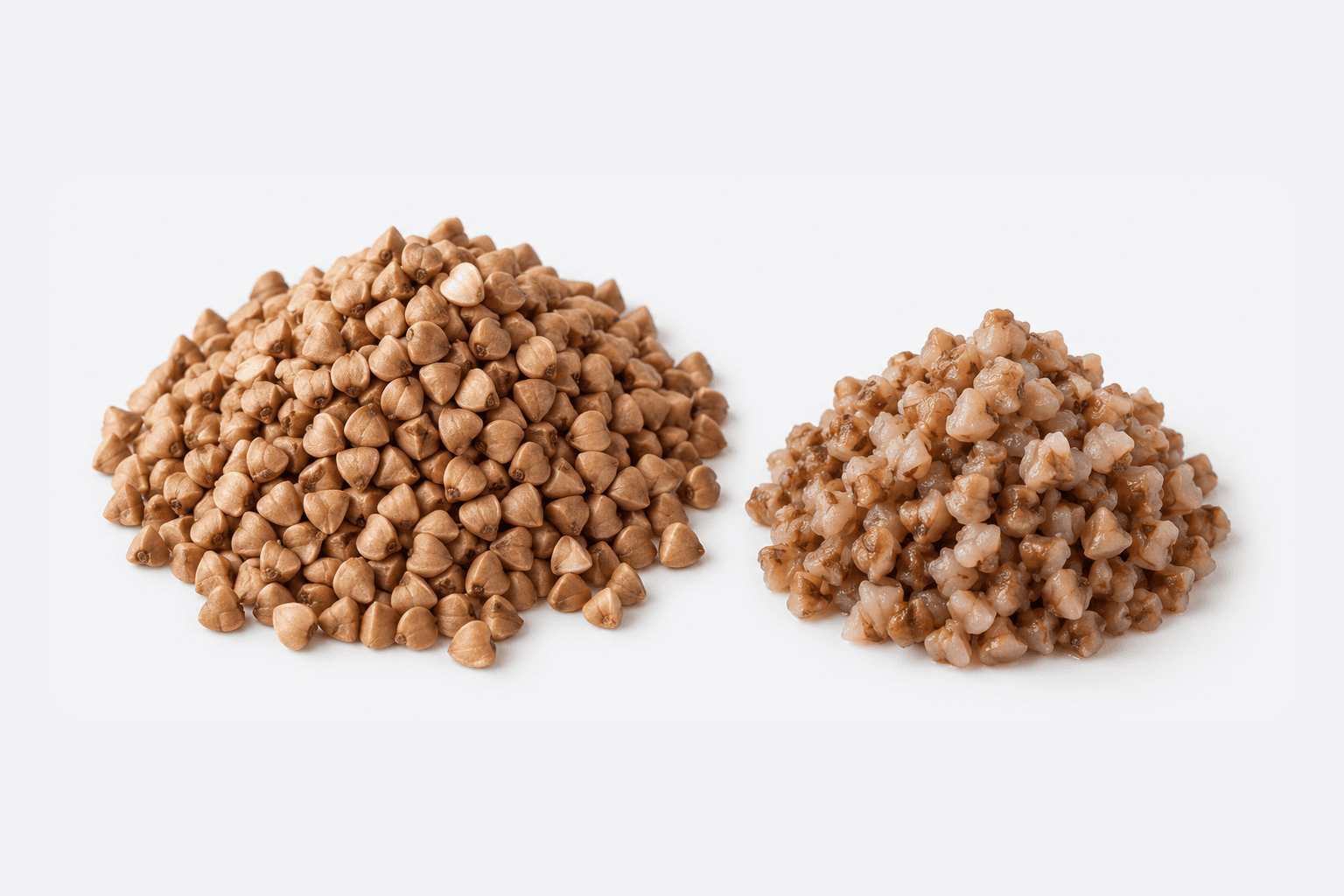
- Roasted groats (kasha) are nuttier and hold their shape; unroasted goes softer and more porridge-like.
- With coeliac disease, read the ingredients. Soba usually contains wheat flour.
- Rinse noodles in cold water the moment they are cooked, or surface starch glues them together.
- The doses in those trials varied widely. With no basis for recommending a specific amount, swapping part of your rice for buckwheat is the realistic move.
- If magnesium is the point, whole groats beat refined buckwheat flour.
How to read the grades
Each benefit carries a label showing how far research on people supports it. Grades differ between items even within the same ingredient.
- Nutrition data
- A fact verifiable from food composition databases or health authorities. This is a different kind of statement from a clinical effect.
- Strong evidence
- Consistently confirmed across randomised controlled trials or meta-analyses.
- Moderate evidence
- Human studies exist, but effect sizes are small or results are mixed.
- Early research
- Cell or animal work, or small preliminary studies.
- Not established
- Commonly claimed, but not confirmed in studies on people.
What to watch out for
- Buckwheat allergy is not rare in Korea and Japan, and tends to be severe. Anaphylaxis has been reported. Introduce it to children in small amounts.
- Buckwheat hull pillows can sensitise too. With a buckwheat allergy, check the pillow as well.
- With coeliac disease, watch the wheat flour in soba. Buckwheat itself is gluten-free; the product may not be.
- The evidence above carries high heterogeneity and low confidence. No conclusion was reached on LDL, blood pressure, insulin or weight.
- If you take glucose-lowering medication, note that fasting glucose fell in the analysis — with the same heterogeneity caveat.
- Rutin's effects are not established. Rutin supplements and buckwheat are different subjects.
Nutrition
Per 100 g of cooked roasted buckwheat groats. A bowl is 150 g. Dry buckwheat roughly triples in weight when cooked.
- Calories
- 92 kcal5%
- Carbohydrates
- 19.9 g7%
- Fiber
- 2.7 g10%
- Protein
- 3.38 g7%
- Magnesium
- 51 mg12%
- Manganese
- 0.403 mg18%
- Copper
- 0.146 mg16%
- Phosphorus
- 70 mg6%
- Potassium
- 88 mg2%
- Choline
- 20.1 mg4%
- Zinc
- 0.61 mg6%
Percentages are of the US FDA Daily Value for adults and children 4 and over. National reference intakes differ by sex and age.
Calculate this alongside other ingredients →
Key nutrients
By health concern
Dishes with this ingredient
Sources
The databases and health authorities this article's nutrition figures and health statements draw on.
- 1Buckwheat and CVD Risk Markers: A Systematic Review and Meta-AnalysisMeta-analysisLi L, et al. Nutrients 2018PMID 29762481
- 2USDA FoodData CentralFood composition database
- 3MFDS Food Composition Database · 식품안전나라Food composition database
- 4European Food Safety Authority (EFSA)Health authority
- 5NIH Office of Dietary SupplementsHealth authority
- 6PubMedResearch literature