Contents
What it is
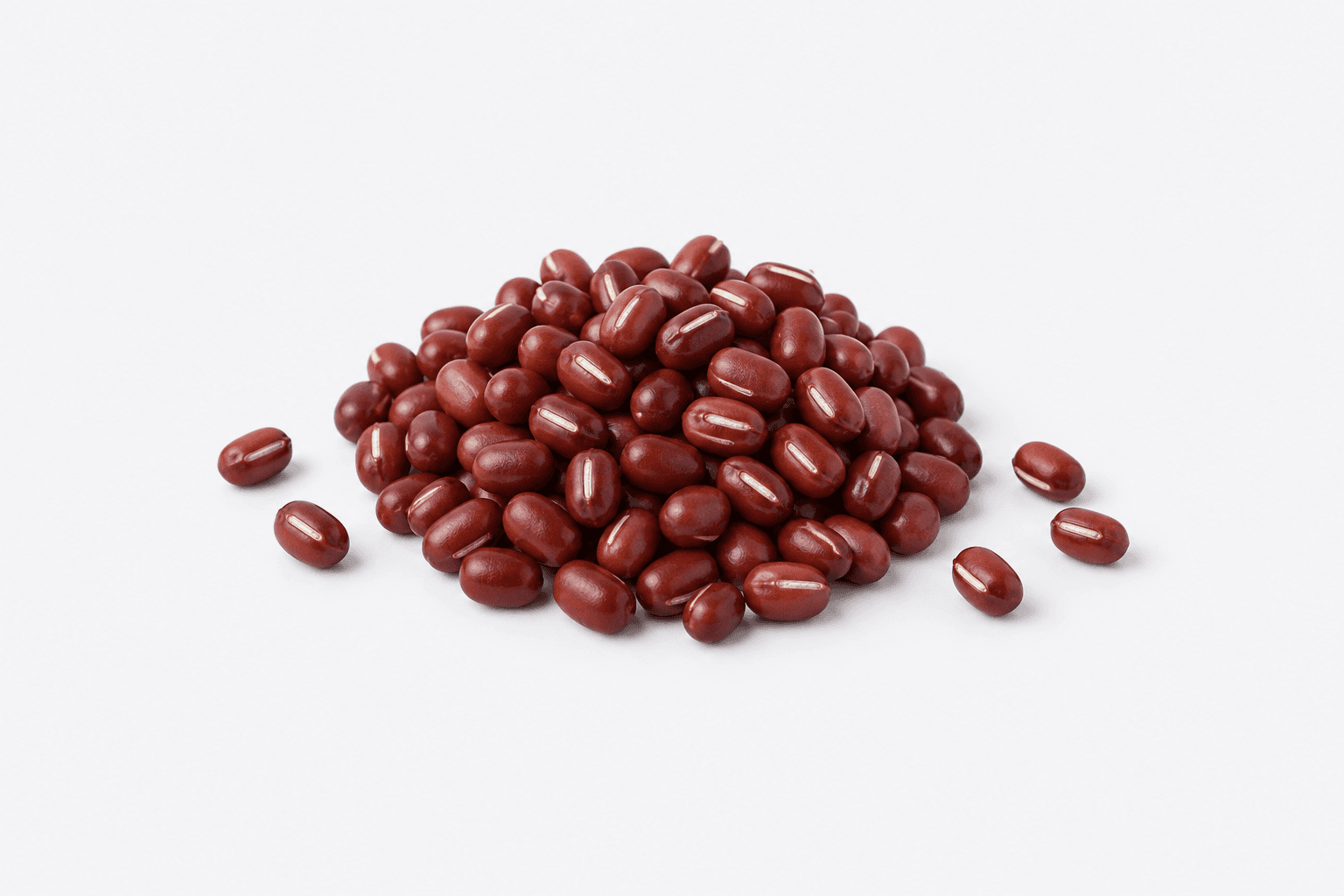
The adzuki bean is an annual legume grown for its small red seeds. It is native to East Asia and has long been cultivated in Korea, China and Japan. The beans are smaller and lower in fat than soybeans and high in starch, so they turn mealy and soft when boiled. In Korea they go into porridge, shaved-ice desserts and the sweet paste filling of rice cakes and buns. The skin is tough, so they are usually soaked, or boiled once and drained before the real cooking.
Scientific name Vigna angularis
Adzuki runs deep in Korean food — the winter-solstice porridge, steamed rice cakes, shaved ice, sweet buns.
The composition is striking. 100 g of dry beans holds 622 µg of folate, 156% of the requirement, along with 12.7 g of fibre, 1,250 mg of potassium and 19.9 g of protein, with only 0.53 g of fat.
The clinical evidence comes from the pulse category. This site found no randomised trial of adzuki alone. What exists is meta-analyses of randomised trials of pulse intake — beans, lentils, chickpeas, adzuki together — and LDL fell.
Which brings us to the point of this page.
Those trials fed unsweetened pulses: boiled beans, beans in soups and salads. That is not how adzuki is usually eaten in Korea — the beans on shaved ice, the paste in a bun, the sugar in the porridge. Sweet red bean paste is made with sugar at 40–50% of the weight of the beans.
That adzuki is a good food and that sweet red bean is a good food are different claims.
Key benefits
- Moderate evidence
Pulse intake lowered LDL — but no trial named adzuki
[1][2]First, what kind of evidence this is. The analyses below examined the category of dietary pulses. Adzuki belongs to that category, but this is not the result of a trial that fed people adzuki.
A 2014 meta-analysis of randomised controlled trials in CMAJ examined pulse intake and lipid targets. In the pulse groups, LDL cholesterol fell significantly. The amounts used were typically around one cup a day (roughly 130 g cooked).
A 2026 updated analysis in the Journal of the American Heart Association broke the results down by type of pulse and added a dose-response analysis.
How to read this.
First, it is category-level evidence. Adzuki is a pulse, but its composition is not identical to lentils or chickpeas. That said, the mechanisms usually proposed — soluble fibre, resistant starch, plant protein — are present in adzuki too.
Second, the size is not large. Across pulse analyses, the LDL reduction sits around 5 mg/dL. That is not comparable to a statin. But it comes from food, and the direction is consistent.
Third, and most importantly — the form those trials fed.
The pulses used were boiled beans, canned beans, beans in soups and salads. Not beans with sugar.
Here is how adzuki usually reaches a Korean table.
Form What comes with the beans Sweet red bean paste Sugar at 40–50% of the beans' weight Patbingsu (shaved ice) Paste + condensed milk + syrup + rice cake Sweet red bean bun Paste + the sugar in the bread Patjuk (porridge) Glutinous rice balls, sugar or salt Plain boiled beans Nothing Only the last row can expect the result of those meta-analyses.
The honest conclusion: eating pulses regularly helps LDL, and adzuki is a pulse. But that benefit attaches to the bean, not to the sweetened paste. Expecting the pulse benefit while eating a paste that is 40% sugar does not add up.
- Nutrition data
622 µg of folate — 156% of the requirement — and 0.53 g of fat
Per 100 g of dry adzuki beans:
- 329 kcal, protein 19.9 g, fat 0.53 g
- Of 62.9 g of carbohydrate, 12.7 g is fibre
- Folate 622 µg — 156% of the requirement (400 µg)
- Potassium 1,250 mg — 27% of the requirement
- Zinc 5.04 mg, iron 4.98 mg, magnesium 127 mg, phosphorus 381 mg
- Copper 1.09 mg, manganese 1.73 mg, thiamin 0.455 mg
The 622 µg of folate defines this bean. Pulses are high in folate generally, and adzuki sits near the top. Folate matters especially around pregnancy, and is involved in DNA synthesis and red blood cell formation.
0.53 g of fat is low even among pulses — next to soybean's 19.9 g it is effectively nothing. That is why adzuki, unlike soy, is not pressed for oil.
But the 100 g is dry weight. Cooked, the beans take up water and weigh about 2.3 times as much.
Dry 100 g Dry 40 g (one serving) ≈92 g cooked Energy 329 kcal 132 kcal 132 kcal Fibre 12.7 g 5.1 g 5.1 g Folate 622 µg 249 µg (62%) 249 µg Protein 19.9 g 8.0 g 8.0 g Potassium 1,250 mg 500 mg 500 mg Even one serving — 40 g dry — gives 62% of the folate requirement and 5.1 g of fibre.
Folate is heat-sensitive, though. Long boiling loses a good share of it and some leaches into the cooking water. The table is for raw beans, so what actually reaches you is less.
Adzuki contains saponins and tannins, the source of its astringency, which is why the first boiling water is traditionally discarded. That step carries off some water-soluble compounds along with the astringency — a trade between flavour and nutrients.
Soaking is similar. Unlike soybeans, adzuki has a hard seed coat, so it is often boiled without soaking. Soaking shortens cooking, makes them easier to digest, and removes some oligosaccharides, so they produce less gas.
- Not established
"Adzuki reduces swelling" — the potassium is real, the next step is not
This entry sorts through a common claim.
The thing you hear most about adzuki is that it "reduces swelling" or "acts as a diuretic". Drinking the cooking water comes from the same idea.
The starting point is true. Adzuki holds 1,250 mg of potassium per 100 g. Potassium promotes sodium excretion, and the sodium-potassium balance is involved in fluid volume and blood pressure. That mechanism is in the physiology textbooks.
The evidence breaks at the next step.
First, "swelling" is not a diagnosis. A puffy face in the morning and the oedema of heart failure, kidney failure or cirrhosis are entirely different things. The latter is not a matter for food but for medical care.
Second, this site found no randomised trial in people where feeding adzuki changed a measure of oedema. Containing potassium and reducing a person's swelling are claims at different levels.
Third, adzuki is not unusual in potassium. Banana, potato, spinach and tomato are all potassium sources. There is no evidence that adzuki is particularly diuretic.
Fourth — and this matters most in practice. If you are thinking about the sodium-potassium balance, cutting sodium does more than adding potassium. Drinking bean water while keeping the same soups and salted seafood cancels the direction out.
And some people need the opposite caution. With reduced kidney function, potassium cannot be excreted and hyperkalaemia becomes a risk. 1,250 mg per 100 g is not a small amount. With kidney disease, the cooking water deserves particular care.
The honest conclusion: adzuki is genuinely high in potassium, and eating pulses regularly is a good habit. But "reduces swelling" is not an effect confirmed in people, and with kidney disease it can be a risk rather than a benefit.
How to eat it well
- Discarding the first boiling water cuts astringency but carries off some water-soluble compounds too.
- Soaking before boiling shortens cooking and reduces gas. Adzuki's hard coat means it can also go in unsoaked.
- Salt after they are cooked. Added early, the skins toughen.
- Plain boiled beans, without sugar, are closest to the evidence. Paste is a different food.
- About 40 g dry per serving is realistic — 132 kcal and 5.1 g of fibre.
- Folate is heat-sensitive. The longer the boil, the less remains.
- Mixed into rice they raise the fibre and protein of plain white rice.
- If you restrict potassium for kidney disease, avoid the cooking water.
How to read the grades
Each benefit carries a label showing how far research on people supports it. Grades differ between items even within the same ingredient.
- Nutrition data
- A fact verifiable from food composition databases or health authorities. This is a different kind of statement from a clinical effect.
- Strong evidence
- Consistently confirmed across randomised controlled trials or meta-analyses.
- Moderate evidence
- Human studies exist, but effect sizes are small or results are mixed.
- Early research
- Cell or animal work, or small preliminary studies.
- Not established
- Commonly claimed, but not confirmed in studies on people.
What to watch out for
- The evidence is at the level of the pulse category, and this site identified no randomised trial of adzuki alone.
- Those trials fed unsweetened pulses. Sweet red bean paste carries sugar at 40–50% of the beans' weight; the same evidence cannot be applied to shaved ice or sweet buns.
- "Reduces swelling" has no confirmed human evidence.
- With reduced kidney function, the potassium is a risk. 100 g holds 1,250 mg, and the cooking water concentrates it.
- Always cook dry beans thoroughly. Undercooked pulses retain lectins that can cause gastrointestinal symptoms.
- Canned sweet beans are very high in sugar. Check the label.
- With IBS, the oligosaccharides in pulses can cause gas and abdominal pain.
- The table is for dry (raw) beans. Cooking multiplies the weight 2.3 times, so do not compare like for like by weight.
Nutrition
Per 100 g of dry adzuki beans. Cooking multiplies the weight about 2.3 times, so 100 g of cooked beans corresponds to about 45 g dry. A single serving is around 40 g dry.
- Calories
- 329 kcal16%
- Protein
- 19.9 g40%
- Fat
- 0.53 g<1%
- Carbohydrates
- 62.9 g23%
- Fiber
- 12.7 g45%
- Folate
- 622 µg156%
- Potassium
- 1250 mg27%
- Iron
- 4.98 mg28%
- Magnesium
- 127 mg30%
- Zinc
- 5.04 mg46%
- Phosphorus
- 381 mg30%
- Vitamin B1
- 0.455 mg38%
Percentages are of the US FDA Daily Value for adults and children 4 and over. National reference intakes differ by sex and age.
Calculate this alongside other ingredients →
Key nutrients
By health concern
Dishes with this ingredient
Sources
The databases and health authorities this article's nutrition figures and health statements draw on.
- 1Effect of dietary pulse intake on established therapeutic lipid targets for cardiovascular risk reduction: a systematic review and meta-analysis of randomized controlled trialsMeta-analysisHa V, et al. CMAJ 2014PMID 24710915
- 2Effect of Different Types of Whole Dietary Pulses on Established Therapeutic Lipid Targets for Cardiovascular Risk Reduction: An Updated Systematic Review and Dose-Response Meta-Analysis of Randomized Controlled TrialsMeta-analysisBack S, et al. J Am Heart Assoc 2026PMID 42132198
- 3USDA FoodData CentralFood composition database
- 4PubMedResearch literature
- 5NIH Office of Dietary SupplementsHealth authority