Contents
What it is
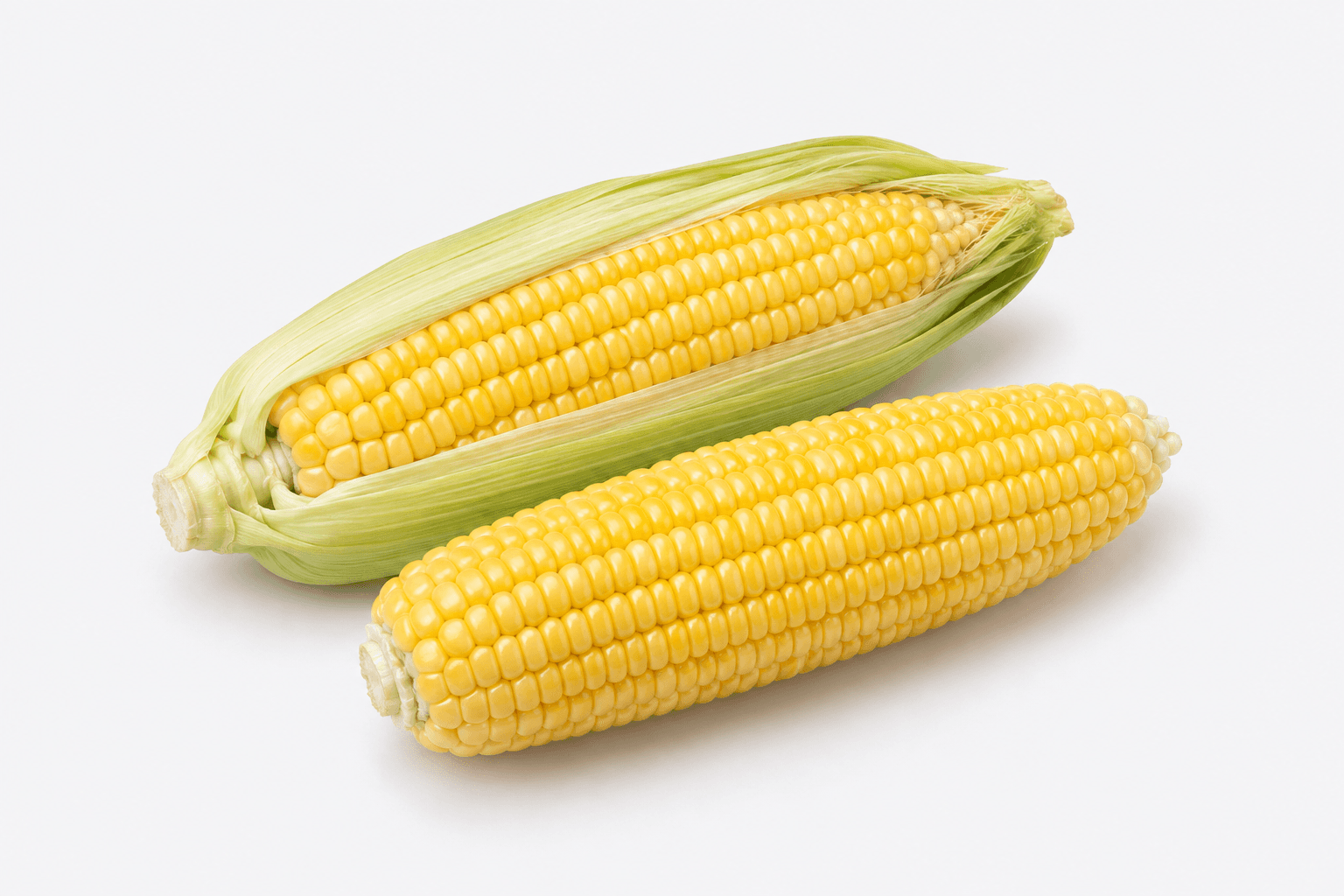
Corn is an annual cereal in the grass family, domesticated from wild teosinte in what is now Mexico. Each kernel is a separate seed, and every strand of silk runs to one kernel. Varieties diverge sharply in use: waxy and sweet corn are steamed while still immature, while fully dried grain becomes flour, feed, starch and oil. Sugar starts converting to starch the moment the ear is picked, so the sooner it is eaten the sweeter it tastes.
Scientific name Zea mays
Corn's yellow is not just a colour. Lutein and zeaxanthin come to 644 µg per 100 g, and those two genuinely accumulate in the macula of the eye.
Hence 'corn is good for your eyes'. Here is where honesty is required: the primary analysis of the largest trial of lutein supplementation, AREDS2, failed.
Another thing about corn is widely misunderstood. It holds 1.77 mg of vitamin B3 (niacin), but most of it is bound in a form the human gut cannot absorb. That fact drove the pellagra epidemics of history.
And the most important distinction of all: corn and corn products are different foods. The numbers on this page belong to boiled corn, not to corn syrup or breakfast cereal.
Key benefits
- Moderate evidence
644 µg of lutein and zeaxanthin — but AREDS2's primary analysis failed
[1]Corn holds 644 µg of lutein plus zeaxanthin per 100 g, unmatched among grains. The pair deposit selectively in the macula and filter blue light.
Here is the largest trial, stated plainly. AREDS2, published in JAMA in 2013, followed 4,203 people for five years, testing 10 mg of lutein plus 2 mg of zeaxanthin.
Primary result: no significant reduction in progression to advanced macular degeneration (hazard ratio 0.90, 95 % CI 0.76–1.07, p = .12).
The confidence interval crosses 1. No effect cannot be ruled out.
Secondary analyses told a different story. Among the lowest fifth for dietary lutein intake, supplementation did appear to help. And a benefit appeared when lutein and zeaxanthin substituted for beta-carotene.
Secondary analyses generate hypotheses; they do not prove them. Slice a trial into enough subgroups and some will come up significant by chance.
Put together: adding more lutein to people already eating plenty did not help. For those eating little, the possibility remains open. Eating corn, kale and spinach speaks to the second case.
One more thing. AREDS2 tested a supplement, not corn. Whether lutein from food behaves the same way is a separate question.
- Nutrition data
The niacin is there but bound — the history of nixtamalisation
Corn holds 1.77 mg of niacin (vitamin B3) per 100 g. As a number, that is respectable.
But much of it exists as niacytin, a bound form the human digestive tract does not absorb.
That fact changed history. When corn spread from the Americas to Europe and Africa, the cooking method did not travel with it. In Mesoamerica, corn had for millennia been simmered in limewater — nixtamalisation — and that alkaline process releases the bound niacin.
In regions that adopted corn as a staple without it — southern Europe, the American South, parts of Africa, from the eighteenth to the twentieth century — pellagra became epidemic. It is niacin deficiency, running through dermatitis, diarrhoea and dementia to death. In the American South alone, an estimated three million cases and a hundred thousand deaths occurred over several decades in the early twentieth century.
This rarely matters now. Diets built on corn alone are uncommon, and many countries fortify grain products with niacin.
The principle still holds, though. There is a reason tortillas go through an alkaline treatment — and as long as corn is one food among many, none of this is a problem.
Folate is 42 µg, 10 % of the adult requirement per 100 g; magnesium 37 mg; fibre 2 g.
- Nutrition data
Corn and corn products are different foods
This may be the section that matters most.
Food kcal per 100 g Note Boiled corn 86 what this page is about Popcorn (oil, salt) around 500 bulky, so portions are small Cornflakes 360 many products add sugar Corn oil 884 100 g of fat High-fructose corn syrup 281 pure sugar Same crop, nutritionally different foods. The lutein and folate figures above apply only to the first row.
High-fructose corn syrup in particular is a leading added sugar in processed drinks and foods, an entirely separate issue from the health of corn. Eating corn and drinking something sweetened with corn syrup are choices in opposite directions.
Popcorn deserves a fair word. Strip out the oil, butter and salt and it is a whole-grain snack. Thirty grams of air-popped popcorn — a large bowl — is about 110 kcal with 3.6 g of fibre. What makes cinema popcorn what it is, is the oil and salt, not the corn.
How to eat it well
- Steam or boil it in the husk. Lutein is fat-soluble and survives cooking; heat actually loosens cell walls and aids absorption.
- Eat it with fat. Lutein and zeaxanthin are fat-soluble. A knob of butter, a spoon of olive oil, or eggs or nuts alongside all raise absorption.
- Check the sodium on canned corn. Choose unsalted, or rinse it, which removes a good share.
- Air-popped popcorn is a decent whole-grain snack, and you control the oil and salt yourself.
- Corn instead of rice is about two thirds the calories for the same weight — though its sweetness makes it easy to eat a lot of.
- Waxy corn holds more starch than sweet corn and produces a larger blood sugar response.
How to read the grades
Each benefit carries a label showing how far research on people supports it. Grades differ between items even within the same ingredient.
- Nutrition data
- A fact verifiable from food composition databases or health authorities. This is a different kind of statement from a clinical effect.
- Strong evidence
- Consistently confirmed across randomised controlled trials or meta-analyses.
- Moderate evidence
- Human studies exist, but effect sizes are small or results are mixed.
- Early research
- Cell or animal work, or small preliminary studies.
- Not established
- Commonly claimed, but not confirmed in studies on people.
What to watch out for
- The large trial of lutein supplementation (AREDS2) failed on its primary analysis. There is no evidence yet that eating more corn prevents macular degeneration.
- Corn is a grain, not a vegetable. At 18.7 g of carbohydrate, it belongs in the place of a bowl of rice, not a plate of vegetables.
- None of this page's evidence applies to corn syrup, cornflakes or corn oil.
- Seeing undigested hulls in your stool is normal. Humans cannot break down the cellulose of the outer skin.
- With diabetes, count corn as a carbohydrate source.
- Corn allergy is uncommon but real, and hard to avoid given how widely corn is used in processed food.
Nutrition
Per 100 g of raw sweet yellow corn. The kernels from one ear are about 90 g. Popcorn, cereal and corn oil are different foods entirely.
- Calories
- 86 kcal4%
- Protein
- 3.27 g7%
- Carbohydrates
- 18.7 g7%
- Fiber
- 2 g7%
- Lutein
- 644 µg
- Folate
- 42 µg11%
- Magnesium
- 37 mg9%
- Vitamin B3
- 1.77 mg11%
Percentages are of the US FDA Daily Value for adults and children 4 and over. National reference intakes differ by sex and age.
Calculate this alongside other ingredients →
Key nutrients
Dishes with this ingredient
Sources
The databases and health authorities this article's nutrition figures and health statements draw on.
- 1Lutein + zeaxanthin and omega-3 fatty acids for age-related macular degeneration: the Age-Related Eye Disease Study 2 (AREDS2) randomized clinical trialClinical trialAge-Related Eye Disease Study 2 Research Group JAMA 2013PMID 23644932
- 2USDA FoodData CentralFood composition database
- 3MFDS Food Composition Database · 식품안전나라Food composition database
- 4NIH Office of Dietary SupplementsHealth authority
- 5PubMedResearch literature