Contents
What it is
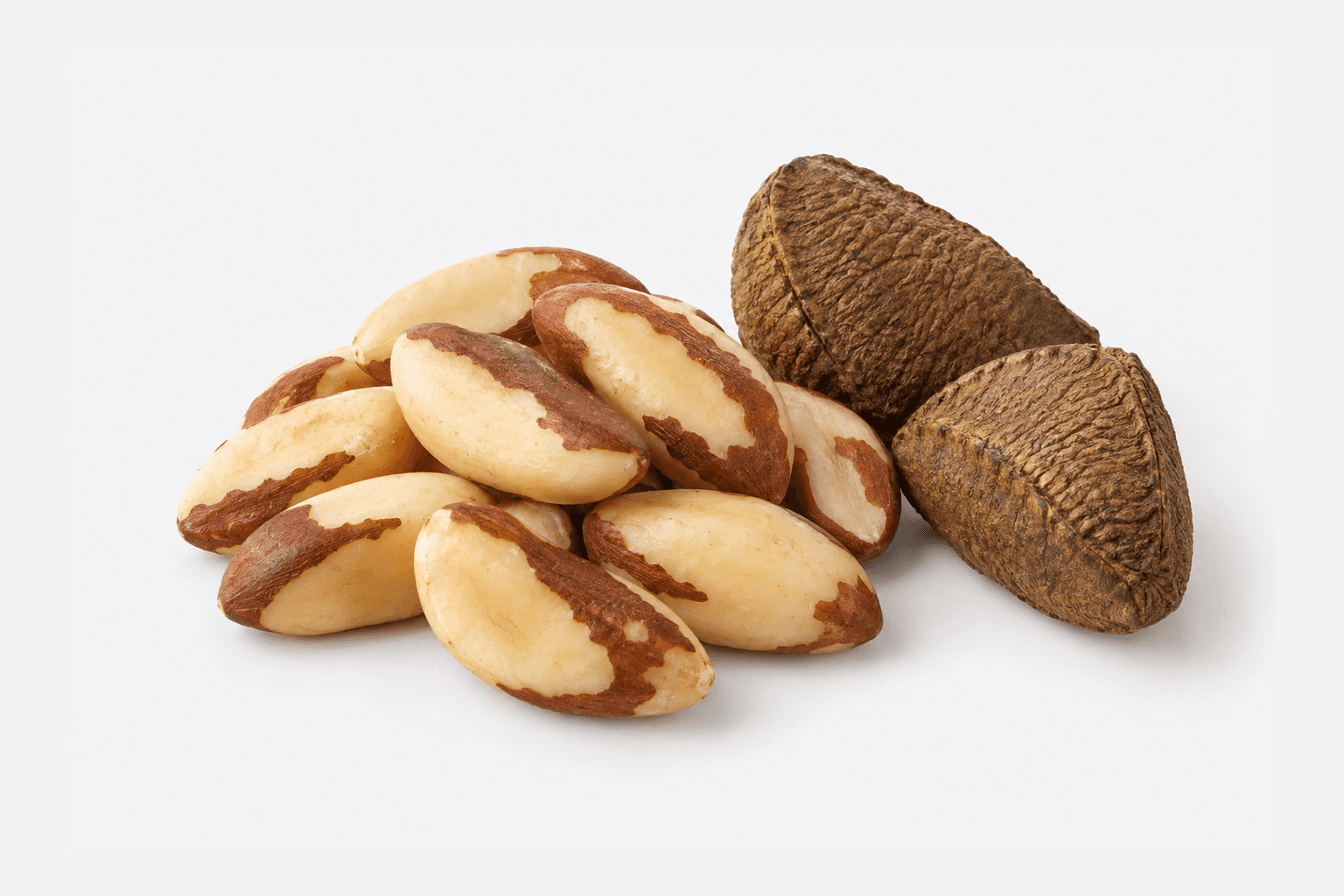
The Brazil nut is the seed of a tall tree in the Amazon rainforest. Inside a hard, coconut-like pod sit a dozen or more seeds, packed like orange segments. Almost the entire supply is gathered from wild trees, because the species is pollinated by particular bees and does not take well to plantations. The nuts are large and oily, with a soft bite. Their selenium content is in a different league from any other nut, which makes this the one nut usually sold with advice to count how many you eat in a day.
Scientific name Bertholletia excelsa
'One nut a day covers your selenium' is widely repeated. The problem is that nobody knows how much selenium is in that nut.
USDA's own records show it.
| Record | Selenium (per 100 g) | One nut (5 g) |
|---|---|---|
| SR Legacy (dried, unblanched) | 1,920 µg | 96 µg |
| Foundation (raw, recent analysis) | 280 µg | 14 µg |
Two figures from the same institution, sevenfold apart. Neither is a measurement error: Brazil nut selenium mirrors the selenium concentration of the soil the tree grew in, and soil selenium varies widely even across the Amazon basin.
The adult requirement is 60 µg and the upper limit is 400 µg. At the high figure, one nut passes the requirement and four reach the limit. At the low figure, it takes four nuts to meet the requirement.
Eating it daily without knowing the dose is this food's real problem.
Key benefits
- Nutrition data
You cannot know the selenium content — why this comes first
This is not a benefit; it is about how to handle this food.
Brazil nut trees take up selenium from soil with unusual efficiency. Content therefore varies by product, by region, even between nuts in the same bag. Studies report anywhere from a few µg to over 100 µg per nut.
Few packages state the selenium content, and where they do it is an average.
Selenium excess (selenosis) shows up as garlic-smelling breath, a metallic taste, brittle or falling hair and nails, gastrointestinal upset and skin rash. Severe cases bring neurological symptoms.
The 400 µg limit covers food and supplements together. Taking a selenium supplement while eating Brazil nuts daily is the riskiest combination.
The practical conclusion is one line. One or two nuts a day. Beyond that you are on the risk side, not the benefit side. If you want selenium at a known dose, a labelled supplement is actually safer.
- Moderate evidence
Selenium markers rise reliably — beyond that, less so
[1]A 2022 systematic review pooled 24 clinical trials.
Antioxidant markers improved consistently. Selenium levels in plasma, serum, whole blood and erythrocytes, and glutathione peroxidase activity, rose in every study that measured them, regardless of the participants' health status. That Brazil nuts actually deliver selenium is clear.
Beyond that it is murkier. Healthy participants showed improved lipids and fasting glucose, and people with obesity showed improved lipid markers — but results varied by group.
The review's limits, stated plainly.
- Fifteen of the 24 studies were not randomised.
- All added Brazil nuts to a habitual free-living diet; none was a controlled comparison against something else.
- No trial measured disease outcomes — heart attack, death, cancer.
So 'selenium levels rise' is solid; 'therefore disease falls' is not established. Large trials of selenium supplements against cancer and cardiovascular disease have mostly failed to show benefit.
- Nutrition data
High in fat and magnesium
Per 100 g Brazil nuts hold 67.1 g of fat and 659 kcal — high even among nuts. One nut (5 g) is 33 kcal.
Magnesium is 376 mg, near the top for nuts. Per 100 g that nearly meets the adult requirement (350–400 mg for men) — but again, 100 g is twenty nuts. One nut gives 19 mg, 5 % of the requirement.
Phosphorus 725 mg, copper 1.74 mg, vitamin E 5.65 mg, fibre 7.5 g.
The fatty acids run roughly 16 g saturated, 24 g monounsaturated, 24 g polyunsaturated — a reasonable balance. But one or two nuts is not a meaningful amount of these nutrients, and a meaningful amount makes the selenium a problem. That is the structure of this food.
How to eat it well
- One or two nuts a day. The single most important line on this page.
- Do not stack it with a selenium supplement. The 400 µg limit covers food and supplements together.
- Mix them with other nuts. A bag of nothing but Brazil nuts on a desk becomes a handful. Mixed with almonds and walnuts, the count falls by itself.
- Keep them cold. At 67 g of fat they go rancid quickly at room temperature. Bitter taste means throw them out.
- Choose unroasted. Many products add salt and oil.
- If selenium is the goal, tuna, oysters or eggs give a far more predictable dose.
How to read the grades
Each benefit carries a label showing how far research on people supports it. Grades differ between items even within the same ingredient.
- Nutrition data
- A fact verifiable from food composition databases or health authorities. This is a different kind of statement from a clinical effect.
- Strong evidence
- Consistently confirmed across randomised controlled trials or meta-analyses.
- Moderate evidence
- Human studies exist, but effect sizes are small or results are mixed.
- Early research
- Cell or animal work, or small preliminary studies.
- Not established
- Commonly claimed, but not confirmed in studies on people.
What to watch out for
- Do not exceed three or four a day. Depending on origin, even that can reach the 400 µg limit.
- Selenosis shows as garlic breath, metallic taste, brittle or falling hair and nails, and gastrointestinal upset.
- If you take a selenium supplement, leaving out Brazil nuts is the safer choice.
- Children have much lower limits. Do not portion them as you would for an adult.
- Avoid them with a nut allergy. Brazil nut allergy can be severe.
- With thyroid disease, discuss selenium intake with your clinician — selenium is involved in thyroid hormone metabolism.
- One nut is 33 kcal, high even for a nut.
Nutrition
Per 100 g of raw Brazil nuts. One nut is about 5 g, so 100 g is twenty nuts — an amount you should not actually eat.
- Calories
- 659 kcal33%
- Protein
- 14.3 g29%
- Fat
- 67.1 g86%
- Fiber
- 7.5 g27%
- Selenium
- 280~1920 µg999%+
- Magnesium
- 376 mg90%
- Phosphorus
- 725 mg58%
- Copper
- 1.74 mg193%
- Vitamin E
- 5.65 mg38%
Percentages are of the US FDA Daily Value for adults and children 4 and over. National reference intakes differ by sex and age.
Calculate this alongside other ingredients →
Key nutrients
Dishes with this ingredient
Sources
The databases and health authorities this article's nutrition figures and health statements draw on.
- 1Effects of Regular Brazil Nut (Bertholletia excelsa H.B.K.) Consumption on Health: A Systematic Review of Clinical TrialsSystematic reviewsda Silva A, et al. Foods 2022PMID 36141050
- 2USDA FoodData CentralFood composition database
- 3NIH Office of Dietary SupplementsHealth authority
- 4European Food Safety Authority (EFSA)Health authority
- 5PubMedResearch literature