Contents
What it is
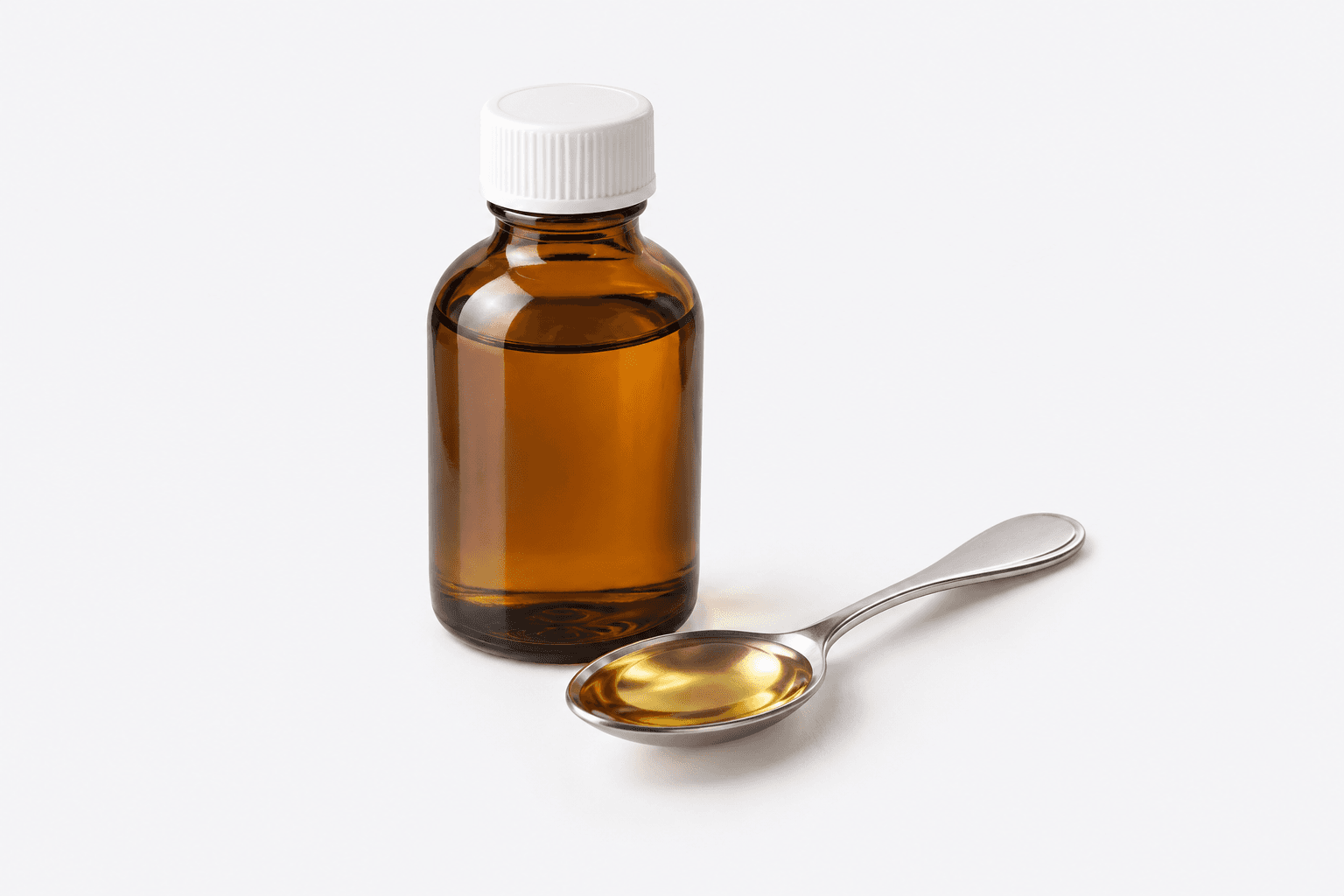
Cod liver oil is extracted from the liver of cod, which makes it different from ordinary fish oil pressed from the flesh. Cod store their fat in the liver rather than the muscle, so that is where the oil comes from — and with it come vitamins A and D, which accumulate in liver tissue. That is precisely why the bottle carries dosing advice: take too much and the vitamin A adds up. It has a long history in northern Europe, where it was given to children through sunless winters.
Cod liver oil is not a thin oil but an overly concentrated one, and that is the point of this page.
Per 100 g it holds 30,000 µg RAE of vitamin A. The adult upper limit is 3,000 µg a day. So 100 g is not ten times the limit — it is ten days of it. Which is why this food is discussed in teaspoons, once a day.
One teaspoon (4.5 g) gives:
- Vitamin D 11 µg — 75 % of the adult requirement of 15 µg
- Omega-3 (EPA + DHA) 0.8 g — roughly what the American Heart Association's two-fish-meals-a-week advice delivers
- Vitamin A 1,350 µg RAE — 45 % of the 3,000 µg limit
The first two are good news; the third is a line to hold. Plenty of writing separates them, so this page keeps them together.
Key benefits
- Nutrition data
Three quarters of a day's vitamin D in one teaspoon
Cod liver oil holds 250 µg of vitamin D per 100 g. No whole food comes close — farmed salmon sits at 10–13 µg, sardines at 4.8 µg, an order of magnitude away.
A teaspoon (4.5 g) delivers 11.3 µg, 75 % of the 15 µg adult requirement.
On supplementation there is a large trial. A 2022 ancillary study of VITAL, in the New England Journal of Medicine, gave 2,000 IU (50 µg) of vitamin D to 25,871 healthy middle-aged and older adults for more than five years.
The result was no reduction in fractures. Total fractures (hazard ratio 0.98), non-vertebral (0.97) and hip (1.01) were all unchanged. Most participants were not vitamin D deficient to begin with.
The message is clear: adding vitamin D to people who are not deficient does nothing for bone. Cod liver oil earns its place when there is a real shortfall — little sun exposure, high-latitude winters, deficiency confirmed by testing.
- Moderate evidence
0.8 g of omega-3 (EPA + DHA) per teaspoon
[1]Per 100 g, cod liver oil carries 6.9 g of EPA and 11.0 g of DHA. A teaspoon gives 0.31 g EPA plus 0.50 g DHA — 0.8 g together.
A 2020 meta-analysis of omega-3 supplementation and cardiovascular outcomes pooled 38 randomised trials and 149,051 participants. The findings are moderate.
- Myocardial infarction reduced (relative risk 0.87)
- Coronary heart disease events reduced (0.90)
- No significant reduction in stroke or total mortality
- Higher doses produced larger effects
So omega-3 is not a cure-all but a moderate effect confined to the coronary side. For someone who does not eat fish it fills a gap; for someone already eating fish twice a week, the case for adding more is weak.
Plant omega-3 — the ALA in canola and perilla oil — does not substitute. Only 5–8 % converts to EPA in the body.
- Strong evidence
Vitamin A is the limiting factor in this food
[2]This is not a benefit but a boundary. It belongs here because it needs checking before either of the two above.
Cod liver oil holds 30,000 µg RAE of vitamin A per 100 g. The adult upper intake level is 3,000 µg RAE a day.
Amount Vitamin A Of the limit 1 teaspoon (4.5 g) 1,350 µg 45 % 1 tablespoon (13.6 g) 4,080 µg 136 % 2 teaspoons 2,700 µg 90 % A single tablespoon exceeds the daily upper limit. That is why this table sits on this page.
An excess of retinol — animal vitamin A — is not the same as beta-carotene from carrots. The body converts beta-carotene only as needed; retinol simply accumulates. Chronic excess can cause liver damage, reduced bone density, headache and dry skin.
Pregnancy demands particular care. High-dose retinol is established as capable of causing birth defects. In pregnancy the right product is fish oil without retinol, not cod liver oil. The names are similar but the products differ: fish body oil carries almost no vitamin A or D; only liver oil is loaded with them.
How to eat it well
- Do not exceed one teaspoon (4.5 g) a day. Check the serving size on the label and follow it — that is the safest rule.
- Do not stack it with other vitamin A. A multivitamin, a liver dish (100 g of pork liver holds about 6,500 µg) or a retinol preparation on the same day will pass the limit easily.
- Take it with a meal. It is fat-soluble and absorbs better that way.
- Refrigerate and use it up. High omega-3 content means fast rancidity. A sharply fishy smell means oxidation.
- If you eat fish twice a week or more, you probably do not need it. Cod liver oil is for filling a shortfall.
- Lemon-flavoured versions go down more easily, but the flavouring can mask rancidity.
How to read the grades
Each benefit carries a label showing how far research on people supports it. Grades differ between items even within the same ingredient.
- Nutrition data
- A fact verifiable from food composition databases or health authorities. This is a different kind of statement from a clinical effect.
- Strong evidence
- Consistently confirmed across randomised controlled trials or meta-analyses.
- Moderate evidence
- Human studies exist, but effect sizes are small or results are mixed.
- Early research
- Cell or animal work, or small preliminary studies.
- Not established
- Commonly claimed, but not confirmed in studies on people.
What to watch out for
- One tablespoon exceeds the daily vitamin A limit. That is the single most important line about this food.
- Avoid it in pregnancy. The teratogenic risk of high-dose retinol is established. If supplementation is needed, choose a retinol-free fish oil with your clinician.
- With liver disease or osteoporosis, excess vitamin A can worsen the condition.
- On anticoagulants such as warfarin, omega-3 can increase bleeding tendency. Discuss it first.
- If you also take a vitamin D supplement, add the two together. The adult upper limit for vitamin D is 100 µg.
- Children need a weight-appropriate dose. Do not simply split an adult one.
- Do not take it if you are allergic to fish.
Nutrition
Per 100 g. In practice a dose is one teaspoon (4.5 g) — a twenty-second of this table. Even that teaspoon carries 1,350 µg RAE of vitamin A.
- Calories
- 902 kcal45%
- Fat
- 100 g128%
- Vitamin A
- 30000 µg999%+
- Vitamin D
- 250 µg999%+
- Omega-3
- 19.7 g
- Vitamin E
- 20 mg133%
Percentages are of the US FDA Daily Value for adults and children 4 and over. National reference intakes differ by sex and age.
Calculate this alongside other ingredients →
Key nutrients
Sources
The databases and health authorities this article's nutrition figures and health statements draw on.
- 1Omega-3 fatty acids for the primary and secondary prevention of cardiovascular diseaseMeta-analysisAbdelhamid AS, et al. Cochrane Database Syst Rev 2020PMID 32114706
- 2Supplemental Vitamin D and Incident Fractures in Midlife and Older AdultsClinical trialLeBoff MS, et al. N Engl J Med 2022PMID 35939577
- 3USDA FoodData CentralFood composition database
- 4NIH Office of Dietary SupplementsHealth authority
- 5European Food Safety Authority (EFSA)Health authority
- 6PubMedResearch literature