Contents
What it is
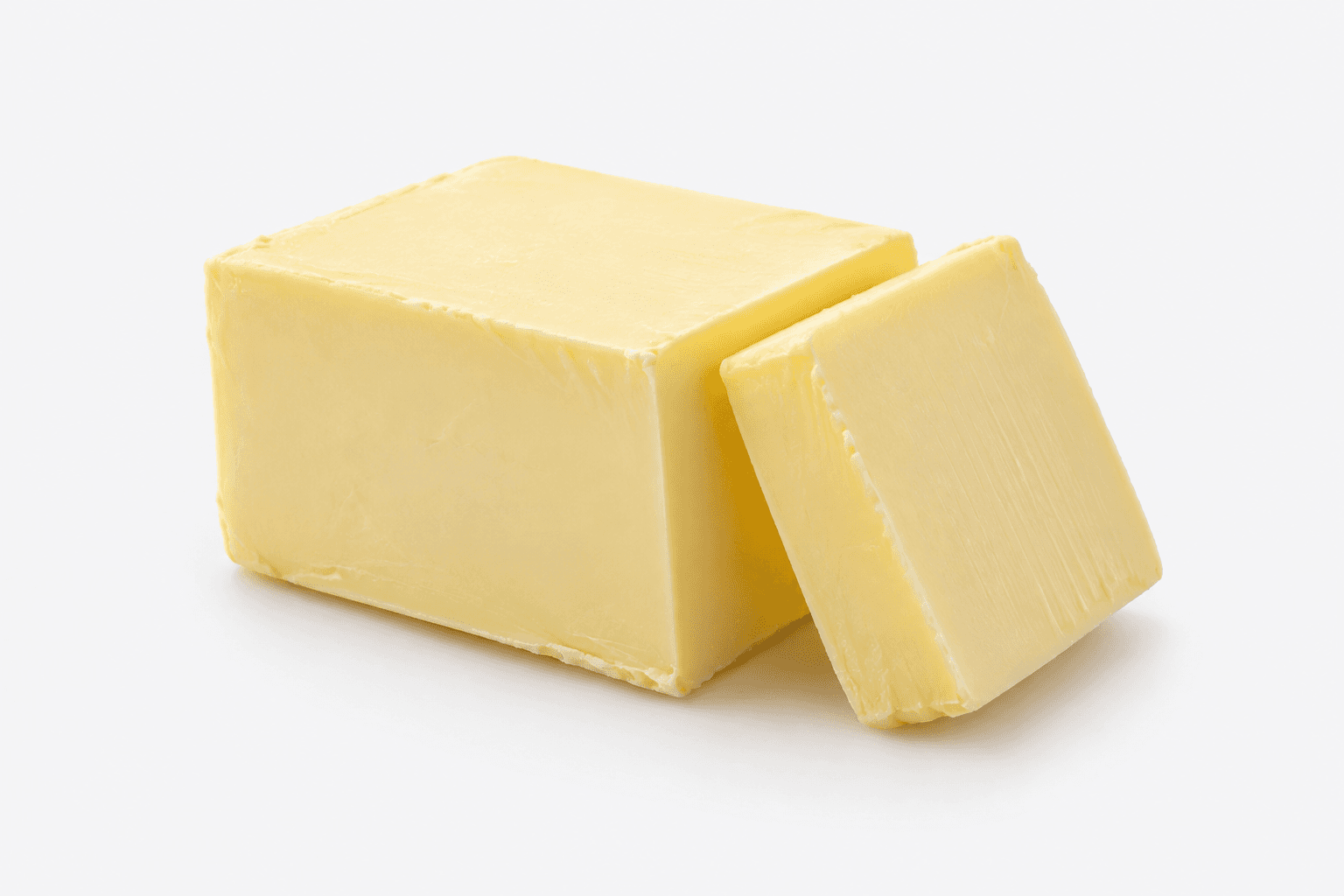
Butter is milk fat gathered and set solid. Churn cream hard enough and the fat globules clump together while the watery buttermilk drains away; the clump is butter. It is at least 80 percent fat, the rest water and milk solids. Made from cultured cream it becomes the more aromatic cultured butter; heated so the water and milk solids can be skimmed off, it becomes clarified butter, or ghee, with a higher smoke point. Butter picks up smells readily, so it should be kept sealed.
Butter spent decades as the emblem of what to avoid, and the last few years being fashionable in the other direction. Both are overstatements.
Here is what holds. Butter carries 50.5 g of saturated fat per 100 g, which is very high among foods. And that cutting saturated fat reduces cardiovascular events is a randomised-trial finding, not a theory.
At the same time, large observational studies of dairy fat have not shown the clear harm the theory predicts. That mismatch is what the butter argument actually is.
This page takes neither side and sets the two bodies of evidence next to each other. The practical conclusion comes at the end: there is no need to eliminate butter, and no reason not to count it.
Key benefits
- Strong evidence
50.5 g of saturated fat — cutting it lowers cardiovascular events 17 %
[1]This is not a benefit but the baseline for reading butter.
A 2020 Cochrane review pooled 15 randomised controlled trials with at least 24 months of follow-up, comparing people who cut saturated fat with people who ate as usual.
Combined cardiovascular events fell 17 % (relative risk 0.83, 95 % CI 0.70–0.98). Fifty-six people cutting saturated fat prevents one event.
Two qualifiers.
- Total mortality and cardiovascular mortality did not fall significantly.
- The benefit depended on what replaced it. Polyunsaturated fat or whole grains gave the larger benefit; swapping to sugar or refined carbohydrate gave none.
The second matters in practice. If white bread or sugar fills the space butter left, the benefit seen in those trials did not appear.
- Moderate evidence
The observational evidence on dairy fat is less tidy than the theory
[2]This is where the butter story splits.
If the saturated fat theory ran cleanly, populations eating more dairy fat should show clearly more cardiovascular disease. Across several large prospective cohorts, that association has not appeared consistently. Direction varied by dairy type, and in some studies fermented dairy — yoghurt, cheese — was associated with lower risk.
Explanations are plentiful: the milk fat globule membrane, calcium's effect on fat absorption, fermentation, and what the dairy is eaten alongside. None is settled.
An important limit belongs here. These are observational studies. People who eat a lot of dairy differ in many other ways from people who eat little. Without randomisation, causation cannot be claimed.
And butter is not fermented dairy. These studies did not show butter itself coming out ahead. That the picture for dairy as a whole is not simple is as far as this section goes.
- Nutrition data
It has vitamin A and K — but not in the amount you would eat for them
Per 100 g butter holds 684 µg RAE of vitamin A, 2.32 mg of vitamin E and 7 µg of vitamin K.
On paper the vitamin A is close to an adult requirement (750 µg for men). But 100 g is an entire block of butter. The tablespoon you actually use (14 g) gives 96 µg — 13 % of the requirement.
Cheaper routes to the same vitamin A exist: one carrot (about 500 µg RAE as beta-carotene, 25 kcal), a handful of spinach. A tablespoon of butter is 100 kcal and 7.1 g of saturated fat.
Grass-fed butter is said to hold more vitamin K2 and omega-3. The compositional difference is real but the absolute amounts are tiny — around 0.05 g of omega-3 per tablespoon, against more than 2 g in a piece of mackerel. No clinical evidence links that compositional difference to a difference in health outcomes.
How to eat it well
- Use it where butter decides the flavour. Bread, pastry, finishing a sauce. Substitutes do not keep up there.
- Do not turn it into your everyday frying fat. For sautéing, canola or olive oil is the better number.
- If you cut it, cut towards unsaturated oil or whole grains. Swapping to sugar or white bread erased the benefit in the Cochrane analysis.
- Count the tablespoon. Spreading by eye puts two or three onto a slice without noticing.
- The smoke point is low, around 150 °C. For high heat use clarified butter (ghee) or another oil.
- Salted butter carries around 600 mg of sodium per 100 g. In baking, unsalted butter plus your own salt is easier to control.
How to read the grades
Each benefit carries a label showing how far research on people supports it. Grades differ between items even within the same ingredient.
- Nutrition data
- A fact verifiable from food composition databases or health authorities. This is a different kind of statement from a clinical effect.
- Strong evidence
- Consistently confirmed across randomised controlled trials or meta-analyses.
- Moderate evidence
- Human studies exist, but effect sizes are small or results are mixed.
- Early research
- Cell or animal work, or small preliminary studies.
- Not established
- Commonly claimed, but not confirmed in studies on people.
What to watch out for
- 100 kcal and 7.1 g of saturated fat per tablespoon — a third of the adult daily ceiling (about 22 g on a 2,000 kcal diet).
- Cholesterol is 215 mg per 100 g. Dietary cholesterol matters less than once thought, but individual response varies widely.
- With dyslipidaemia, do not make butter your default fat.
- Lactose intolerance is usually not a problem — butter holds under 0.1 g of lactose per 100 g. Milk protein allergy is different: trace casein can matter.
- 'Butter coffee' adds calories, which runs opposite to weight loss.
- The superiority of grass-fed butter is a compositional claim, not one confirmed by clinical outcomes.
Nutrition
Per 100 g of unsalted butter. A tablespoon is 14 g — 100 kcal and 7.1 g of saturated fat. Salted butter runs around 600 mg of sodium per 100 g.
Percentages are of the US FDA Daily Value for adults and children 4 and over. National reference intakes differ by sex and age.
Calculate this alongside other ingredients →
Key nutrients
Dishes with this ingredient
Sources
The databases and health authorities this article's nutrition figures and health statements draw on.
- 1Reduction in saturated fat intake for cardiovascular diseaseMeta-analysisHooper L, et al. Cochrane Database Syst Rev 2020PMID 32827219
- 2Dairy Product Consumption and Cardiovascular Health: A Systematic Review and Meta-analysis of Prospective Cohort StudiesMeta-analysisChen Z, et al. Adv Nutr 2022PMID 34550320
- 3USDA FoodData CentralFood composition database
- 4World Health Organization · Healthy dietHealth authority
- 5European Food Safety Authority (EFSA)Health authority
- 6PubMedResearch literature