Contents
What it is
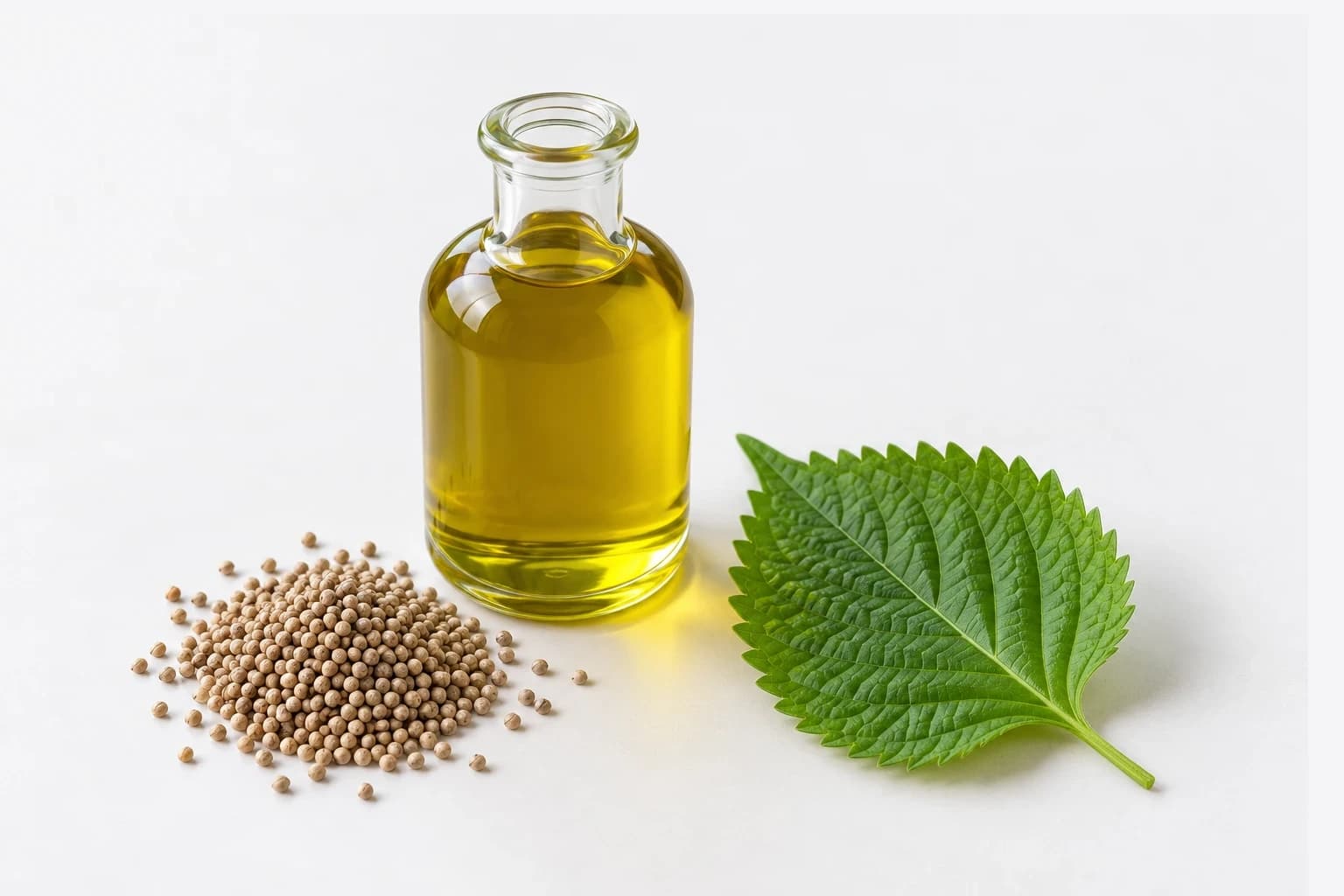
Perilla oil is pressed from the seeds of the perilla plant, an annual herb in the mint family grown in Korea, China and Japan; the leaf sold as kkaennip comes from the same plant. It is a different species from sesame, so perilla oil and sesame oil are not interchangeable. The aroma is strong and nutty, and it is used to dress vegetables or brush over sheets of seaweed. Being high in unsaturated fat it goes rancid quickly, so it is best kept refrigerated and used soon after opening. It is not suited to high-temperature frying.
Scientific name Perilla frutescens
Perilla oil is pressed from perilla seeds. In Korean cooking it is the oil that dresses namul, brushes seaweed and finishes bibimbap.
The compound that defines this oil is alpha-linolenic acid (ALA), the plant omega-3. Perilla oil is widely known to carry a high share of it among common culinary oils.
But this site has not printed that share as a number. The USDA standard composition database has no entry for perilla oil, and the branded data holds only energy, fat and saturated fat. That is why the composition table is empty.
What there is instead is a human trial. A twelve-month one.
2023, Phytotherapy Research.
- 52 Japanese adults (mean age 54.2 ± 6.4)
- Randomised, double-blind, placebo-controlled
- 27 in the perilla oil group at 7.0 mL a day; 25 in the control group on 7.0 mL of olive oil
- Twelve months
- Measured: quantitative ultrasound of the right calcaneus, reported as percentage of the Young Adult Mean (%YAM); serum TRACP-5b and BALP; polyunsaturated fatty acids in the erythrocyte membrane; serum antioxidant markers
The results:
- %YAM rose significantly against placebo
- TRACP-5b, a marker of bone resorption, fell significantly
- BALP, a marker of bone formation, did not change
- Erythrocyte membrane ALA rose, as did the antioxidant ratio (BAP/d-ROM)
Three things have to be read alongside this. They are below.
Key benefits
- Early research
Twelve months, double-blind — but what it measured was a heel ultrasound
[1]2023, Phytotherapy Research, design as above.
Outcome Perilla oil group %YAM (vs young adult mean) rose significant vs placebo TRACP-5b (bone resorption) fell significant vs placebo BALP (bone formation) no change Erythrocyte membrane ALA rose significant vs placebo BAP/d-ROM ratio (antioxidant) rose significant vs placebo Start with the design's strengths. Twelve months is a long run. Most nutrition trials end at four to twelve weeks, and bone does not move in that time. It was double-blind and placebo-controlled, and the rise in erythrocyte membrane ALA is itself evidence that participants actually took the oil.
But three things belong alongside it.
First, what was measured is not bone mineral density.
The trial used quantitative ultrasound (QUS) of the right heel. The standard for diagnosing osteoporosis and measuring bone density is dual-energy X-ray absorptiometry (DXA), and QUS is a screening tool. The two measure different physical quantities, and a QUS figure does not stand in for a DXA bone density.
And fractures were not measured. The ultimate outcome in bone health is fracture; this trial's results are markers.
Second, there were 52 participants — 25 to 27 per group. Keeping them for twelve months is impressive, but the scale is small and one trial cannot settle it. Replication is needed.
Third, the placebo was olive oil.
This is the interesting part of the design. Participants were not given nothing; they were given 7.0 mL of a different oil. That is good for blinding, but it makes the comparison "perilla oil versus olive oil", not "perilla oil versus nothing". Read the result that way.
That BALP did not change belongs in the reading too. Bone runs resorption and formation together, and in this trial only the resorption side came down while formation stayed put. That is why the authors wrote "by inhibiting bone resorption".
The honest conclusion:
- A 12-month double-blind placebo-controlled trial found a bone resorption marker fall
- But the measurement was a heel ultrasound, not DXA bone density
- Fractures were not measured
- It is a single trial of 52 people
- The comparator was olive oil
- The grade is "early"
- Not established
ALA is not the omega-3 in fish
The omega-3 in perilla oil is alpha-linolenic acid (ALA) — the same family as this site's walnuts, flaxseed, chia and canola oil.
It is a different compound from the EPA and DHA in fish.
The body does convert ALA to EPA. But the conversion runs at a single-digit percentage, and conversion to DHA is far lower still. So "perilla oil means you can skip the fish" does not hold.
The trial above illustrates the point. It reported a rise in erythrocyte membrane ALA. ALA rose — not EPA, not DHA.
That ALA is itself an essential fatty acid is not in doubt. The body cannot make it, so it has to be eaten, and perilla oil supplies it efficiently. But it is a separate nutrient, not a stand-in for fish.
On the empty composition table, again.
That perilla oil is high in ALA is widely known, but the USDA standard database this site works from has no entry for perilla oil. The branded data holds energy, fat and saturated fat, and no ALA share.
The two rows every oil shares — "100 g = 100 g fat, 884 kcal" — could be printed. But olive oil, canola oil and sesame oil carry exactly the same two rows, so they say nothing about this one. Rather than build a table missing the single line that describes the oil, this site leaves it empty and explains why.
It will be filled when a source exists. If the Korean food composition database is brought in, the figures go here.
On quantity. The trial used 7.0 mL a day, about one and a half teaspoons — close to what dresses a plate of namul. As an oil, a tablespoon is 14 g and around 124 kcal, the same as any other.
- Nutrition data
Rancidity — the most important practical fact about this oil
Before any benefit, the thing to know about perilla oil is storage.
Polyunsaturated fat goes rancid. The more double bonds, the more vulnerable to air, light and heat. ALA has three double bonds, which makes it among the fastest-oxidising fats in any culinary oil. Oleic acid, the main fatty acid in olive oil, has one, and is far more stable.
So perilla oil has to be handled differently from other oils.
- Buy small bottles. A large bottle used slowly goes rancid before it is finished
- Refrigerate once opened. This matters more than it does for sesame oil
- Choose dark glass. Light accelerates oxidation
- Use it within a month or two
- Your nose will tell you. A stale, paint-like or fishy smell means it has gone. Throw it out
Rancid oil is not good for you. Oxidised lipids and their breakdown products are studied in connection with inflammation, and if you bought the oil for its ALA and that ALA has already oxidised, the reason to eat it has gone too.
Do not heat it.
Perilla oil has a low smoke point, and heating degrades the ALA. As set out in this site's olive oil and canola oil comparison, splitting oils by job is the sensible approach.
- Perilla oil — dressing namul, brushing seaweed, finishing bibimbap
- Sautéing and roasting — olive oil or canola
- Deep-frying — a refined oil
Do not make fried rice with it. You lose the aroma and the ALA together.
The cautions.
Perilla is in the mint family, the same genus as shiso and the same family as mint, basil and rosemary. Allergy is reported, though rarely.
If you take anticoagulants, talk to your clinician. Research indicates omega-3 fatty acids can affect platelet function. Culinary amounts rarely cause a problem, but if you are facing surgery or taking anticoagulants it is worth mentioning.
Perilla oil is an oil. A tablespoon is around 120 kcal. Even a healthy oil is worth counting as you pour.
How to eat it well
- The trial used 7.0 mL a day, about one and a half teaspoons.
- Do not heat it. Low smoke point, and heat degrades the ALA. It is a finishing oil.
- Buy small bottles and refrigerate once opened. It oxidises faster than any other culinary oil.
- Use it within a month or two. Dark glass is better.
- If it smells stale, paint-like or fishy, throw it out. It has gone rancid.
- Use another oil for sautéing and frying.
- It does not replace fish. ALA is a different compound from EPA and DHA.
- A tablespoon is around 120 kcal.
How to read the grades
Each benefit carries a label showing how far research on people supports it. Grades differ between items even within the same ingredient.
- Nutrition data
- A fact verifiable from food composition databases or health authorities. This is a different kind of statement from a clinical effect.
- Strong evidence
- Consistently confirmed across randomised controlled trials or meta-analyses.
- Moderate evidence
- Human studies exist, but effect sizes are small or results are mixed.
- Early research
- Cell or animal work, or small preliminary studies.
- Not established
- Commonly claimed, but not confirmed in studies on people.
What to watch out for
- What the 12-month trial measured was quantitative ultrasound of the heel, not DXA, the standard for bone density.
- Fractures were not measured. The results are markers.
- There were 52 participants, 25 to 27 per group, in a single trial.
- The placebo was 7.0 mL of olive oil. The comparison is "perilla oil versus olive oil".
- The bone formation marker (BALP) did not change. Only the resorption side came down.
- ALA is a different compound from the EPA and DHA in fish and converts poorly. It does not replace fish.
- It goes rancid fast. Refrigerate it and use it within a month or two; throw it out if it smells stale.
- If you take anticoagulants or face surgery, tell your clinician.
- The composition table is empty. The USDA standard database has no entry for perilla oil, and no figure has been estimated to fill the gap.
Nutrition
The composition table is deliberately empty. The USDA standard database has no entry for perilla oil, and the branded data carries only energy, fat and saturated fat — not the alpha-linolenic acid share that actually describes this oil. The two rows every oil shares could be printed, but they would say nothing about this one. No figure has been estimated to fill the gap.
Dishes with this ingredient
Sources
The databases and health authorities this article's nutrition figures and health statements draw on.