Contents
What it is
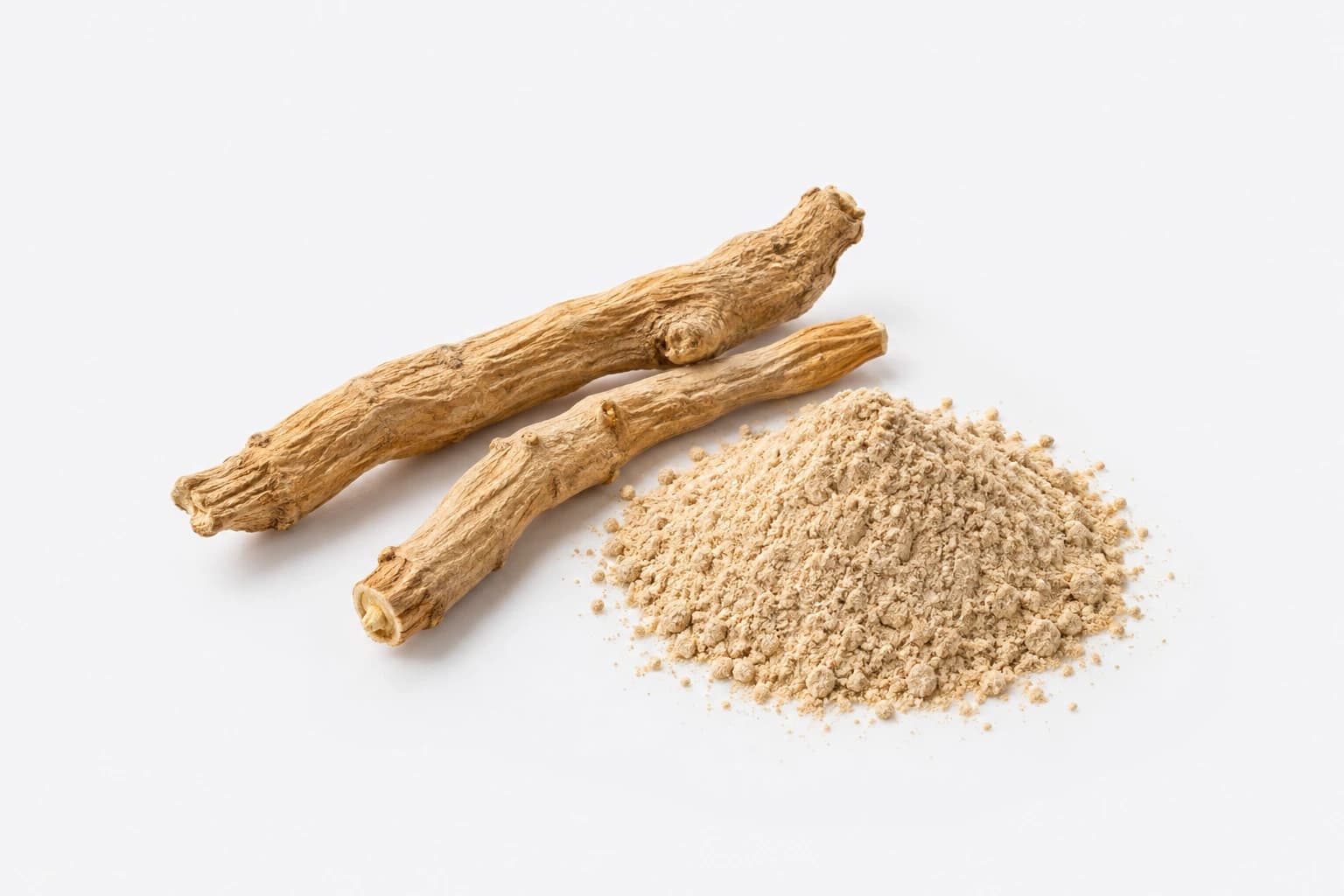
Ashwagandha is the root of a shrub in the nightshade family. It grows in the dry regions of India and the Middle East and has long been used in Ayurveda, the traditional medicine of India. It is closer to a medicinal herb than to an ingredient: rather than being cooked, the root is dried and milled, or extracted, and sold as capsules and powder. Unlike most entries on this site, it is not something you pick up while doing the groceries — worth keeping in mind as you read.
Scientific name Withania somnifera
Ashwagandha is the root of Withania somnifera, used in Indian Ayurvedic medicine. In recent years it has sold heavily as a sleep and stress supplement.
This entry has to be read in two halves — the evidence for the effect, and the reports of liver injury.
The effect first.
2021 meta-analysis, PLoS One. Randomised controlled trials comparing ashwagandha extract against placebo in adults 18 and over: five trials, 400 participants.
- A small but significant effect on overall sleep — standardised mean difference −0.59 (95% CI −0.75 to −0.42), I² = 62%
- The effect was more prominent in adults diagnosed with insomnia, at 600 mg a day or more, over eight weeks or more
- Mental alertness on rising and anxiety also improved
- There was no significant effect on quality of life
And the paper's conclusion continues: data on serious adverse effects are limited, and more safety data would be needed.
Why that reservation matters is set out below.
Key benefits
- Moderate evidence
Sleep and anxiety — two meta-analyses point the same way
[1][2]2021, PLoS One.
- CENTRAL, MEDLINE, SCOPUS, the WHO trials portal and India's clinical trial registry among the sources searched
- Only randomised controlled trials of ashwagandha extract against placebo
- Five trials, 400 participants
- Primary outcomes: sleep quantity and quality
Outcome Result Overall sleep SMD −0.59 (95% CI −0.75 to −0.42), I² = 62% Mental alertness on rising improved Anxiety improved Quality of life no significant effect The effect was more prominent in those diagnosed with insomnia, at 600 mg a day or more, over eight weeks or more.
The 2024 meta-analysis in Human Psychopharmacology points the same way.
- Five randomised controlled trials, 254 participants with anxiety or insomnia
- The Hamilton Anxiety Scale fell by 5.96 points (95% CI −10.34 to −1.59, p=0.008)
- Sleep onset latency, total sleep time, sleep quality index and sleep efficiency improved
- Wake after sleep onset and total time in bed did not
These results have to be read at their true weight.
First, the samples are small. Four hundred and 254 people. Even as meta-analyses, the individual trials inside run to a few dozen each.
Second, the heterogeneity is large. I² was 62% in the 2021 analysis and 98% in 2024. I² measures how scattered the results are across trials, and 98% is close to extreme. It means a single pooled average is hard to summarise with.
Third, the confidence intervals are wide. The 2024 figure of −5.96 runs from −10.34 to −1.59. The true value might be close to ten points, or it might be 1.6.
Fourth, what was used is standardised extract, not the root. Three hundred to 600 mg a day, and the content of the marker compound withanolides differs between products.
Fifth, the durations are short. Mostly eight to twelve weeks. There is no data built on taking it long-term the way people take sleep aids.
The honest conclusion:
- Two meta-analyses point the same way on short-term improvement in sleep and anxiety measures
- The effect is small, the heterogeneity large, the samples small
- Quality of life did not move
- The grade is "moderate"
- And it must be read together with the safety section below
- Not established
Liver injury — cases reported in the US, Iceland and India
[3][4]The 2021 sleep meta-analysis wrote that no serious side effects were reported. And immediately after, that data on serious adverse effects are limited.
Short trials do not catch rare adverse effects. Those show up elsewhere.
2020, Liver International — a case series from Iceland and the US Drug-Induced Liver Injury Network (DILIN).
- Five cases of liver injury attributed to ashwagandha-containing supplements
- Three collected in Iceland during 2017-2018, two from DILIN in 2016
- Other causes excluded; causality assessed with DILIN's structured expert opinion approach
Patients 5 (3 male), mean age 43 (range 21-62) Symptoms all developed jaundice, plus nausea, lethargy, pruritus, abdominal discomfort Latency 2 to 12 weeks Injury pattern cholestatic or mixed (R ratios 1.4-3.3) Course pruritus and hyperbilirubinaemia lasted 5 to 20 weeks Recovery liver tests normalised in 1-5 months in four; one lost to follow-up Hepatic failure none Chemical analysis confirmed ashwagandha in the available supplements, and no other toxic compounds were identified. No patient was taking potentially hepatotoxic prescription medication.
2023, Hepatology Communications carries a case series from India with a literature review. The same phenomenon is being reported independently in different countries.
How to read case reports.
A case series does not tell you the frequency. Five reported cases do not tell you how many people out of all who take ashwagandha this happens to. There may be unreported cases, or it may be rare overall.
But a case series does tell you something — that it can happen, and what shape it takes.
- The latency is 2 to 12 weeks. Not right after starting, but some weeks later
- Jaundice was common to all. Yellowing of the eyes or skin
- The itching lasted a long time — 5 to 20 weeks
- Most recovered, but it took months
So do this.
- Stop and seek care immediately if your eyes or skin turn yellow
- Unexplained itching, severe lethargy, nausea or dark urine are the same signal
- Do not take it with liver disease or raised liver enzymes
- Avoid it if you drink frequently or take hepatotoxic medication
- Tell your clinician. Raised liver enzymes need an explanation they can find
And there are further cases where this supplement should be avoided.
- Do not take it in pregnancy. There is a traditional record linking it to miscarriage, and no safety data
- With thyroid disease, talk to your clinician. There are reports of ashwagandha affecting thyroid hormone levels, especially relevant if you take thyroid medication
- With autoimmune disease, discuss it. There are claims of immune action, and on immunosuppressants the direction may be the wrong one
- Before surgery, agree a stopping point with your clinician. Its sedative action can compound anaesthesia
- Do not combine it with sedatives, sleep aids or anti-anxiety medication. The effects add
- It is a nightshade. Take care if you have reacted to tomato, potato or aubergine
- Nutrition data
Why there is no composition table — and choosing a product
Most ingredients on this site have a composition table. Ashwagandha does not.
The reason is the same as in the red yeast rice entry — a composition table does not describe this ingredient.
The trials used 300 to 600 mg a day of standardised extract. A per-100 g table would be numbers for more than two hundred times the actual intake. Such a table tells you nothing.
And what matters in ashwagandha is not a nutrient but withanolides. This site's nutrient system has no entry for them, and even if it did, the content differs by product.
What to check when choosing a product.
First, look for a declared withanolide content. The trials used standardised extracts. Without a declaration you cannot know whether you are taking what they tested.
Second, check root or leaf. What has traditionally been used is the root, and most trials used root extract. Leaf has a different composition and less data.
Third, look at the daily dose. In the 2021 meta-analysis the effect was more prominent at 600 mg a day or more. But that does not mean raising the dose is also better on the safety side.
Fourth, look for heavy metal testing. There are reports of lead, mercury and arsenic in traditional Indian herbal products. It is not a problem unique to ashwagandha, but it is worth checking in this category.
Set expectations accurately.
- It is not a sleeping pill. The effect size is small, SMD −0.59
- Quality of life did not move
- These were 8 to 12 week trials. There is no data on taking it for years
- If insomnia persists, finding the cause comes first. Sleep apnoea, thyroid disease, depression, caffeine, shift work — not something to paper over with a supplement
This site neither forbids nor recommends ashwagandha. There is evidence of an effect, and there are liver injury cases. Knowing both before you decide is what this entry is for.
How to eat it well
- The trials used 300 to 600 mg a day of standardised extract. The effect was more prominent at 600 mg or more, over eight weeks or more.
- Choose a product that declares its withanolide content.
- Check that it is root extract. Traditional use and most trials used root.
- Look for heavy metal testing.
- Stop and seek care immediately if your eyes or skin turn yellow.
- Tell your clinician you are taking it.
- Do not combine it with sedatives, sleep aids or anti-anxiety medication.
- If insomnia persists, find the cause rather than reaching for a supplement.
How to read the grades
Each benefit carries a label showing how far research on people supports it. Grades differ between items even within the same ingredient.
- Nutrition data
- A fact verifiable from food composition databases or health authorities. This is a different kind of statement from a clinical effect.
- Strong evidence
- Consistently confirmed across randomised controlled trials or meta-analyses.
- Moderate evidence
- Human studies exist, but effect sizes are small or results are mixed.
- Early research
- Cell or animal work, or small preliminary studies.
- Not established
- Commonly claimed, but not confirmed in studies on people.
What to watch out for
- Liver injury cases are reported from the US DILIN, Iceland and India. Latency 2 to 12 weeks, jaundice in all, itching lasting 5 to 20 weeks.
- Stop and seek care if your eyes or skin turn yellow, or with unexplained itching, severe lethargy or dark urine.
- Do not take it with liver disease or raised liver enzymes. Avoid it if you drink frequently.
- Do not take it in pregnancy. There is a traditional record linking it to miscarriage.
- With thyroid disease or thyroid medication, talk to your clinician.
- With autoimmune disease or immunosuppressants, discuss it.
- Its effects add to those of sedatives, sleep aids and anti-anxiety medication.
- Before surgery, agree a stopping point with your clinician.
- It is a nightshade. Take care if you have reacted to tomato, potato or aubergine.
- Heterogeneity was I² 62% in the sleep meta-analysis and 98% in the anxiety one — very large. The samples, 400 and 254, are small.
Nutrition
No composition table is printed for this ingredient. The trials used standardised extract, not root powder, at 300-600 mg a day. A per-100 g table would be more than two hundred times what anyone actually takes.
By health concern
Sources
The databases and health authorities this article's nutrition figures and health statements draw on.
- 1Effect of Ashwagandha (Withania somnifera) extract on sleep: A systematic review and meta-analysisMeta-analysisCheah KL, et al. PLoS One 2021PMID 34559859
- 2Safety and efficacy of Withania somnifera for anxiety and insomnia: Systematic review and meta-analysisMeta-analysisFatima K, et al. Human Psychopharmacology 2024PMID 39083548
- 3Ashwagandha-induced liver injury: A case series from Iceland and the US Drug-Induced Liver Injury NetworkResearch literatureBjornsson HK, et al. Liver International 2020PMID 31991029
- 4Ashwagandha-induced liver injury - A case series from India and literature reviewResearch literaturePhilips CA, et al. Hepatology Communications 2023PMID 37756041
- 5PubMedResearch literature
- 6World Health Organization · Healthy dietHealth authority