Contents
What it is
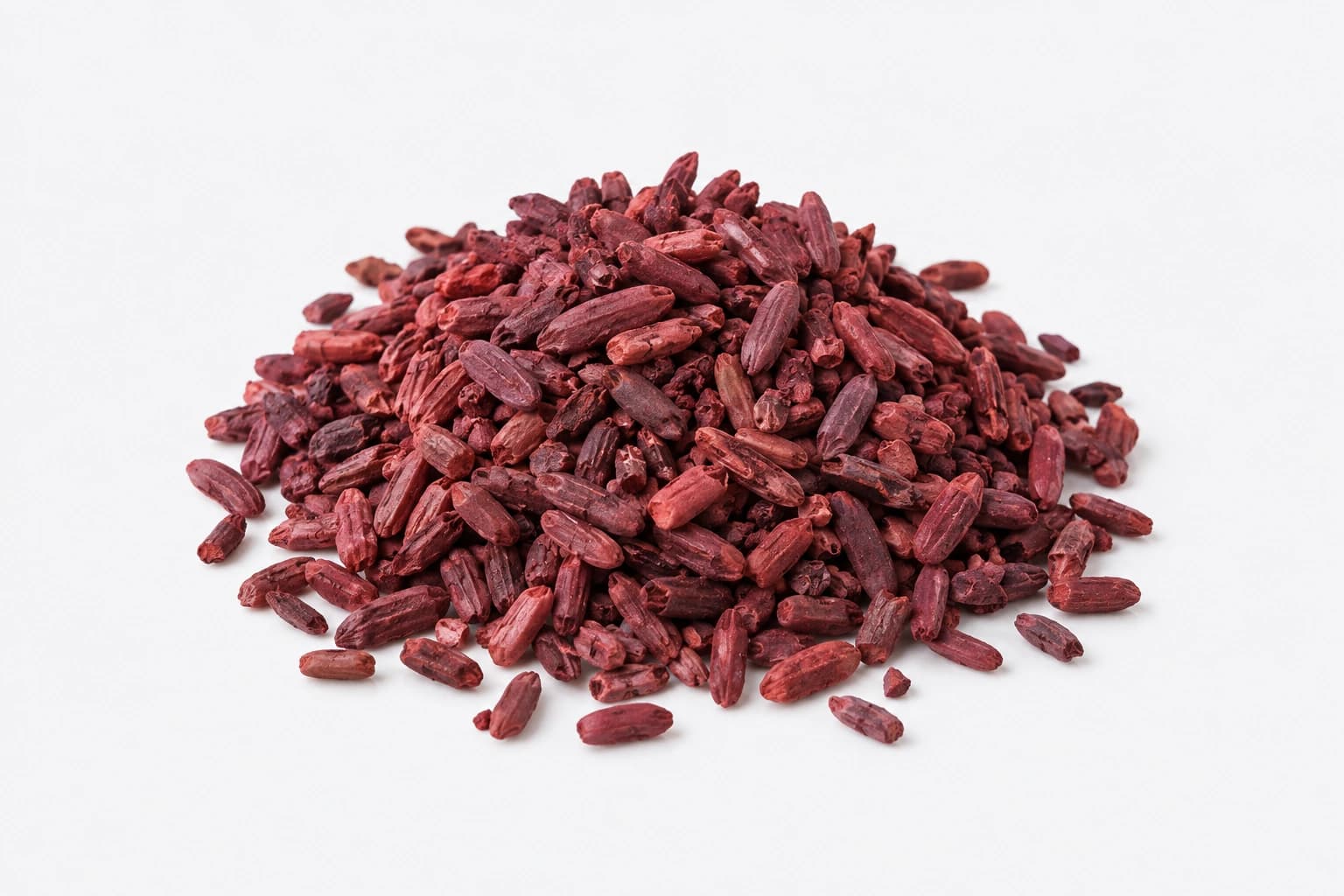
Red yeast rice is rice fermented with a red mould of the genus Monascus. China and East Asia have long used it to colour food and to make wine. The fermentation produces monacolin K, which is chemically the same molecule as lovastatin, a cholesterol drug — making this one of the rare ingredients on this site whose active compound overlaps with a pharmaceutical. That is also why content varies so widely between products, and why anyone already taking a statin should be careful about doubling up.
Red yeast rice is rice fermented with the mould Monascus purpureus. It has long been used in China and is sold as a cholesterol supplement in Korea too.
This is the hardest ingredient on this site to write about — because it works.
2015 systematic review and meta-analysis, Atherosclerosis.
- Only randomised studies of red yeast rice with a known monacolin K content, against placebo or an active control
- Twenty studies
- LDL cholesterol fell by 1.02 mmol/L (95% CI −1.20 to −0.83) — about 39 mg/dL
- The effect was not different from statin therapy (0.03 mmol/L, 95% CI −0.36 to 0.41)
Why does it match a statin? Because it is the same substance.
The monacolin K in red yeast rice is chemically identical to lovastatin, a prescription statin approved in 1987. Red yeast rice is sold like a food, but what is inside it is a drug.
Which is why the paper's title matters. It reads: "Traditional Chinese lipid-lowering agent red yeast rice results in significant LDL reduction but safety is uncertain."
And in 2024 something happened in Japan. Kidney injury was reported in people taking red yeast rice tablets, and a nationwide questionnaire study appeared in Kidney International in 2025.
Why this site does not recommend red yeast rice is set out below.
Key benefits
- Strong evidence
LDL falls by 1.02 mmol/L — because it is the same substance as a statin
[1]2015, Atherosclerosis.
- Medline and EMBASE searched through November 2014
- Only randomised studies of red yeast rice with a known monacolin K content, against placebo or an active control
- Outcomes were LDL and the incidence of adverse reactions — especially liver and kidney injury and muscle symptoms
- Twenty studies
Outcome Result LDL cholesterol −1.02 mmol/L (95% CI −1.20 to −0.83) Difference from statin 0.03 mmol/L (95% CI −0.36 to 0.41) — no difference Liver and kidney injury incidence 0-5%, no difference between treatment and control Quality of safety assessment low in the majority of studies 1.02 mmol/L is about 39 mg/dL. This site's psyllium entry is 0.33 mmol/L, so this is more than three times that.
And it was no different from a statin. That is the heart of this entry.
Why?
The monacolin K in red yeast rice is the same molecule as lovastatin. A mould grown on rice produces it, and it is chemically indistinguishable from the lovastatin a pharmaceutical company makes.
Statins inhibit HMG-CoA reductase, blocking cholesterol synthesis in the liver. Red yeast rice does the same thing because there is a statin in it.
So working is not a reason to be relaxed about this ingredient. It is the opposite.
- The side effects of statins come with it — muscle pain, rhabdomyolysis, raised liver enzymes
- The drug interactions of statins come with it
- But the dose is not on the label. A prescription says 10 mg or 20 mg exactly; the monacolin K content of red yeast rice products varies dozens of times over and is often not declared
Europe regulated it for this reason. The European Union limits monacolin K in red yeast rice foods to under 3 mg per serving. Below that, the LDL effect shrinks with it.
The honest conclusion:
- The evidence that red yeast rice lowers LDL is thick. A meta-analysis of 20 trials, and a large effect
- It works because there is a statin in it
- So it should be treated not as a food but as a drug with an undeclared dose
- The grade is "established". But that grade is about the effect, not about safety
- Not established
Safety — what happened in Japan in 2024
The 2015 meta-analysis reported liver and kidney injury at 0-5%, no different from control. But the same paper wrote that the quality of safety assessment was low in the majority of studies.
Why that reservation mattered became clear in 2024.
In Japan, kidney injury was reported in people taking tablets containing red yeast rice ingredients. Products were recalled, and a nationwide questionnaire study appeared in Kidney International in 2025.
This was a different problem from the known side effects of statins. The investigation raised the possibility of contamination in manufacturing.
What that episode showed is this.
A product made by fermentation is hard to control completely. Growing a mould can produce substances nobody intended. Citrinin, a mycotoxin, has long been a monitored contaminant of red yeast rice, and Europe sets a limit for it.
Prescription statins do not have this problem. Pharmaceutical processes control what goes in, test every batch, and are overseen by regulators.
So red yeast rice carries two layers of risk.
First, the risk of the statin itself muscle pain, rhabdomyolysis, raised liver enzymes, drug interactions — at an unknown dose Second, the risk of a fermentation product mycotoxins such as citrinin, contamination in manufacturing Which is why this site does not recommend red yeast rice for managing cholesterol.
If LDL needs lowering, there are two options.
- A prescription statin — same action, dose stated exactly, a clinician tracking liver enzymes and muscle symptoms, regulated manufacture
- Food — see this site's psyllium, oat and barley entries. The effect is smaller, and so is the risk
Red yeast rice is not something between those two. It is an uncontrolled form of the first.
Cases where it must be avoided.
- If you already take a statin, do not add red yeast rice. You are adding more of the same substance
- Do not take it with liver disease or raised liver enzymes
- Do not take it in pregnancy or while breastfeeding. Statins are contraindicated in pregnancy
- Do not take it with grapefruit juice. It interferes with statin metabolism
- If you take other medication, check interactions especially with antifungals, some antibiotics, ciclosporin and fibrates
Stop and seek care immediately if you develop muscle pain, severe fatigue or dark urine. Those can be signs of rhabdomyolysis.
- Nutrition data
Why there is no composition table here
[2]Every other ingredient on this site has a composition table. This one does not. Here is why.
First, the USDA standard composition database has no entry for red yeast rice. Every other ingredient here uses that database.
Second, and more importantly, a composition table does not describe this ingredient.
Red yeast rice is fermented rice, so analysing 100 g would mostly return carbohydrate. But nobody eats red yeast rice 100 g at a time. As a supplement it is a few hundred milligrams to a couple of grams a day.
And what acts within that is one thing only: monacolin K. Not a vitamin, not a mineral.
The monacolin K content varies greatly between products. The same weight of powder can differ dozens of times over depending on the strain and the fermentation conditions. And many products do not declare it.
Printing a few grams of carbohydrate would hide what actually matters here. So the table is blank.
This is the first entry on this site with no composition table. Psyllium had no USDA data either, but three branded products agreed on a fibre figure that genuinely meant something. Red yeast rice is different.
If you are choosing a product anyway.
If you decide to use it despite the above, check at least these.
- Is the monacolin K content declared? Without it, you are taking a statin without knowing how much
- Is there a citrinin test result?
- Are the country of manufacture and the maker clear?
And tell your clinician. If they do not know you are taking it, raised liver enzymes or muscle pain will have no explanation. Do not think "it is a health food, no need to mention it" — by composition, this is a drug.
Red yeast rice as a colouring is a separate matter. The small amounts used to colour tofu, fish cake or some traditional liquors are very low intakes. Everything above concerns supplements taken for cholesterol.
How to eat it well
- This site does not recommend red yeast rice for managing cholesterol.
- If LDL needs lowering, talk to your clinician. A prescription statin does the same thing with a stated dose and follow-up.
- If you want a food approach, psyllium, oats and barley have smaller effects and smaller risks.
- If you already take a statin, do not add red yeast rice.
- If you use it anyway, choose a product that declares its monacolin K content and check for citrinin testing.
- Tell your clinician. It is not a health food; by composition it is a drug.
- Do not take it with grapefruit juice.
- Red yeast rice used in small amounts as a colouring is a different level of intake from the above.
How to read the grades
Each benefit carries a label showing how far research on people supports it. Grades differ between items even within the same ingredient.
- Nutrition data
- A fact verifiable from food composition databases or health authorities. This is a different kind of statement from a clinical effect.
- Strong evidence
- Consistently confirmed across randomised controlled trials or meta-analyses.
- Moderate evidence
- Human studies exist, but effect sizes are small or results are mixed.
- Early research
- Cell or animal work, or small preliminary studies.
- Not established
- Commonly claimed, but not confirmed in studies on people.
What to watch out for
- Monacolin K is the same substance as lovastatin. The side effects and interactions of statins come with it, at a dose that is not declared.
- The 2015 meta-analysis stated that the quality of safety assessment was low in the majority of studies.
- Kidney injury linked to red yeast rice tablets was reported in Japan in 2024, with a nationwide study published in Kidney International in 2025.
- Citrinin, a mycotoxin, can arise in fermentation, and Europe sets a limit for it.
- Do not combine it with a statin you are already taking.
- Do not take it with liver disease or raised liver enzymes.
- Do not take it in pregnancy or while breastfeeding. Statins are contraindicated in pregnancy.
- It interacts with grapefruit juice, antifungals, some antibiotics, ciclosporin and fibrates.
- Stop and seek care if you develop muscle pain, severe fatigue or dark urine.
- The European Union limits monacolin K in red yeast rice foods to under 3 mg per serving.
Nutrition
No composition table is printed for this ingredient. What red yeast rice does comes from one substance, monacolin K, not from vitamins or minerals — and its content varies dozens of times over between products and is often not declared. Printing a per-100 g table would hide that.
By health concern
Sources
The databases and health authorities this article's nutrition figures and health statements draw on.
- 1Traditional Chinese lipid-lowering agent red yeast rice results in significant LDL reduction but safety is uncertain - a systematic review and meta-analysisMeta-analysisGerards MC, et al. Atherosclerosis 2015PMID 25897793
- 2A nationwide questionnaire study evaluated kidney injury associated with Beni-koji tablets in JapanResearch literatureShinzawa M, et al. Kidney International 2025PMID 39708997
- 3PubMedResearch literature
- 4World Health Organization · Healthy dietHealth authority